
小窝介导的转胞吞作用及其在神经系统疾病中的作用。
Caveolae-Mediated Transcytosis and Its Role in Neurological Disorders.
作者信息
Yang Kunjian, Li Qian, Ruan Yushuang, Xia Yuanpeng, Fang Zhi
机构信息
Department of Neurology, Union Hospital, Tongji Medical College, Huazhong University of Science and Technology, Wuhan 430022, China.
Department of Rehabilitation Medicine, Tongji Hospital, Tongji Medical College, Huazhong University of Science and Technology, Wuhan 430022, China.
出版信息
Biomolecules. 2025 Mar 21;15(4):456. doi: 10.3390/biom15040456.
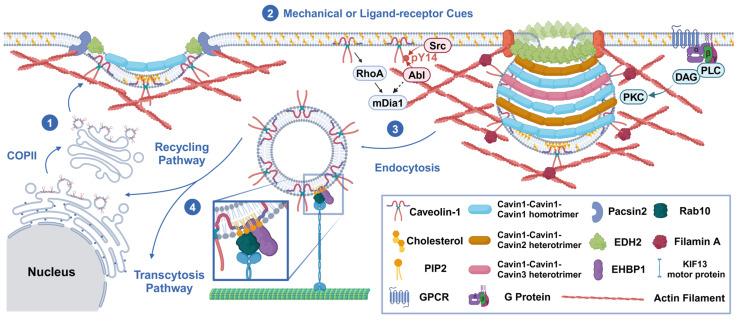
The blood-brain barrier (BBB) controls the flow of substances to maintain a homeostatic environment in the brain, which is highly regulated and crucial for the normal function of the central nervous system (CNS). Brain endothelial cells (bECs), which are directly exposed to blood, play the most important role in maintaining the integrity of the BBB. Unlike endothelial cells in other tissues, bECs have two unique features: specialized endothelial tight junctions and actively suppressed transcellular vesicle trafficking (transcytosis). These features help to maintain the relatively low permeability of the CNS barrier. In addition to the predominant role of tight junctions in the BBB, caveolae-mediated adsorptive transcytosis has attracted much interest in recent years. The active suppression of transcytosis is dynamically regulated during development and in response to diseases. Altered caveolae-mediated transcytosis of bECs has been reported in several neurological diseases, but the understanding of this process in bECs is limited. Here, we review the process of caveolae-mediated transcytosis based on previous studies and discuss its function in the breakdown of the BBB in neurological disorders.
血脑屏障(BBB)控制物质的流动,以维持大脑内的稳态环境,该环境受到高度调节,对中枢神经系统(CNS)的正常功能至关重要。直接接触血液的脑内皮细胞(bECs)在维持血脑屏障的完整性方面发挥着最重要的作用。与其他组织中的内皮细胞不同,bECs具有两个独特的特征:特殊的内皮紧密连接和活跃抑制的跨细胞囊泡运输(转胞吞作用)。这些特征有助于维持中枢神经系统屏障相对较低的通透性。除了紧密连接在血脑屏障中的主要作用外,近年来小窝介导的吸附性转胞吞作用引起了人们的广泛关注。转胞吞作用的主动抑制在发育过程中以及对疾病的反应中受到动态调节。在几种神经系统疾病中,已有报道称bECs的小窝介导的转胞吞作用发生改变,但对bECs中这一过程的了解有限。在此,我们基于以往的研究综述小窝介导的转胞吞作用过程,并讨论其在神经系统疾病中血脑屏障破坏中的作用。

 Zotero 插件