
严重急性呼吸综合征冠状病毒2(SARS-CoV-2)感染对接种疫苗与未接种疫苗的孕妇的影响:一项回顾性队列研究。
The impact of SARS-CoV-2 infection on vaccinated versus unvaccinated pregnant women: a retrospective cohort study.
作者信息
Rodríguez-Blanco Noelia, Sánchez-Más Jesús, Herrero Estela Gimenez, Moreno Paloma Calvo, Gonzalez-Román Macarena Mateo, Duro-Torrijos José Luis
机构信息
Faculty of Health Sciences, Department of Nursing. Research Group Quality of Life and Health, Universidad Europea de Valencia SLU, Elche, Spain.
Biomedical Sciences Department, Health Sciences Faculty, Universidad CEU Cardenal-Herrera, Elche, Spain.
出版信息
BMC Pregnancy Childbirth. 2025 Apr 30;25(1):519. doi: 10.1186/s12884-025-07630-z.
BACKGROUND/OBJECTIVES: Pregnant women were included in the COVID-19 vaccination strategy adopted in Spain in May 2021. We evaluated the obstetric and neonatal symptoms and complications presented by these first pregnant women infected with SARS-CoV-2, vaccinated and unvaccinated.
METHODS
A retrospective observational cohort study of 156 pregnant women with a positive diagnosis of SARS-CoV-2 (infection rate of 4.2%, 156/3719 births), treated at two public hospitals in the Valencian Community (Spain) over two years (2020-2022). Of those pregnant women infected, 28.8% (45) had received at least one dose of the COVID-19 vaccine before infection. The data were obtained from the digital medical record, the Nominal Vaccination Registry (RNV), and symptom data from the Epidemiological Surveillance Application (AVE) of the CV, supervised by the epidemiology units. We analyzed the symptoms of the disease and the main obstetric and neonatal variables depending on whether or not they were vaccinated with mRNA vaccines.
RESULTS
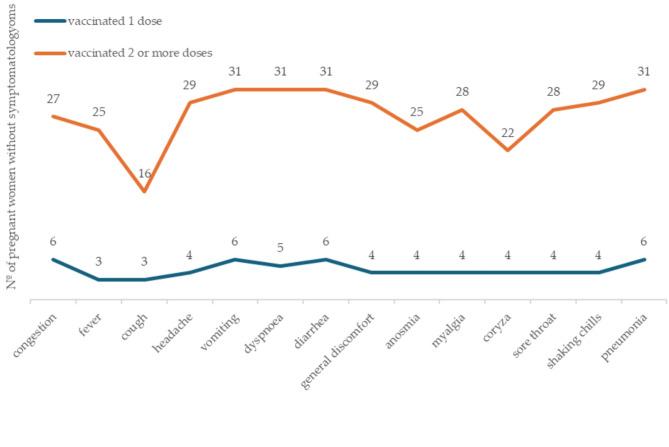
Most pregnant women were diagnosed in the third trimester of pregnancy (p = 0.003) and reported symptoms associated with the infection (73%), but vaccinated women reported all the symptoms described to a lesser extent, with headache (R1.38, 95%IC 1.15 to 1.66) and vomiting (R 1.38, 95%IC 1.15 to 1.66) statistically significant. All cases of pneumonia occurred in unvaccinated pregnant women who required ventilatory assistance and referral to the Intensive Care Unit. Pregnant women vaccinated against SARS-CoV-2 infection had lower rates of gestational pathology, milder symptoms, and fewer postpartum complications than unvaccinated women, although the small sample size did not allow for a significant difference to be seen. Neonatal outcomes were similar in both groups.
CONCLUSIONS
COVID-19 vaccination in pregnant women with at least one dose is associated with reduced symptoms, less headache and vomiting, and fewer maternal complications, including pneumonia, which did not occur in the vaccinated cohort. Furthermore, the Apgar score at one and five minutes is higher than 7 in children of immunized mothers.Public health strategies should promote access to vaccines during pregnancy as an urgent priority, to minimize the risk of complications from COVID-19.
背景/目的:2021年5月西班牙采用的新冠病毒疾病(COVID-19)疫苗接种策略将孕妇纳入其中。我们评估了这些首批感染严重急性呼吸综合征冠状病毒2(SARS-CoV-2)的孕妇(包括接种和未接种疫苗的孕妇)出现的产科和新生儿症状及并发症。
方法
对156名确诊感染SARS-CoV-2的孕妇进行回顾性观察队列研究(感染率为4.2%,156/3719例分娩),这些孕妇在两年(2020 - 2022年)期间在西班牙巴伦西亚自治区的两家公立医院接受治疗。在这些感染的孕妇中,28.8%(45名)在感染前至少接种了一剂COVID-19疫苗。数据来自数字病历、名义疫苗接种登记处(RNV)以及由流行病学单位监督的巴伦西亚自治区流行病学监测应用程序(AVE)的症状数据。我们根据她们是否接种了信使核糖核酸(mRNA)疫苗,分析了疾病症状以及主要的产科和新生儿变量。
结果
大多数孕妇在妊娠晚期被诊断出感染(p = 0.003),并且报告了与感染相关的症状(73%),但接种疫苗的孕妇报告的所有症状程度较轻,其中头痛(相对风险1.38,95%置信区间1.15至1.66)和呕吐(相对风险1.38,95%置信区间1.15至1.66)具有统计学意义。所有肺炎病例均发生在未接种疫苗且需要通气辅助并转诊至重症监护病房的孕妇中。与未接种疫苗的孕妇相比,接种SARS-CoV-2疫苗的孕妇妊娠病理发生率较低、症状较轻且产后并发症较少,尽管样本量较小,未观察到显著差异。两组的新生儿结局相似。
结论
至少接种一剂COVID-19疫苗的孕妇,其症状减轻,头痛和呕吐减少,包括肺炎在内的母体并发症也减少,接种疫苗的队列中未出现肺炎。此外,接种疫苗母亲的孩子出生后1分钟和5分钟的阿氏评分高于7分。公共卫生策略应将促进孕期接种疫苗作为紧迫优先事项,以尽量降低COVID-19并发症的风险。

 Zotero 插件