
1990 - 2021年感染性心内膜炎负担的全球趋势和地区差异:全球疾病负担研究2021分析
Global Trends and Regional Differences in the Burden of Infective Endocarditis, 1990-2021: An Analysis of the Global Burden of Disease Study 2021.
作者信息
Miao Huanhuan, Zhou Zhanyang, Yin Zheng, Li Xue, Zhang Yuhui, Zhang Yuqing, Zhang Jian
机构信息
Heart Failure Center, State Key Laboratory of Cardiovascular Disease, Fuwai Hospital, National Center for Cardiovascular Disease, Chinese Academy of Medical Science, Peking Union Medical College, No. 167 Fuwai Hospital, Beilishi Rd. Xicheng District, Beijing, 10037, China.
Key Laboratory of Clinical Research for Cardiovascular Medications, National Health Committee, Beijing, China.
出版信息
J Epidemiol Glob Health. 2025 May 6;15(1):69. doi: 10.1007/s44197-025-00413-x.
BACKGROUND
The study aimed to offer detailed insights into the global, regional, and national burden of IE in 2021, while also examining the temporal trends of IE from 1990 to 2021.
METHODS
Data on the absolute numbers and age-standardized rates (ASR) of incidence, deaths, and disability-adjusted life years (DALYs) related to IE were sourced from the Global Burden of Disease Study (GBD) 2021. The estimated annual percentage changes (EAPC) of ASR were calculated to quantify the temporal trends. Furthermore, joinpoint regression models were used to identify the temporal trends and the primary joinpoint year of ASR.
RESULTS
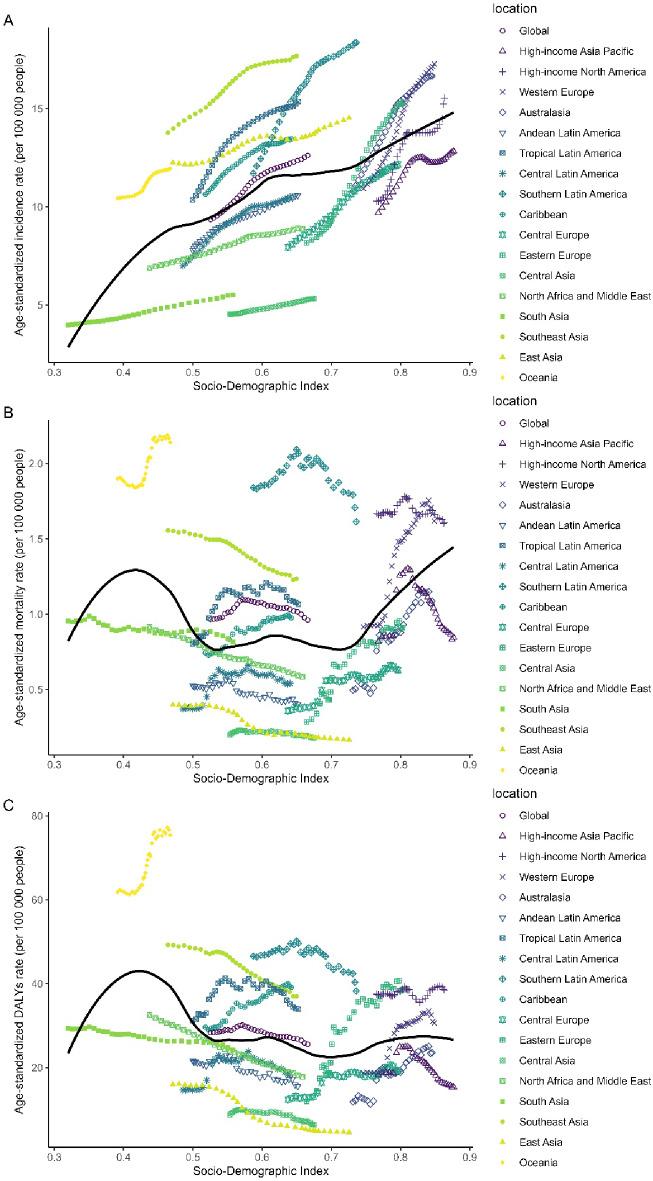
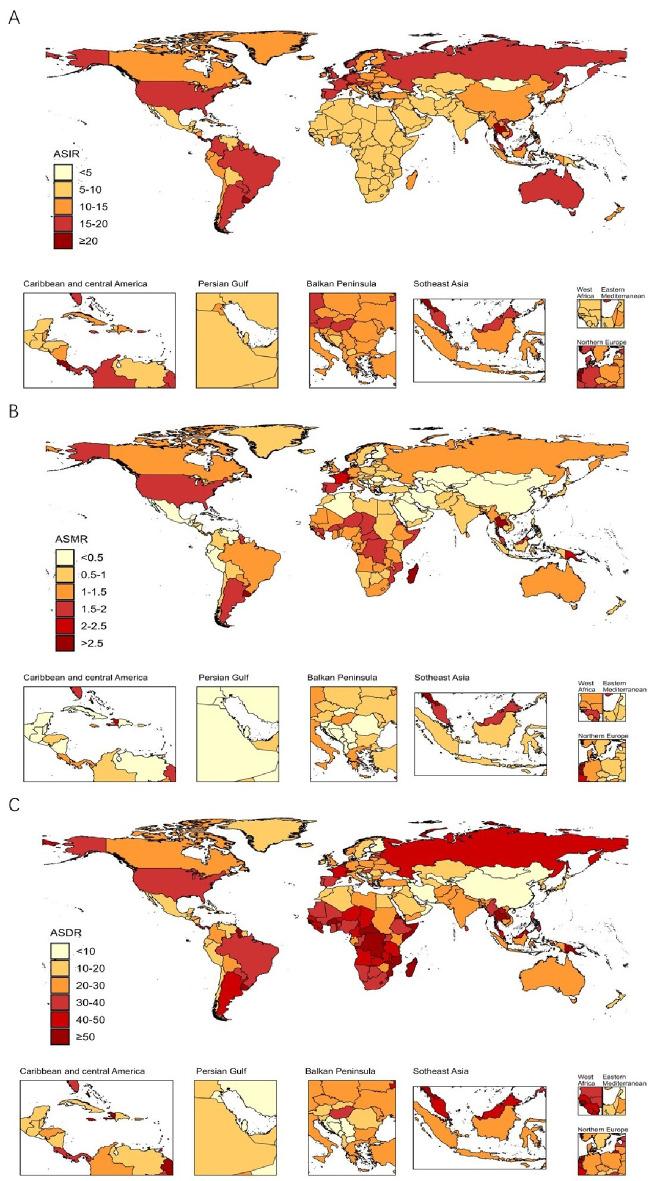
Globally, the age-standardized incidence rate (ASIR) for IE increased with an EAPC of 1.00 (95%CI: 0.93-1.08) from 9.35 per 100 000 population in 1990 to 12.61 per 100 000 population in 2021. Despite a rise in the absolute number of death cases and DALYs related to IE, the age-standardized mortality rate (ASMR) has remained stable (EAPC 0.06, 95%CI: -0.10-0.22), and the age-standardized DALYs rate (ASDR) has exhibited a decline (EAPC - 0.34, 95%CI: -0.45-0.24) between 1990 and 2021. Males bore a higher burden of IE compared to females, with the peak burden gradually shifting towards older individuals. In 2021, the ASIR for IE exhibited an increase with the rise in socio-demographic index (SDI) quintiles, with the highest ASIR observed in the high SDI region (15.77 per 100 000 population). Moreover, the highest growth rates of ASIR, ASMR, and ASDR were also noted in the high SDI region. On the other hand, the ASMR (1.34 per 100 000 population) and ASDR (40.71 per 100 000 population) for IE were relatively high in the low SDI region. Joinpoint analysis demonstrated that the ASIR, ASMR, and ASDR did not experience any sudden surges either globally or across different SDI regions after 2007.
CONCLUSIONS
The burden of IE remained relatively high, characterized by a rising ASIR and a stable ASMR on a global scale. This burden was notably prominent among males, the elderly, and in the high and low SDI regions. Region-specific prevention and management strategies might be warranted to reduce the burden of IE.
背景
本研究旨在深入了解2021年全球、区域和国家层面感染性心内膜炎(IE)的负担情况,同时考察1990年至2021年IE的时间趋势。
方法
与IE相关的发病率、死亡数及伤残调整生命年(DALY)的绝对数和年龄标准化率(ASR)数据来源于《2021年全球疾病负担研究》(GBD 2021)。计算ASR的估计年度百分比变化(EAPC)以量化时间趋势。此外,采用连接点回归模型确定ASR的时间趋势和主要连接点年份。
结果
全球范围内,IE的年龄标准化发病率(ASIR)从1990年的每10万人9.35例增加至2021年的每10万人12.61例,EAPC为1.00(95%CI:0.93 - 1.08)。尽管与IE相关的死亡病例数和DALY的绝对数有所上升,但年龄标准化死亡率(ASMR)保持稳定(EAPC 0.06,95%CI: - 0.10 - 0.22),且年龄标准化DALY率(ASDR)在1990年至2021年间呈下降趋势(EAPC - 0.34,95%CI: - 0.45 - 0.24)。男性感染性心内膜炎的负担高于女性,且负担峰值逐渐向老年人转移。2021年,IE的ASIR随社会人口指数(SDI)五分位数升高而增加,在高SDI地区观察到最高的ASIR(每10万人15.77例)。此外,高SDI地区的ASIR、ASMR和ASDR增长率也最高。另一方面,低SDI地区IE的ASMR(每10万人1.34例)和ASDR(每10万人40.71例)相对较高。连接点分析表明,2007年后全球及不同SDI地区的ASIR、ASMR和ASDR均未出现任何突然激增。
结论
感染性心内膜炎的负担仍然相对较高,全球范围内表现为ASIR上升而ASMR稳定。这种负担在男性、老年人以及高SDI和低SDI地区尤为突出。可能需要针对特定区域的预防和管理策略来减轻感染性心内膜炎的负担。


 Zotero 插件