
5'-转运RNA片段:一种具有反向序列激活见解的首选内源性Toll样受体7配体。
5'-tRNA fragment: A preferred endogenous TLR7 Ligand with reverse sequence activation insights.
作者信息
Lokhande Kiran Bharat, Singh Ashutosh, Vyas Rajan, Joe Shreya, Asthana Shailendra, Pawar Kamlesh
机构信息
Department of Life Sciences, School of Natural Science, Shiv Nadar Institution of Eminence Deemed to be University, Delhi National Capital Region, Greater Noida 201314, India; Computational Biophysics and CADD Group, Computational and Mathematical Biology Center, Translational Health Science and Technology Institute, Faridabad 121001, India.
Department of Life Sciences, School of Natural Science, Shiv Nadar Institution of Eminence Deemed to be University, Delhi National Capital Region, Greater Noida 201314, India.
出版信息
Biophys J. 2025 May 5. doi: 10.1016/j.bpj.2025.04.027.
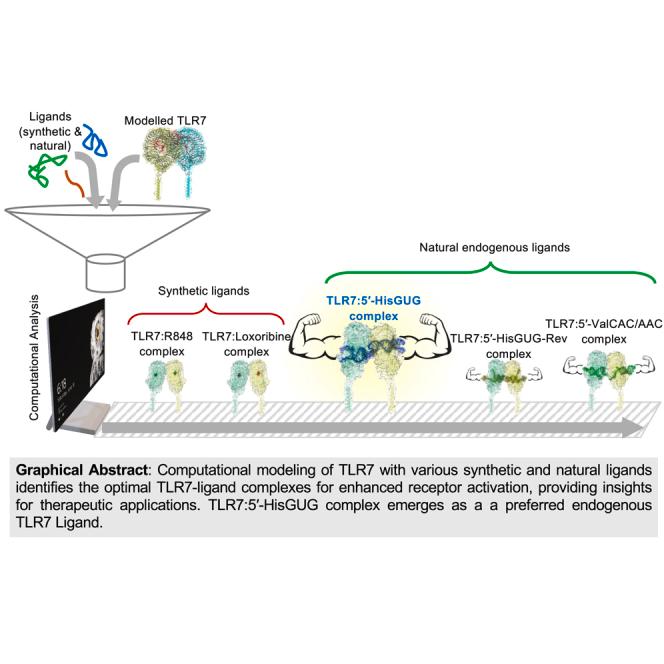
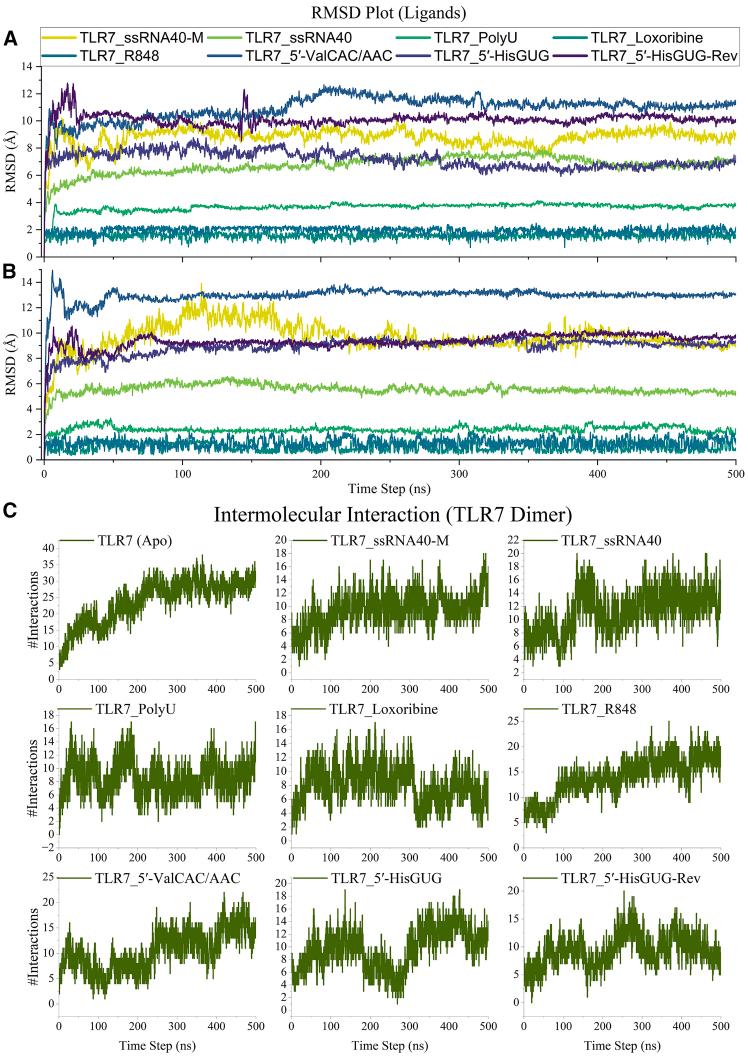
Toll-like receptor 7 (TLR7), a key member of the TLR family, plays a pivotal role in innate immunity, making it an attractive therapeutic target. However, current synthetic TLR7 agonists are often associated with significant toxicity, highlighting the need for safer, naturally occurring alternatives. Our recent research identified 5'-fragments of tRNA (5'-HisGUG) and tRNA (5'-ValCAC/AAC) as potent, naturally occurring TLR7 activators. While endogenous RNAs like 5'-HisGUG are known to activate TLR7, the molecular details of their interaction remain unclear. To address this, we performed molecular dynamics simulations and MM/GBSA binding free energy analysis to investigate how these RNA fragments engage with TLR7 in comparison to synthetic agonists. Our results revealed that 5'-HisGUG, 5'-ValCAC/AAC, and reverse sequence (5'-HisGUG-Rev) exhibit strong binding affinities, with higher energetic favorability than synthetic agonists. The free energy fluctuations suggested that endogenous RNA ligands display greater conformational variability, possibly contributing to their activation potential. Notably, 5'-HisGUG-Rev effectively activated TLR7 and enhanced cytokine mRNA expression. Comparative analysis suggests that binding affinity alone does not directly predict activation, emphasizing the importance of both strong interaction and conformational flexibility in TLR7 activation. These findings position 5'-HisGUG as a promising natural TLR7 activator with potential therapeutic applications.
Toll样受体7(TLR7)是TLR家族的关键成员,在先天免疫中起关键作用,使其成为一个有吸引力的治疗靶点。然而,目前的合成TLR7激动剂通常与显著的毒性相关,这凸显了对更安全的天然替代品的需求。我们最近的研究确定了tRNA的5'片段(5'-HisGUG)和tRNA(5'-ValCAC/AAC)作为有效的天然TLR7激活剂。虽然已知像5'-HisGUG这样的内源性RNA能激活TLR7,但其相互作用的分子细节仍不清楚。为了解决这个问题,我们进行了分子动力学模拟和MM/GBSA结合自由能分析,以研究这些RNA片段与合成激动剂相比如何与TLR7结合。我们的结果表明,5'-HisGUG、5'-ValCAC/AAC和反向序列(5'-HisGUG-Rev)表现出很强的结合亲和力,比合成激动剂具有更高的能量优势。自由能波动表明内源性RNA配体表现出更大的构象变异性,这可能有助于它们的激活潜力。值得注意的是,5'-HisGUG-Rev有效激活了TLR7并增强了细胞因子mRNA表达。比较分析表明,仅结合亲和力并不能直接预测激活,强调了在TLR7激活中强相互作用和构象灵活性的重要性。这些发现使5'-HisGUG成为一种有前途的天然TLR7激活剂,具有潜在的治疗应用价值。





 Zotero 插件