
人工智能在骨转移中的应用:对92项研究指南依从性的系统评价
Artificial Intelligence in bone Metastases: A systematic review in guideline adherence of 92 studies.
作者信息
van der Linden Lotte R, Vavliakis Ioannis, de Groot Tom M, Jutte Paul C, Doornberg Job N, Lozano-Calderon Santiago A, Groot Olivier Q
机构信息
Department of Orthopaedic Surgery, University Medical Center Groningen, Groningen, the Netherlands.
Department of Orthopaedic Surgery, Massachusetts General Hospital, Boston, MA, USA.
出版信息
J Bone Oncol. 2025 Apr 24;52:100682. doi: 10.1016/j.jbo.2025.100682. eCollection 2025 Jun.
BACKGROUND
The last decade has witnessed a surge in artificial intelligence (AI). With bone metastases becoming more prevalent, there is an increasing call for personalized treatment options, a domain where AI can greatly contribute. However, integrating AI into clinical settings has proven to be difficult. Therefore, we aimed to provide an overview of AI modalities for treating bone metastases and recommend implementation-worthy models based on TRIPOD, CLAIM, and UPM scores.
METHODS
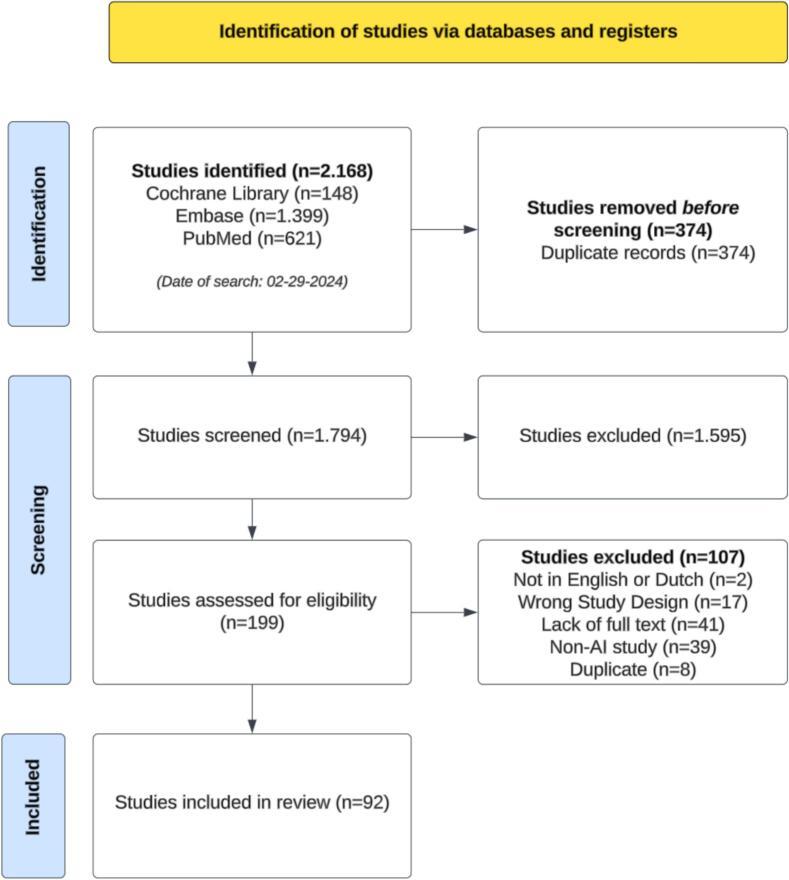
This systematic review included 92 studies on AI models in bone metastases between 2008 and 2024. Using three assessment tools we provided a reliable foundation for recommending AI modalities fit for clinical use (TRIPOD or CLAIM ≥ 70 % and UPM score ≥ 10).
RESULTS
Most models focused on survival prediction (44/92;48%), followed by imaging studies (37/92;40%). Median TRIPOD completeness was 70% (IQR 64-81%), CLAIM completeness was 57% (IQR 48-67%), and UPM score was 7 (IQR 5-9). In total, 10% (9/92) AI modalities were deemed fit for clinical use.
CONCLUSION
Transparent reporting, utilizing the aforementioned three evaluation tools, is essential for effectively integrating AI models into clinical practice, as currently, only 10% of AI models for bone metastases are deemed fit for clinical use. Such transparency ensures that both patients and clinicians can benefit from clinically useful AI models, potentially enhancing AI-driven personalized cancer treatment.
背景
在过去十年中,人工智能(AI)发展迅速。随着骨转移变得越来越普遍,对个性化治疗方案的需求日益增加,而人工智能在这一领域可以做出巨大贡献。然而,将人工智能整合到临床环境中已被证明是困难的。因此,我们旨在概述用于治疗骨转移的人工智能模式,并根据TRIPOD、CLAIM和UPM评分推荐值得实施的模型。
方法
本系统评价纳入了2008年至2024年间关于骨转移人工智能模型的92项研究。我们使用三种评估工具为推荐适合临床使用的人工智能模式提供了可靠的基础(TRIPOD或CLAIM≥70%且UPM评分≥10)。
结果
大多数模型专注于生存预测(44/92;48%),其次是影像学研究(37/92;40%)。TRIPOD完整性中位数为70%(IQR 64-81%),CLAIM完整性为57%(IQR 48-67%),UPM评分为7(IQR 5-9)。总共有10%(9/92)的人工智能模式被认为适合临床使用。
结论
利用上述三种评估工具进行透明报告对于将人工智能模型有效整合到临床实践中至关重要,因为目前,只有10%的骨转移人工智能模型被认为适合临床使用。这种透明度确保患者和临床医生都能从临床有用的人工智能模型中受益,有可能加强人工智能驱动的个性化癌症治疗。

 Zotero 插件