
抑郁症与脑脊液之间的因果关联分析:基于孟德尔随机化的视角
The Causal Association Analysis between Depression and Cerebrospinal Fluid: From the Perspective of Mendelian Randomization.
作者信息
Zhang Yu, Wu Ping, Liu Zhuo
机构信息
Hunan Provincial Hospital of Integrated Traditional Chinese and Western Medicine (The Affiliated Hospital of Hunan Academy of Traditional Chinese Medicine), Changsha, Hunan, 410006, People's Republic of China.
Integrated Traditional Chinese and Western Medicine College of Hunan University of Chinese Medicine, Changsha, Hunan, 410208, People's Republic of China.
出版信息
Psychol Res Behav Manag. 2025 May 5;18:1085-1097. doi: 10.2147/PRBM.S508610. eCollection 2025.
BACKGROUND
Major depressive disorder (MDD) leads to significant distress and disruption across social, occupational, and other functional domains. Although cerebrospinal fluid (CSF) biomarkers have been identified as potential indicators and therapeutic targets for depression, their causal relationship with MDD remains unclear.
METHODS
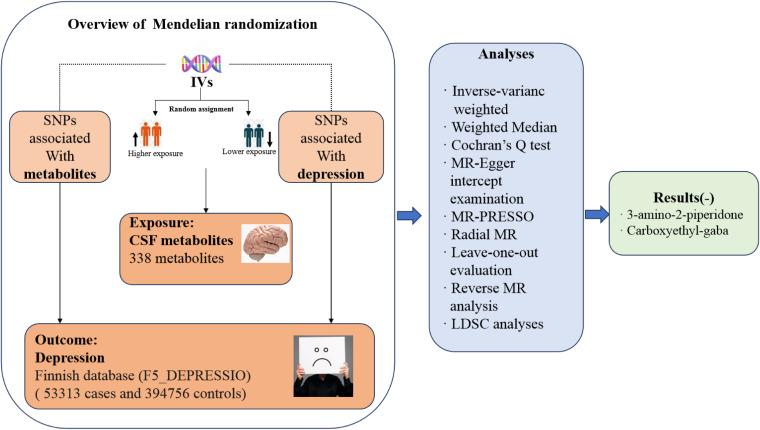
We analyzed publicly available CSF metabolomics and genotype data, quantifying 338 distinct metabolites. Among these, 296 were chemically validated and classified into eight major metabolic groups, while 38 remained undefined. To assess the genetic association with depression, we used summary statistics from a GWAS (F5_DEPRESSIO dataset, including 53,313 diagnosed cases and 394,756 controls from Finland). An integrated approach combining Mendelian randomization (MR), inverse variance weighting (IVW), and linkage disequilibrium score regression (LDSC) was applied to explore the causal impact of CSF metabolites on depression risk.
RESULTS
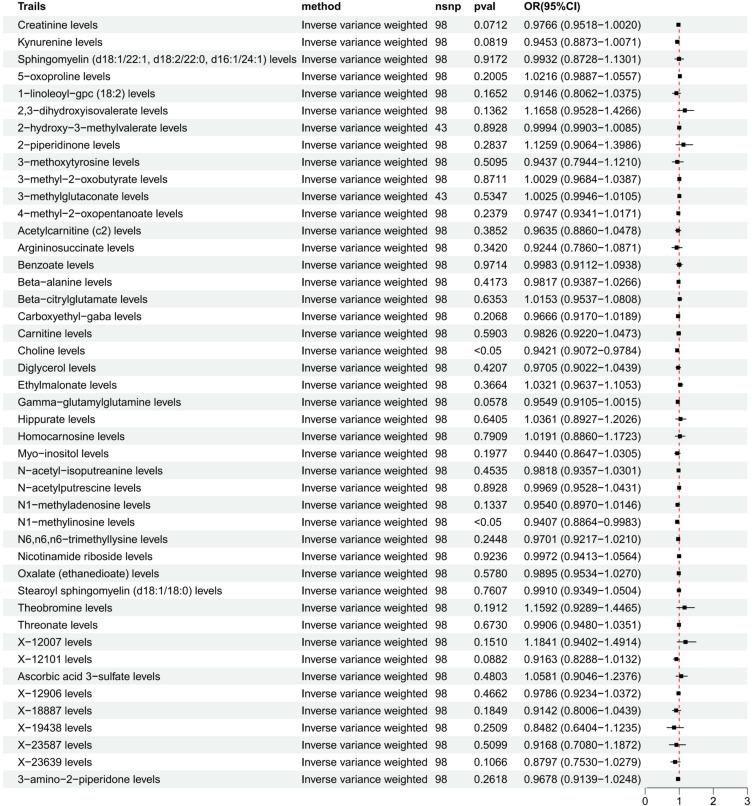
Our analysis identified 62 metabolites significantly associated with depression (p < 0.05). Sensitivity tests revealed heterogeneity in five metabolites: 5-hydroxyindoleacetic acid, X-19438, ethylmalonic acid, γ-glutamylglutamine, and β-alanine. A focused analysis on 14 metabolites further supported a potential causal link with depression. LDSC confirmed significant genetic heritability for metabolites such as creatinine, arginine succinate, N-acetylisourea, 3-amino-2-piperidone, and carboxyethyl-GABA. Systematic leave-one-out analyses demonstrated that these associations are driven by multiple interacting SNPs rather than a single variant.
CONCLUSION
This study provides novel insights into the potential causal relationship between CSF metabolites and depression, highlighting 14 key metabolites with significant associations. The robustness of these findings is supported by MR and sensitivity analyses. Further longitudinal studies are warranted to confirm the clinical relevance of these CSF biomarkers in MDD.
背景
重度抑郁症(MDD)会导致社会、职业和其他功能领域出现严重困扰和紊乱。尽管脑脊液(CSF)生物标志物已被确定为抑郁症的潜在指标和治疗靶点,但其与MDD的因果关系仍不明确。
方法
我们分析了公开可用的脑脊液代谢组学和基因型数据,对338种不同的代谢物进行了定量。其中,296种经过化学验证并分为八个主要代谢组,38种仍未明确。为了评估与抑郁症的遗传关联,我们使用了全基因组关联研究(GWAS)的汇总统计数据(F5_DEPRESSIO数据集,包括来自芬兰的53313例确诊病例和394756例对照)。采用孟德尔随机化(MR)、逆方差加权(IVW)和连锁不平衡评分回归(LDSC)相结合的综合方法,探讨脑脊液代谢物对抑郁症风险的因果影响。
结果
我们的分析确定了62种与抑郁症显著相关的代谢物(p < 0.05)。敏感性测试显示5种代谢物存在异质性:5-羟吲哚乙酸、X-19438、乙基丙二酸、γ-谷氨酰谷氨酰胺和β-丙氨酸。对14种代谢物的重点分析进一步支持了与抑郁症的潜在因果联系。LDSC证实了肌酐、精氨酸琥珀酸、N-乙酰异脲、3-氨基-2-哌啶酮和羧乙基-GABA等代谢物具有显著的遗传遗传性。系统的留一法分析表明,这些关联是由多个相互作用的单核苷酸多态性(SNP)驱动的,而不是单个变异。
结论
本研究为脑脊液代谢物与抑郁症之间的潜在因果关系提供了新的见解,突出了14种具有显著关联的关键代谢物。MR和敏感性分析支持了这些发现的稳健性。有必要进行进一步的纵向研究,以确认这些脑脊液生物标志物在MDD中的临床相关性。




 Zotero 插件