
应激颗粒:神经退行性疾病中的新角色。
Stress granules: emerging players in neurodegenerative diseases.
作者信息
Yuan Lin, Mao Li-Hong, Huang Yong-Ye, Outeiro Tiago F, Li Wen, Vieira Tuane C R G, Li Jia-Yi
机构信息
Laboratory of Research in Parkinson's Disease and Related Disorders, Health Sciences Institute, China Medical University, Shenyang, 110122, China.
College of Life and Health Sciences, Northeastern University, Shenyang, 110169, China.
出版信息
Transl Neurodegener. 2025 May 12;14(1):22. doi: 10.1186/s40035-025-00482-9.
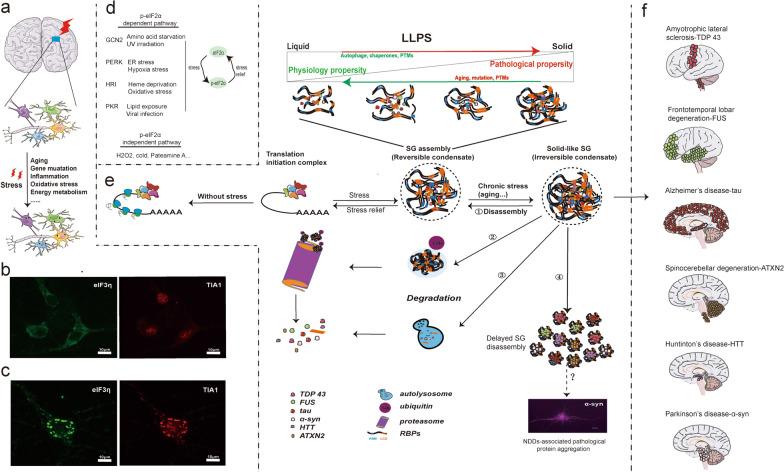
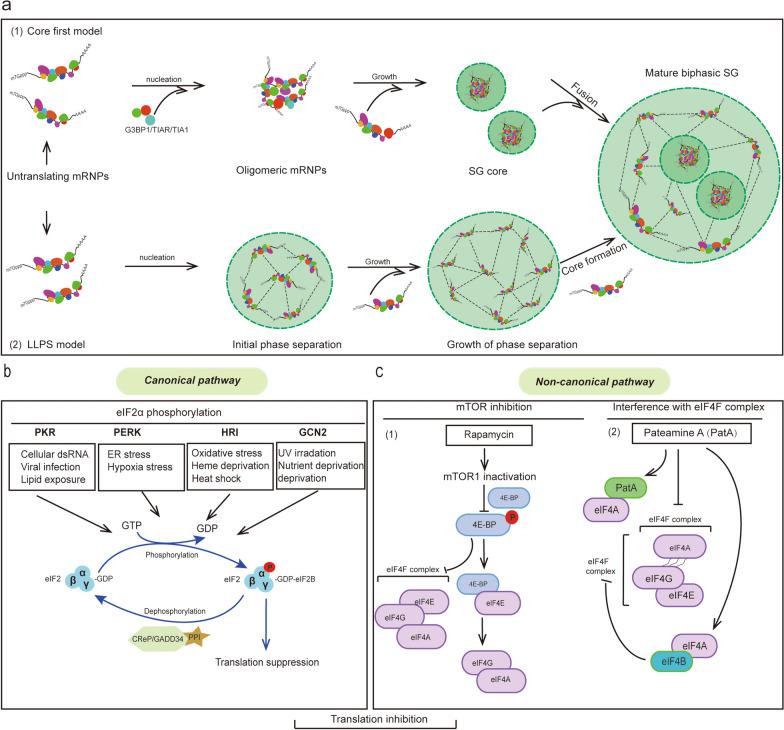
Stress granules (SGs) are membraneless organelles formed in the cellular cytoplasm under stressful conditions through liquid-liquid phase separation (LLPS). SG assembly can be both dependent and independent of the eIF2α pathway, whereas cellular protein quality control systems mediate SG disassembly. Chaperones and specific domains of RNA-binding proteins strongly contribute to the regulation SG dynamics. Chronic stress, arising in association with aging, may promote persistent SGs that are difficult to disassemble, thereby acting as a potential pathological nidus for protein aggregation in neurodegenerative diseases (NDDs). In this review, we discuss the dynamics of SGs and the factors involved with SG assembly and disassembly. We also highlight the relationship among LLPS, SGs, and the pathogenesis of different NDDs. More importantly, we summarize SG assembly-disassembly, which may be a double-edged sword in the pathophysiology of NDDs. This review aims to provide new insights into the biology and pathology of LLPS, SGs, and NDDs.
应激颗粒(SGs)是在应激条件下通过液-液相分离(LLPS)在细胞质中形成的无膜细胞器。SG组装既可以依赖也可以不依赖于eIF2α途径,而细胞蛋白质质量控制系统介导SG的解体。分子伴侣和RNA结合蛋白的特定结构域对SG动态调节有重要作用。与衰老相关的慢性应激可能会促进难以解体的持续性SG形成,从而成为神经退行性疾病(NDDs)中蛋白质聚集的潜在病理病灶。在这篇综述中,我们讨论了SG的动态变化以及参与SG组装和解体的因素。我们还强调了LLPS、SGs与不同NDDs发病机制之间的关系。更重要的是,我们总结了SG的组装-解体过程,这在NDDs的病理生理学中可能是一把双刃剑。这篇综述旨在为LLPS、SGs和NDDs的生物学和病理学提供新的见解。
 Zotero 插件