
单核细胞与高密度脂蛋白胆固醇比值与2型糖尿病的关联:一项横断面研究。
The association between monocyte-to-high-density lipoprotein cholesterol ratio and type 2 diabetes mellitus: a cross-sectional study.
作者信息
Yu Honghai, Yang Cunqing, Lv Jiao, Zhao Yunyun, Wang Guoqiang, Wang Xiuge
机构信息
Department of Traditional Chinese Medicine, Hunan University of Medicine General Hospital, Huaihua, China.
Department of Dermatology, Guang'Anmen Hospital, China Academy of Chinese Medical Sciences, Beijing, China.
出版信息
Front Med (Lausanne). 2025 Apr 28;12:1521342. doi: 10.3389/fmed.2025.1521342. eCollection 2025.
OBJECTIVE
Type 2 diabetes mellitus (T2DM) is a prevalent chronic condition often associated with low-grade inflammation. Previous studies have indicated that the monocyte-to-high-density lipoprotein cholesterol ratio (MHR) may serve as a novel inflammatory biomarker with potential predictive value for various metabolic diseases. This study aims to investigate the association between the MHR and the prevalence of T2DM in a general population, using data from the National Health and Nutrition Examination Survey (NHANES).
METHODS
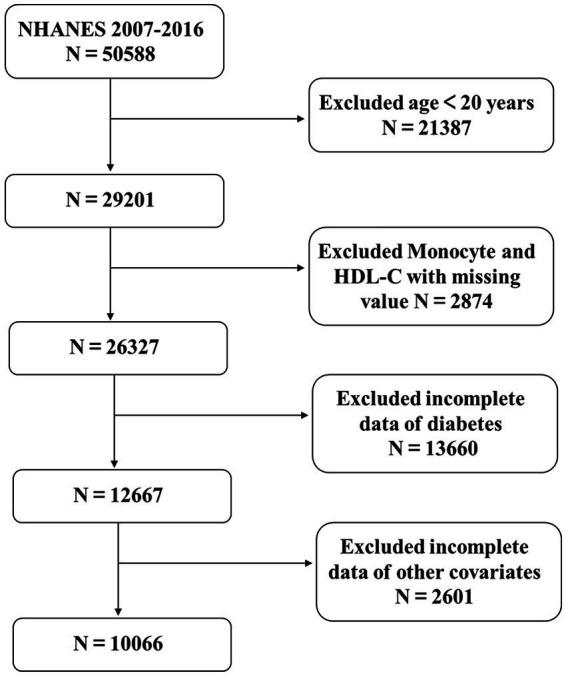
We conducted a cross-sectional study analyzing data from five NHANES cycles spanning 2007-2016. We excluded individuals aged under 20 years, those with missing data on monocytes, HDL-C, diabetes status, or other key covariates, and extreme MHR outliers. Statistical analyses were performed using SPSS 26.0, EmpowerStats 4.1, Stata 16, and DecisionLinnc1.0. We employed weighted logistic regression models, subgroup analyses, restricted cubic splines (RCS), and threshold analyses were used to assess the MHR-T2DM association.
RESULTS
A total of 10,066 participants met the inclusion criteria, of whom 1,792 were diagnosed with T2DM. The MHR levels in the T2DM group were significantly higher than those in the non-T2DM group. After adjusting for potential confounders, elevated MHR levels were significantly associated with an increased prevalence of T2DM ( < 0.001, OR = 2.80, 95% CI: 1.823-4.287). Subgroup analyses revealed a significant interaction between MHR and T2DM with respect to gender ( for interaction < 0.05), with a stronger association in women. No significant interactions were observed for age, race, education level, poverty income ratio (PIR), body mass index (BMI), smoking status, physical activity, alcohol consumption, or hypertension ( for interaction > 0.05). RCS analysis indicated a significant nonlinear relationship between MHR and T2DM, with a threshold point for MHR identified at 0.51. Above this threshold, the risk of T2DM increased significantly.
CONCLUSION
Our findings suggest that elevated MHR levels, particularly above the threshold of 0.51, are significantly associated with an increased prevalence of T2DM. The gender-specific interaction further highlights that women may be more susceptible to the impact of elevated MHR on T2DM risk. These findings suggest MHR as a potential biomarker for early T2DM screening and highlight gender-specific risk factors.
目的
2型糖尿病(T2DM)是一种常见的慢性病,常与低度炎症相关。先前的研究表明,单核细胞与高密度脂蛋白胆固醇比值(MHR)可能作为一种新型炎症生物标志物,对各种代谢性疾病具有潜在的预测价值。本研究旨在利用美国国家健康与营养检查调查(NHANES)的数据,探讨MHR与普通人群中T2DM患病率之间的关联。
方法
我们进行了一项横断面研究,分析了2007 - 2016年五个NHANES周期的数据。我们排除了20岁以下的个体、单核细胞、高密度脂蛋白胆固醇(HDL - C)、糖尿病状态或其他关键协变量数据缺失的个体,以及MHR极端异常值。使用SPSS 26.0、EmpowerStats 4.1、Stata 16和DecisionLinnc1.0进行统计分析。我们采用加权逻辑回归模型、亚组分析、受限立方样条(RCS)分析,并使用阈值分析来评估MHR与T2DM的关联。
结果
共有10,066名参与者符合纳入标准,其中1,792人被诊断为T2DM。T2DM组的MHR水平显著高于非T2DM组。在调整潜在混杂因素后,MHR水平升高与T2DM患病率增加显著相关(<0.001,OR = 2.80,95%CI:1.823 - 4.287)。亚组分析显示,MHR与T2DM在性别方面存在显著交互作用(交互作用P<0.05),女性中的关联更强。在年龄、种族、教育水平、贫困收入比(PIR)、体重指数(BMI)、吸烟状况、身体活动、饮酒或高血压方面未观察到显著的交互作用(交互作用P>0.05)。RCS分析表明,MHR与T2DM之间存在显著的非线性关系,MHR的阈值点为0.51。高于此阈值,T2DM的风险显著增加。
结论
我们的研究结果表明,MHR水平升高,特别是高于0.51的阈值,与T2DM患病率增加显著相关。性别特异性交互作用进一步凸显了女性可能更容易受到MHR升高对T2DM风险的影响。这些发现表明MHR作为早期T2DM筛查的潜在生物标志物,并突出了性别特异性风险因素。

 Zotero 插件