
聚合物胶束作为生物活性肽的纳米载体
Polymer Micelles as Nanocarriers of Bioactive Peptides.
作者信息
Petrov Petar D, Davidova Slavena, Satchanska Galina
机构信息
Institute of Polymers, Bulgarian Academy of Sciences, Akad. G. Bonchev St., Bl. 103A, 1113 Sofia, Bulgaria.
Department of Natural Sciences, New Bulgarian University, Montevideo Str. 21, 1618 Sofia, Bulgaria.
出版信息
Polymers (Basel). 2025 Apr 25;17(9):1174. doi: 10.3390/polym17091174.
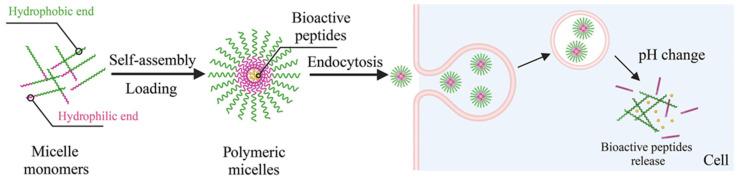
Bioactive peptides (BPs) have demonstrated diverse inhibitory effects against parasites, viruses, bacteria, fungi, and other pathogens, and therefore, they have been extensively used for developing various therapeutics. However, several challenges for the clinical use of BPs related to their stability, bioavailability, and cytotoxicity remain. The encapsulation of BPs in polymer micelles (PMs) has emerged as an effective strategy that can improve the pharmacological profiles, safety, and efficacy of treatments. This review describes the recent advances of micellar carriers of peptides with antimicrobial, anticancer, anti-inflammatory, immunomodulatory, and anti-diabetic activities. The mode of action of BPs and the unique characteristics of PMs are described, and a critical evaluation of their advantages and disadvantages is made. The upcoming challenges and future perspectives of micellar systems carrying BPs are discussed as well.
生物活性肽(BPs)已显示出对寄生虫、病毒、细菌、真菌及其他病原体具有多种抑制作用,因此,它们已被广泛用于开发各种治疗药物。然而,生物活性肽在临床应用中仍面临一些与稳定性、生物利用度和细胞毒性相关的挑战。将生物活性肽包裹于聚合物胶束(PMs)中已成为一种有效的策略,可改善治疗的药理学特性、安全性和疗效。本综述介绍了具有抗菌、抗癌、抗炎、免疫调节和抗糖尿病活性的肽类胶束载体的最新进展。描述了生物活性肽的作用方式和聚合物胶束的独特特性,并对其优缺点进行了批判性评估。还讨论了携带生物活性肽的胶束系统即将面临的挑战和未来前景。




 Zotero 插件