
糖尿病患者的长期健康改善与经济表现
Long-Term Health Improvements and Economic Performance Among Individuals With Diabetes.
作者信息
Chapel Jack M, Goldman Dana P, Kahn Matthew E, Tysinger Bryan
机构信息
Leonard D. Schaeffer Center for Health Policy and Economics, Los Angeles, California.
Sol Price School of Public Policy, University of Southern California, Los Angeles.
出版信息
JAMA Health Forum. 2025 May 2;6(5):e250756. doi: 10.1001/jamahealthforum.2025.0756.
IMPORTANCE
Advances in diabetes detection and treatment have mitigated the risks of serious complications and death, but little is known about whether economic outcomes for people with diabetes have similarly improved.
OBJECTIVE
To assess whether associations between diagnosed diabetes and labor market outcomes have changed over time.
DESIGN, SETTING, AND PARTICIPANTS: This cross-sectional study analyzed data from the National Health Interview Survey from 1998 to 2018. The sample was nationally representative of the US population aged 40 to 64 years. Average marginal effects, the regression-adjusted difference in probability of outcomes between people with and without diabetes, pooled by 3-year periods (1998-2000 to 2016-2018), were estimated with controls for demographics, education, and comorbid health risks. Behavioral Risk Factor Surveillance (BRFSS) data from 1993 to 2023 were included in robustness analyses. Data were analyzed from September 2023 to November 2024.
EXPOSURE
Diagnosed diabetes, defined based on respondents' self-report that they have ever been diagnosed by a medical professional.
MAIN OUTCOMES AND MEASURES
The main outcomes were labor force participation and any Supplemental Security Income or Social Security Disability Insurance income receipt. Secondary outcomes included reporting health limitations for any activities, health limitations for work, any nights in hospital, and receiving health care 10 or more times in the past year.
RESULTS
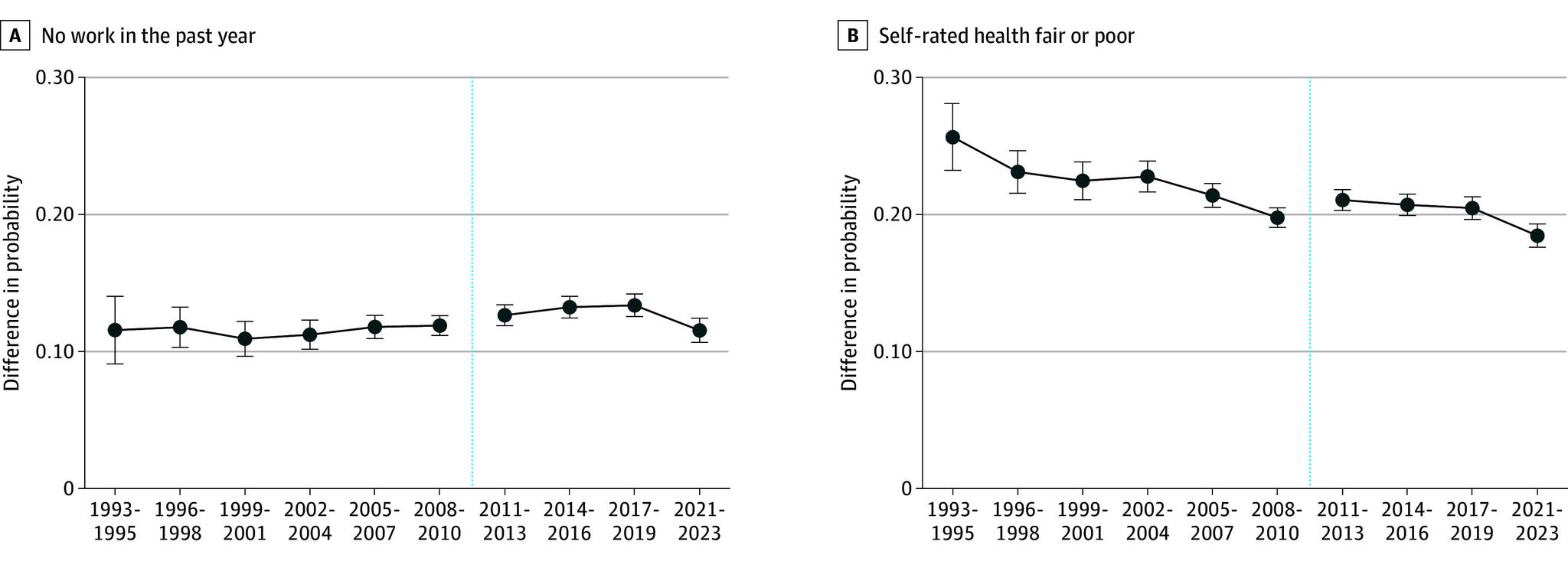
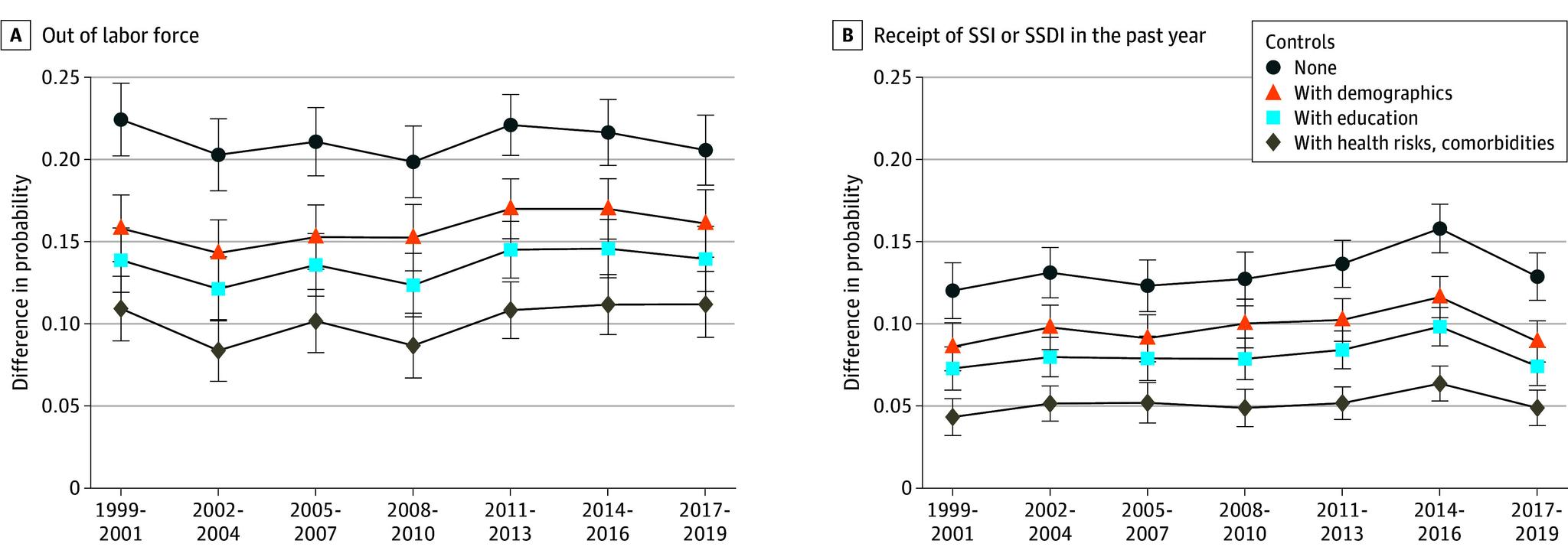
The study included 249 712 individuals, 25 177 with diabetes. The weighted population was 50% female, 12% Hispanic, 11% non-Hispanic Black, 72% non-Hispanic White, and 5% multiracial or other race (Alaska Native or American Indian, Asian, or nonspecified). In the weighted population from 1998 to 2000, 46% of people with diabetes were 55 years and older, while 27% of people without diabetes were 55 years and older. In the weighted population from 2016 to 2018, 56% of people with diabetes were 55 years and older, while 38% of people without diabetes were 55 years and older. The average marginal effect of diabetes on probability of labor force participation was -10.9 percentage points (95% CI, -13.0 to -8.9) from 1998 to 2000 and -11.0 percentage points (95% CI, -13.0 to -9.1) from 2016 to 2018; for people who received Supplemental Security Income or Social Security Disability Insurance income, it was 4.4 percentage points (95% CI, 3.3-5.5) and 4.9 percentage points (95% CI, 3.7-6.0) from 1998 to 2000 and 2016 to 2018, respectively. During the same period, average marginal effects for all examined health outcomes significantly improved. Similar patterns were observed using BRFSS data, but with a slight improvement in labor force participation between 2017 to 2019 and 2021 to 2023.
CONCLUSIONS AND RELEVANCE
This cross-sectional study demonstrated that while people with diabetes experienced meaningful health improvements, they saw little progress in economic performance. Changing patient selection appears to play a role. Future research is needed to disentangle the paradox.
重要性
糖尿病检测和治疗方面的进展降低了严重并发症和死亡风险,但对于糖尿病患者的经济状况是否同样得到改善,人们知之甚少。
目的
评估确诊糖尿病与劳动力市场结果之间的关联是否随时间发生了变化。
设计、背景和参与者:这项横断面研究分析了1998年至2018年美国国家健康访谈调查的数据。样本具有美国40至64岁人群的全国代表性。通过对人口统计学、教育程度和共病健康风险进行控制,估计了1998 - 2000年至2016 - 2018年这3年期间糖尿病患者和非糖尿病患者在结局概率上的回归调整平均边际效应。稳健性分析纳入了1993年至2023年的行为风险因素监测(BRFSS)数据。数据于2023年9月至2024年11月进行分析。
暴露因素
确诊糖尿病,根据受访者自我报告他们曾被医疗专业人员诊断来定义。
主要结局和衡量指标
主要结局是劳动力参与情况以及是否领取补充保障收入或社会保障残疾保险收入。次要结局包括报告任何活动存在健康限制、工作存在健康限制、住院过夜情况以及过去一年接受医疗护理10次或更多次。
结果
该研究纳入了249712人,其中25177人患有糖尿病。加权人群中50%为女性,12%为西班牙裔,11%为非西班牙裔黑人,72%为非西班牙裔白人,5%为多种族或其他种族(阿拉斯加原住民或美洲印第安人、亚洲人或未明确种族)。在1998年至2000年的加权人群中,46%的糖尿病患者年龄在55岁及以上,而无糖尿病患者中这一比例为27%。在2016年至2018年的加权人群中,56%的糖尿病患者年龄在55岁及以上,而无糖尿病患者中这一比例为38%。1998年至2000年糖尿病对劳动力参与概率的平均边际效应为 - 10.9个百分点(95%置信区间,- 13.0至- 8.9),2016年至2018年为 - 11.0个百分点(95%置信区间,- 13.0至- 9.1);对于领取补充保障收入或社会保障残疾保险收入的人,1998年至2000年为4.4个百分点(95%置信区间,3.3 - 5.5),2016年至2018年为4.9个百分点(95%置信区间,3.7 - 6.0)。在同一时期,所有检查的健康结局的平均边际效应均有显著改善。使用BRFSS数据也观察到了类似模式,但2017年至


 Zotero 插件