
2024年5月通过对苏格兰初级和二级医疗保健机构进行随机抽样来评估人群对新冠病毒的免疫力。
Estimating population immunity to SARS-CoV-2 by random sampling from primary and secondary healthcare in Scotland, May 2024.
作者信息
McCormack Mhairi J, Scott Sam, Logan Nicola, Raveendran Savitha, Newman Joseph, Santos Igor A, Bailey Dalan, Murcia Pablo R, Thomson Emma C, Hosie Margaret J, Willett Brian J
机构信息
MRC University of Glasgow Centre for Virus Research, Garscube Estate, Glasgow, United Kingdom.
The Pirbright Institute, Guildford, Surrey, United Kingdom.
出版信息
EBioMedicine. 2025 Jun;116:105760. doi: 10.1016/j.ebiom.2025.105760. Epub 2025 May 16.
BACKGROUND
As the COVID-19 pandemic has ended, the global focus has shifted from "pandemic response" to "long-term management". With no ongoing nationwide serosurveillance studies, our understanding of the level of immunity in the general population has diminished. In this study, we screened random samples from a biorepository serving the largest health board in Scotland for antibodies against SARS-CoV-2 to define the current immunological landscape, informing vaccine strategies going forward.
METHODS
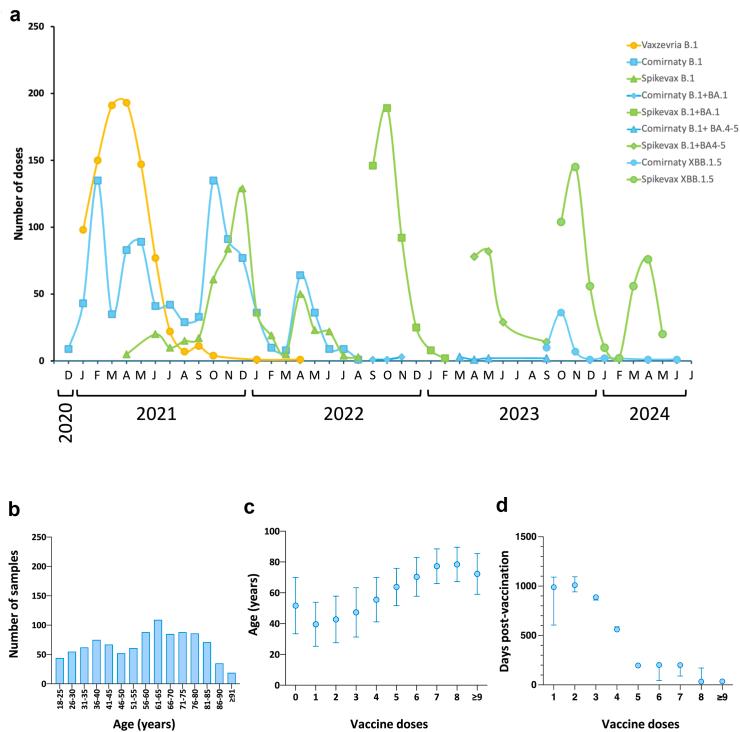
997 pseudonymized serum samples were obtained from NHS Greater Glasgow and Clyde (NHS GGC) biorepository in May 2024, along with associated data for age, sex, and COVID-19 vaccine history. Samples spanned ages from 19 to 98 years, with 59.0% female and 41.0% male, and 39.1% from primary healthcare (GP practices) and 61.0% from secondary healthcare (hospitals). Anti-SARS-CoV-2 receptor binding domain (RBD)-specific antibodies were measured by enzyme-linked immunosorbent assay (ELISA), while neutralising antibodies were quantified using HIV(SARS-CoV-2) pseudotype-based virus neutralisation assay (PVNA). ELISAs measured both total IgG and IgG4-mediated responses. Pseudotypes were prepared bearing spike proteins from vaccine antigens B.1 and XBB.1.5, contemporaneous circulating variants KP.3.1.1 and LB.1, and the emerging variant XEC. Samples were grouped by number of COVID-19 vaccine doses received (from no vaccination to ≥8 doses) and 12 samples from each group were screened by ELISA and PVNA.
FINDINGS
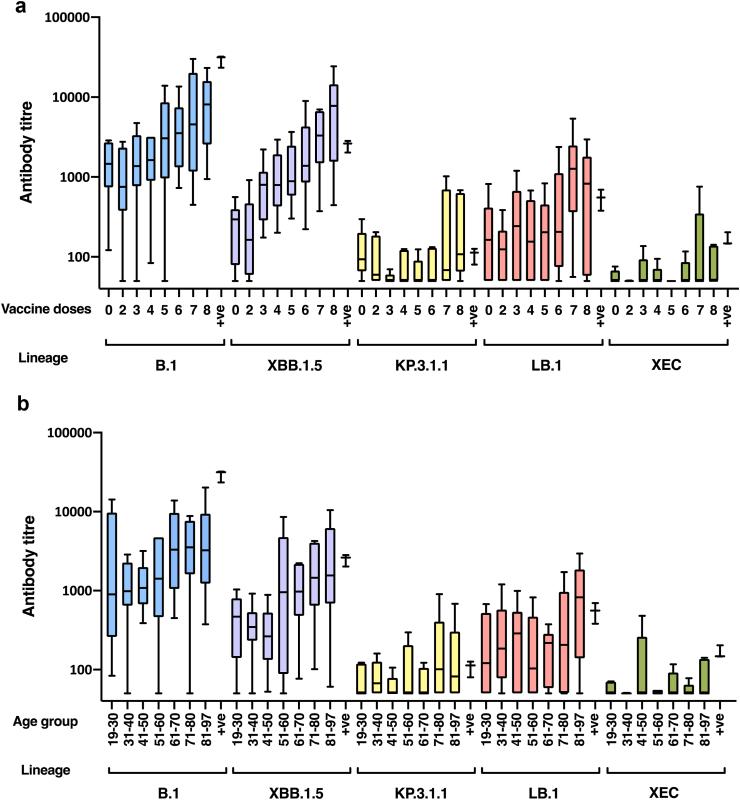
The random selection of 1000 samples provided a broad cross-section of the population derived from patients with a range of individual vaccine histories, from those having received no COVID-19 vaccines to those having received 8 or more doses. The number of doses received increased with age, from a mean age of ∼40 for those having received one dose to a mean age of 77-78 for those having received 7 or 8 doses. While total IgG responses were similar across each of the groups, irrespective of vaccine history, repeated exposure to mRNA-based vaccines elicited an increase in SARS-CoV-2-specific IgG4. Neutralising antibody titres against the vaccine antigens B.1 and XBB.1.5 increased with age, reaching maximum geometric mean titres of 5610 (95% CI, 2773-11,349) for B.1 and 4577 (1832-11,440) for XBB.1.5 in those receiving 8 doses. In all groups, titres measured against the KP.3.1.1, LB.1 and XEC were significantly lower, consistent with the emergence of immune evasive variants over time. Cross-neutralisation of KP.3.1.1 was limited to maxima of 145 (62.2-336) and 187 (83.8-418) in the 7 and 8 dose groups, while titres against XEC were 105 (47-233) and 90.9 (48.1-172) respectively.
INTERPRETATION
In the absence of systematic COVID-19 serosurveillance, random sampling of sera from biorepositories associated with major health boards can generate valuable data about the level of immunity in the general population, informing estimates of vaccine effectiveness and antigen selection.
FUNDING
United Kingdom Medical Research Council and Genotype-to-Phenotype National Virology Consortium.
背景
随着新冠疫情结束,全球关注点已从“疫情应对”转向“长期管理”。由于全国范围内没有正在进行的血清学监测研究,我们对普通人群免疫水平的了解有所减少。在本研究中,我们从服务于苏格兰最大卫生委员会的生物样本库中随机抽取样本,检测抗SARS-CoV-2抗体,以确定当前的免疫状况,为未来的疫苗策略提供信息。
方法
2024年5月从NHS大格拉斯哥和克莱德(NHS GGC)生物样本库获取了997份匿名血清样本,以及年龄、性别和新冠疫苗接种史的相关数据。样本年龄跨度为19至98岁,女性占59.0%,男性占41.0%,39.1%来自初级医疗保健(全科医生诊所),61.0%来自二级医疗保健(医院)。通过酶联免疫吸附测定(ELISA)检测抗SARS-CoV-2受体结合域(RBD)特异性抗体,同时使用基于HIV(SARS-CoV-2)假病毒的病毒中和测定(PVNA)对中和抗体进行定量。ELISA检测总IgG和IgG4介导的反应。制备携带疫苗抗原B.1和XBB.1.5、同期流行变体KP.3.1.1和LB.1以及新兴变体XEC的刺突蛋白的假病毒。样本按新冠疫苗接种剂量数分组(从未接种到≥8剂),每组选取12个样本进行ELISA和PVNA检测。
研究结果
随机选取的1000个样本提供了来自具有不同疫苗接种史患者的广泛人群样本,从未接种新冠疫苗的患者到接种8剂或更多剂的患者。接种剂量数随年龄增加,接种1剂的患者平均年龄约为40岁,接种7或8剂的患者平均年龄为77 - 78岁。尽管各组的总IgG反应相似,与疫苗接种史无关,但反复接触基于mRNA的疫苗会导致SARS-CoV-2特异性IgG4增加。针对疫苗抗原B.1和XBB.1.5 的中和抗体滴度随年龄增加,接种8剂的人群中,针对B.1的几何平均滴度最高达到5610(95%CI,2773 - 11349),针对XBB.1.5的为4577(1832 - 11440)。在所有组中,针对KP.3.1.1、LB.1和XEC的滴度显著较低,这与免疫逃逸变体随时间出现一致。KP.3.1.1的交叉中和在7剂和8剂组中最高分别为145(62.2 - 336)和187(83.8 - 418),而针对XEC的滴度分别为105(47 - 233)和90.9(48.1 - 172)。
解读
在缺乏系统性新冠血清学监测的情况下,从与主要卫生委员会相关的生物样本库中随机抽取血清样本,可以生成有关普通人群免疫水平的有价值数据,为疫苗有效性评估和抗原选择提供信息。
资金来源
英国医学研究理事会和基因型到表型国家病毒学联盟。

 Zotero 插件