
用于潜在抗菌应用的光活化卟啉功能化塑料试样的光漂白
Photobleaching of Light-Activated Porphyrin-Functionalized Plastic Coupons for Potential Antimicrobial Applications.
作者信息
Tieman Grace M O, Shatila Fatima, Ceschia Stefania, Wulff Jeremy E, Buckley Heather L
机构信息
Department of Chemistry, University of Victoria, 3800 Finnerty Road, Victoria, British Columbia V8P 5C2, Canada.
Centre for Advanced Materials and Related Technologies (CAMTEC), University of Victoria, 3800 Finnerty Road, Victoria, British Columbia V8P 5C2, Canada.
出版信息
ACS Mater Au. 2025 Mar 4;5(3):537-546. doi: 10.1021/acsmaterialsau.4c00172. eCollection 2025 May 14.
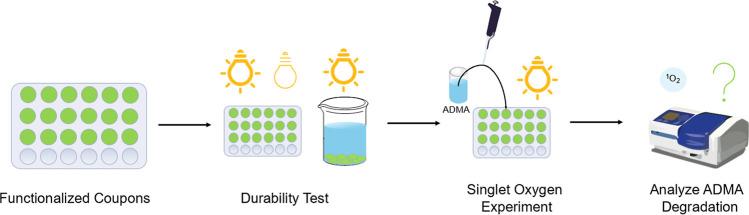
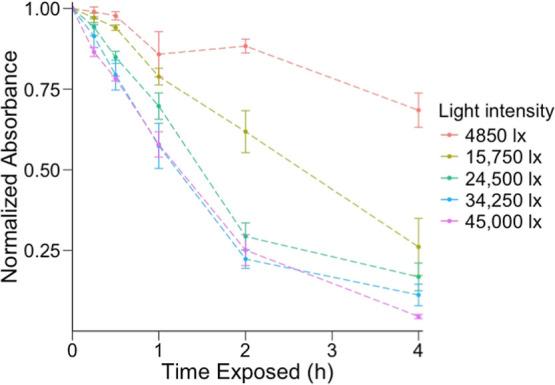
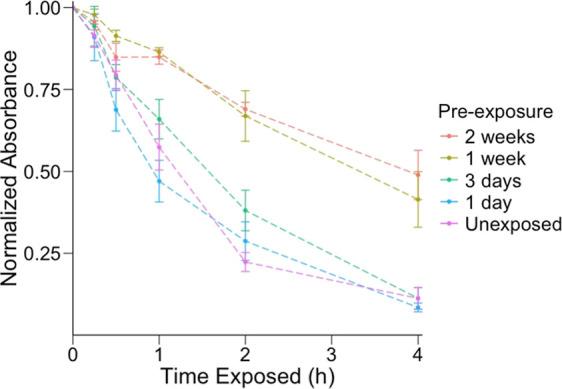
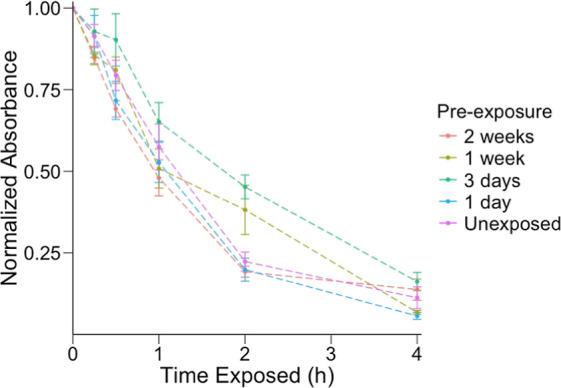
Developing greener alternatives for harmful conventional cleaning agents is an important focus for preventing negative impacts on both the environment and human health. One potential alternative of interest is photodynamic inactivation (PDI), where a photosensitizing molecule is used to generate singlet oxygen (O) and other reactive oxygen species (ROS). ROS, O in particular, are known to react with cellular membranes of bacteria, resulting in cellular death. Porphyrinoids are one of these known light sensitizing species. In this work, zinc(II) 5,10,15,20-tetrakis((-4-[3-(trifluoromethyl)-3-diazirin-3-yl]benzyl)-4-pyridyl)-21,23-porphine tetrabromide is covalently attached to polyethylene terephthalate (PET) via thermal activation of a diazirine to initiate a C-H insertion. With the porphyrin now covalently bonded to the PET, the functionalized PET was assessed at a range of light intensities on its ability to generate O and for antimicrobial activity against ; the results were found to be correlated. Because photobleaching and resultant loss of activity are one of the weaknesses of PDI, the material was further assessed for its ability to withstand various photobleaching conditions. The photobleaching conditions assessed were high intensity light in dry and underwater conditions and ambient light, along with a set of dark controls. Results indicate that after 2 weeks of high intensity irradiation, the material still mediates singlet oxygen generation, albeit less efficiently. This shows promise for the use of this approach as an alternative to conventional cleaning agents.
开发有害传统清洁剂的更环保替代品是预防对环境和人类健康产生负面影响的一个重要关注点。一种潜在的有趣替代品是光动力灭活(PDI),即使用光敏分子来产生单线态氧(O)和其他活性氧物种(ROS)。已知ROS,尤其是O,会与细菌的细胞膜发生反应,导致细胞死亡。卟啉类化合物就是这些已知的光敏物种之一。在这项工作中,通过二氮杂环丙烷的热活化引发C-H插入反应,将5,10,15,20-四((-4-[3-(三氟甲基)-3-二氮杂环丙烷-3-基]苄基)-4-吡啶基)-21,23-卟啉锌(II)四溴化物共价连接到聚对苯二甲酸乙二酯(PET)上。由于卟啉现在已与PET共价键合,因此对功能化的PET在一系列光强度下产生O的能力以及对……的抗菌活性进行了评估;结果发现两者具有相关性。由于光漂白以及由此导致的活性丧失是PDI的弱点之一,因此进一步评估了该材料承受各种光漂白条件的能力。评估的光漂白条件包括干燥和水下条件下的高强度光以及环境光,同时设置了一组黑暗对照。结果表明,在高强度照射2周后,该材料仍能介导单线态氧的产生,尽管效率较低。这表明这种方法有望作为传统清洁剂的替代品。




 Zotero 插件