
睡眠时间对冠心病患者的影响:一项为期四年的观察性研究。
The influence of sleep duration on patients with coronary artery disease: a four-year observational study.
作者信息
Ma Runfeng, Wang Ruoyu, Wang Bingqian, Tang Zihan, Qiu Tian, Lu Yiduo, Liu Gang
机构信息
International Medical College, Chongqing Medical University, Chongqing, China.
College of Basic Medical Sciences, Naval Medical University, Shanghai, China.
出版信息
Front Endocrinol (Lausanne). 2025 May 5;16:1555880. doi: 10.3389/fendo.2025.1555880. eCollection 2025.
BACKGROUND
Coronary artery disease (CAD) is highly prevalent and fatal worldwide. In China, particularly in the southwest region, the association between CAD and sleep duration remains insufficiently understood. This study aims to investigate outcomes among CAD patients with varying sleep duration.
METHODS
In a Southwest Chinese cohort, patients with CAD were categorized into three sleep duration groups: <6 hours, 6-8 hours, and >8 hours. Over a four-year follow-up, the endpoint including new-onset myocardial infarction and CAD-related deaths was recorded. The Fine-Gray model was employed to evaluate the estimated marginal occurrence probability of the target event. Additionally, Kaplan-Meier estimation and Cox regression analysis were conducted to further investigate the association between sleep duration and outcomes.
RESULTS
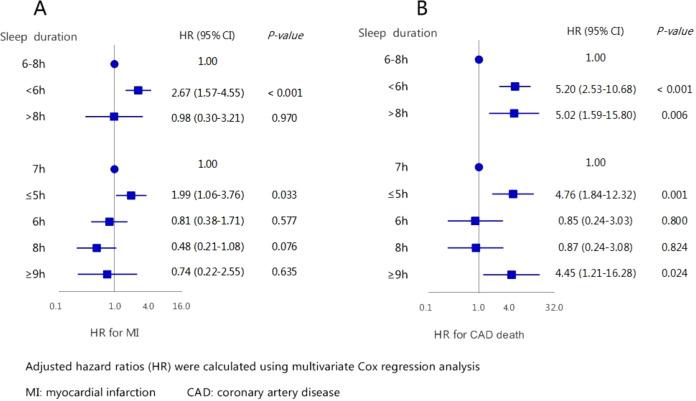
The study enrolled 816 residents with CAD, who had an average age of 69.2 ± 8.3 years old, of whom 40.2% were male. Across the three sleep duration groups (6-8h, <6h, and >8h), the hazard ratios (HRs) with 95% confidence interval for new-onset myocardial infarction were: 1.00 (reference), 2.67 (1.57-4.55) ( < 0.001), and 0.98 (0.30-3.21) (=0.970). For CAD-related mortality, the HRs were: 1.00 (reference), 5.20 (2.53-10.68) ( < 0.001), and 5.02 (1.59-15.80) (=0.006). This trend was consistently observed in both the Fine-Gray model and subgroup analyses.
CONCLUSIONS
Both short (<6 hours/day) and long (>8 hours/day) sleep duration were linked to an elevated risk of cardiac mortality among CAD patients in Southwest China. Short sleep duration was also found to be associated with high myocardial infarction risk.
背景
冠状动脉疾病(CAD)在全球范围内高度流行且具有致命性。在中国,尤其是西南地区,CAD与睡眠时间之间的关联仍未得到充分了解。本研究旨在调查不同睡眠时间的CAD患者的预后情况。
方法
在中国西南地区的一个队列中,CAD患者被分为三个睡眠时间组:<6小时、6 - 8小时和>8小时。在四年的随访期间,记录包括新发心肌梗死和CAD相关死亡在内的终点事件。采用Fine - Gray模型评估目标事件的估计边际发生概率。此外,进行了Kaplan - Meier估计和Cox回归分析,以进一步研究睡眠时间与预后之间的关联。
结果
该研究纳入了816名CAD患者,他们的平均年龄为69.2±8.3岁,其中40.2%为男性。在三个睡眠时间组(6 - 8小时、<6小时和>8小时)中,新发心肌梗死的风险比(HRs)及其95%置信区间分别为:1.00(参考值)、2.67(1.57 - 4.55)(<0.001)和0.98(0.30 - 3.21)(=0.970)。对于CAD相关死亡率,HRs分别为:1.00(参考值)、5.20(2.53 - 10.68)(<0.001)和5.02(1.59 - 15.80)(=0.006)。在Fine - Gray模型和亚组分析中均一致观察到这一趋势。
结论
在中国西南部,CAD患者睡眠时间过短(<6小时/天)和过长(>8小时/天)均与心脏死亡风险升高有关。还发现睡眠时间过短与心肌梗死风险高有关。


 Zotero 插件