
多种新冠病毒变异株在小鼠模型中的致病性比较。
Comparison of the pathogenicity of multiple SARS-CoV-2 variants in mouse models.
作者信息
Lv Qi, Liu Ming, Qi Feifei, Liu Mingya, Li Fengdi, Deng Ran, Liang Xujian, Xu Yanfeng, Song Zhiqi, Yan Yiwei, Li Shuyue, Mou Guocui, Bao Linlin
机构信息
Beijing Key Laboratory for Animal Models of Emerging and Reemerging Infectious Diseases, NHC Key Laboratory of Comparative Medicine, Institute of Laboratory Animal Science, CAMS & PUMC, Beijing, China.
National Center of Technology Innovation for Animal Model, Beijing, China.
出版信息
Animal Model Exp Med. 2025 Jul;8(7):1302-1312. doi: 10.1002/ame2.70029. Epub 2025 May 20.
BACKGROUND
New variants of severe acute respiratory syndrome coronavirus 2(SARS-CoV-2)continue to drive global epidemics and pose significant health risks. The pathogenicity of these variants evolves under immune pressure and host factors. Understanding these changes is crucial for epidemic control and variant research.
METHODS
Human angiotensin-converting enzyme 2(hACE2) transgenic mice were intranasally challenged with the original strain WH-09 and the variants Delta, Beta, and Omicron BA.1, while BALB/c mice were challenged with Omicron subvariants BA.5, BF.7, and XBB.1. To compare the pathogenicity differences among variants, we conducted a comprehensive analysis that included clinical symptom observation, measurement of viral loads in the trachea and lungs, evaluation of pulmonary pathology, analysis of immune cell infiltration, and quantification of cytokine levels.
RESULTS
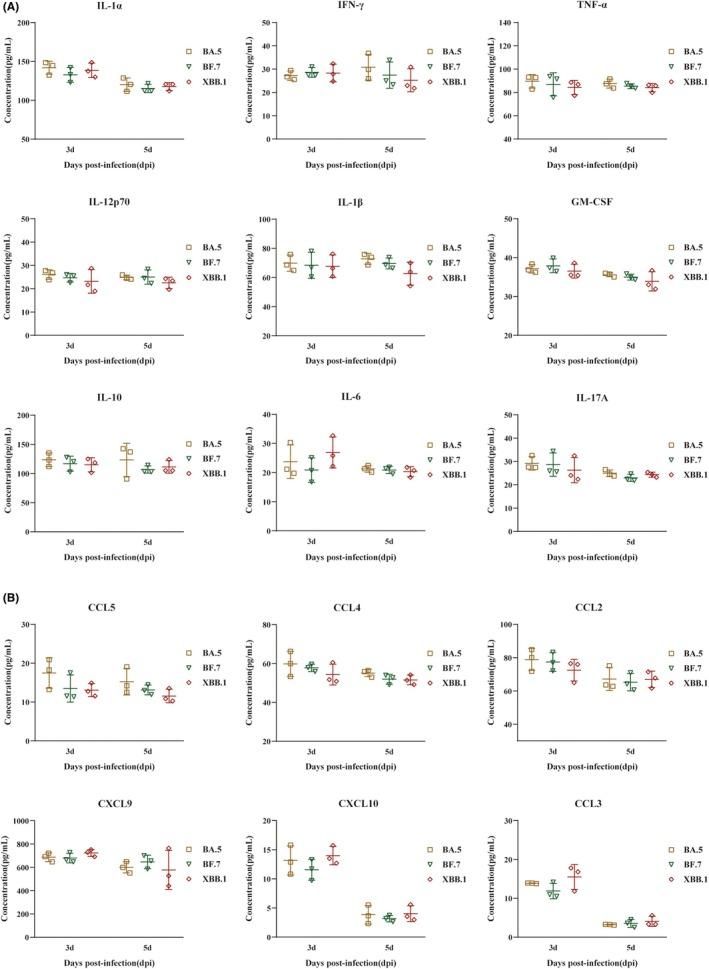
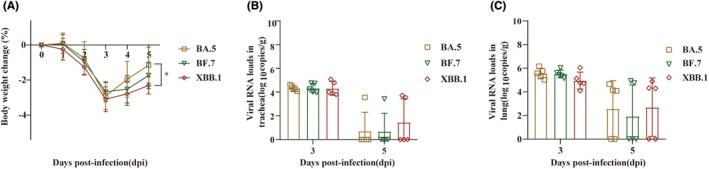
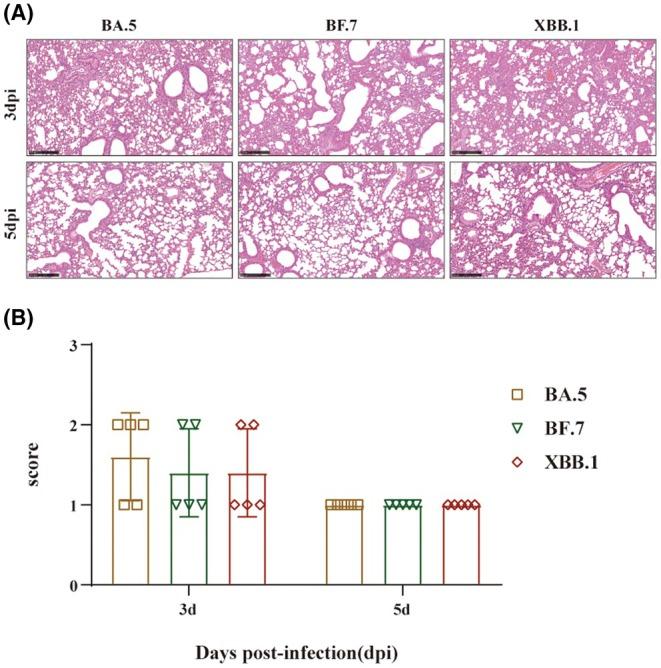
In hACE2 mice, the Beta variant caused significant weight loss, severe lung inflammation, increased inflammatory and chemotactic factor secretion, greater macrophage and neutrophil infiltration in the lungs, and higher viral loads with prolonged shedding duration. In contrast, BA.1 showed a significant reduction in pathogenicity. The BA.5, BF.7, and XBB.1 variants were less pathogenic than the WH-09, Beta, and Delta variants when infected in BALB/c mice. This was evidenced by reduced weight loss, diminished pulmonary pathology, decreased secretion of inflammatory factors and chemokines, reduced macrophage and neutrophil infiltration, as well as lower viral loads in both the trachea and lungs.
CONCLUSION
In hACE2 mice, the Omicron variant demonstrated the lowest pathogenicity, while the Beta variant exhibited the highest. Pathogenicity of the Delta variant was comparable to the original WH-09 strain. Among BALB/c mice, Omicron subvariants BA.5, BF.7, and XBB.1 showed no statistically significant differences in virulence.
背景
严重急性呼吸综合征冠状病毒2(SARS-CoV-2)的新变种持续推动全球疫情,并构成重大健康风险。这些变种的致病性在免疫压力和宿主因素作用下不断演变。了解这些变化对于疫情防控和变种研究至关重要。
方法
用原始毒株WH-09以及变种Delta、Beta和奥密克戎BA.1经鼻感染人血管紧张素转换酶2(hACE2)转基因小鼠,同时用奥密克戎亚变种BA.5、BF.7和XBB.1感染BALB/c小鼠。为比较变种之间的致病性差异,我们进行了全面分析,包括临床症状观察、气管和肺部病毒载量测量、肺部病理学评估、免疫细胞浸润分析以及细胞因子水平定量。
结果
在hACE2小鼠中,Beta变种导致显著体重减轻、严重肺部炎症、炎症和趋化因子分泌增加、肺部巨噬细胞和中性粒细胞浸润增多以及病毒载量更高且排毒持续时间延长。相比之下,BA.1的致病性显著降低。在BALB/c小鼠中感染时,BA.5、BF.7和XBB.1变种的致病性低于WH-09、Beta和Delta变种。体重减轻减少、肺部病理学改变减轻、炎症因子和趋化因子分泌减少、巨噬细胞和中性粒细胞浸润减少以及气管和肺部病毒载量降低均证明了这一点。
结论
在hACE2小鼠中,奥密克戎变种致病性最低,而Beta变种致病性最高。Delta变种的致病性与原始WH-09毒株相当。在BALB/c小鼠中,奥密克戎亚变种BA.5、BF.7和XBB.1的毒力无统计学显著差异。



 Zotero 插件