
中性粒细胞明胶酶相关脂质运载蛋白作为新型冠状病毒肺炎感染中急性肾损伤的预测生物标志物:一项系统评价和荟萃分析
Neutrophil gelatinase-associated lipocalin as a predictive biomarker of acute kidney injury in COVID-19 infection: A systematic review and meta-analysis.
作者信息
Dey Puja, Mal Nilanjan, Sinha Rashmi, Kumar Amit, Kumar Pramod, Saroj Usha, Chaudhuri Partha Kumar, Sinha Mani Bhushan Kumar, Guria Rishi, Mishra Brajesh, Prasad Manohar Lal, Kumar Divakar, Kumar Satish, Prasad Manoj Kumar
机构信息
Department of Medicine, Rajendra Institute of Medical Sciences, Ranchi, Jharkhand, India.
Department of Laboratory Medicine, Rajendra Institute of Medical Sciences, Ranchi, Jharkhand, India.
出版信息
J Family Med Prim Care. 2025 Apr;14(4):1194-1206. doi: 10.4103/jfmpc.jfmpc_1513_24. Epub 2025 Apr 25.
BACKGROUND
Coronavirus 2019 (COVID-19) is an infectious disease caused by a novel coronavirus, SARS-CoV-2. Acute kidney injury (AKI) affects approximately 20-40% of patients with COVID-19 admitted to the intensive care unit (ICU), and it is a complication that has been linked to increased morbidity and mortality. Neutrophil gelatinase-associated lipocalin (NGAL) is a biomarker of acute kidney injury.
METHODS
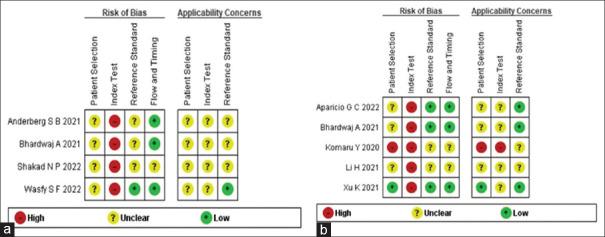
Articles were searched from databases such as PubMed, Google Scholar, and Cochrane Library till June 2023. Pooled sensitivity, specificity, area under the curve (AUC), diagnostic odds ratio (DOR), and summery receiver operating curve (SROC) were calculated with 95% confidence interval. I statistics and Chi-square test were used to look for the heterogeneity in between studies. Meta-regression was conducted to look for the source of heterogeneity and GRADE analysis was performed to look for the certainty of evidence.
RESULTS
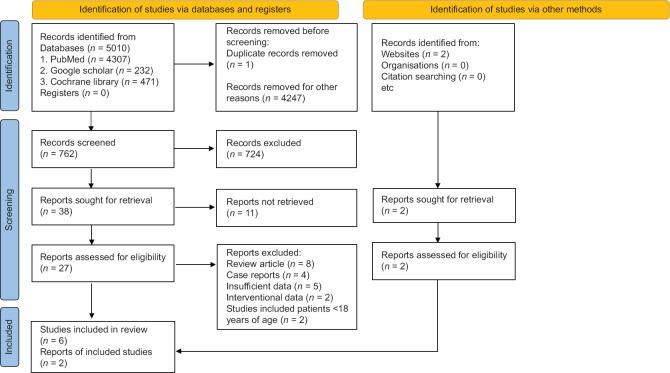
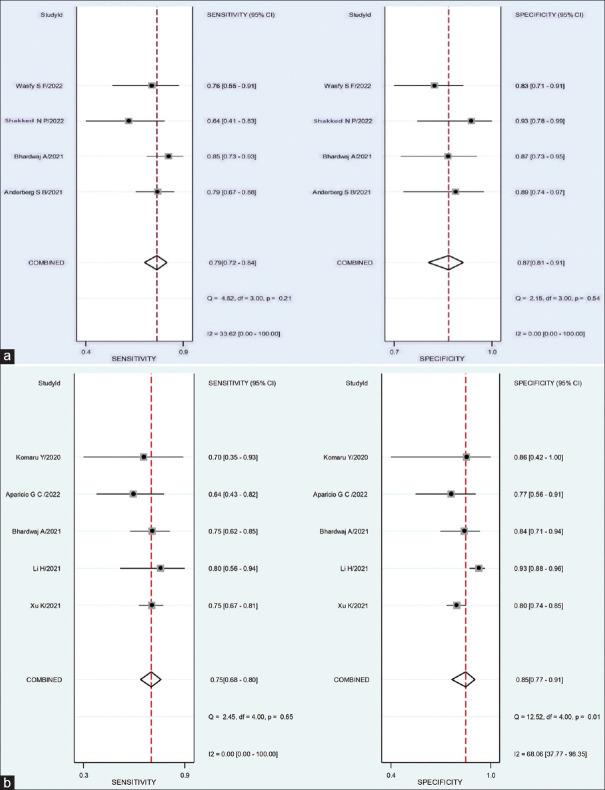
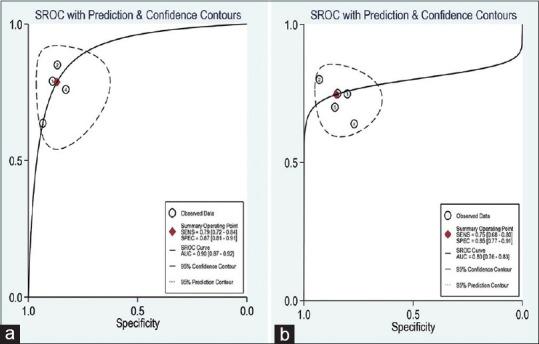
Altogether, eight studies were selected (4 serum/5 urine), out of which one study had both serum and urine NGAL data. The total sample size was 1,067 (349 serum/718 urine). For serum and urine NGAL, the pooled sensitivity was 0.79 (95% CI: 0.72-0.84) and 0.75 (95% CI: 0.68-0.80), pooled specificity was 0.87 (95% CI: 0.81-0.91) and 0.85 (95% CI: 0.77-0.91), DOR was 24 (95% CI: 14-43), and 17 (95% CI: 9-32) and AUC was 0.90 (95% CI: 0.87-0.92) and 0.80 (95% CI: 0.76-0.83), respectively.
CONCLUSION
Both serum and urine NGAL have favourable pooled sensitivity, specificity, DOR and AUC for the diagnosis of AKI in COVID-19 infection, however, with low certainty of evidence.
背景
2019冠状病毒病(COVID-19)是由一种新型冠状病毒严重急性呼吸综合征冠状病毒2(SARS-CoV-2)引起的传染病。急性肾损伤(AKI)影响约20%-40%入住重症监护病房(ICU)的COVID-19患者,并且它是一种与发病率和死亡率增加相关的并发症。中性粒细胞明胶酶相关脂质运载蛋白(NGAL)是急性肾损伤的一种生物标志物。
方法
检索了PubMed、谷歌学术和Cochrane图书馆等数据库中截至2023年6月的文章。计算合并敏感度、特异度、曲线下面积(AUC)、诊断比值比(DOR)和汇总受试者工作特征曲线(SROC),并给出95%置信区间。采用I统计量和卡方检验寻找研究间的异质性。进行Meta回归以寻找异质性来源,并进行GRADE分析以寻找证据的确定性。
结果
共纳入八项研究(4项血清研究/5项尿液研究),其中一项研究同时有血清和尿液NGAL数据。总样本量为1067例(血清样本349例/尿液样本718例)。血清和尿液NGAL的合并敏感度分别为0.79(95%CI:0.72-0.84)和0.75(95%CI:0.68-0.80),合并特异度分别为0.87(95%CI:0.81-0.91)和0.85(95%CI:0.77-0.91),DOR分别为24(95%CI:14-43)和17(95%CI:9-32),AUC分别为0.90(95%CI:0.87-0.92)和0.80(95%CI:0.76-0.83)。
结论
血清和尿液NGAL在诊断COVID-19感染中的急性肾损伤方面均具有良好的合并敏感度、特异度、DOR和AUC,但证据确定性较低。

 Zotero 插件