
人类肾脏是新型严重急性呼吸综合征冠状病毒 2 感染的靶器官。
Human kidney is a target for novel severe acute respiratory syndrome coronavirus 2 infection.
机构信息
Institute of Immunology, PLA, Third Military Medical University, Chongqing, P. R. China.
Department of Medical Laboratory Center, General Hospital of Central Theater Command, Wuhan, Hubei Province, P. R. China.
出版信息
Nat Commun. 2021 May 4;12(1):2506. doi: 10.1038/s41467-021-22781-1.
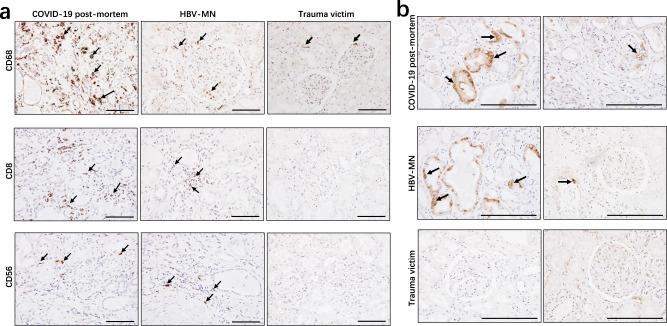
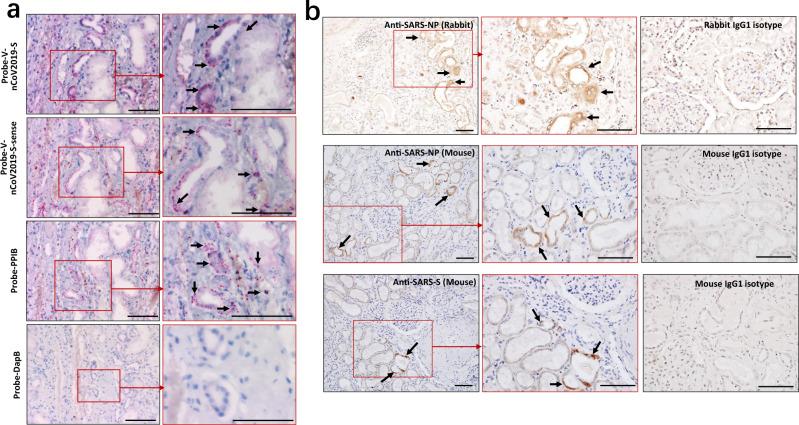
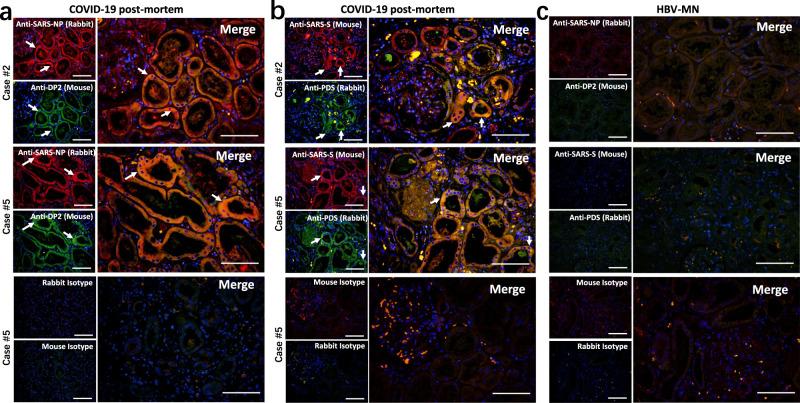
It is unclear whether severe acute respiratory syndrome coronavirus 2 (SARS-CoV-2) can directly infect human kidney, thus leading to acute kidney injury (AKI). Here, we perform a retrospective analysis of clinical parameters from 85 patients with laboratory-confirmed coronavirus disease 2019 (COVID-19); moreover, kidney histopathology from six additional COVID-19 patients with post-mortem examinations was performed. We find that 27% (23/85) of patients exhibited AKI. The elderly patients and cases with comorbidities (hypertension and heart failure) are more prone to develop AKI. Haematoxylin & eosin staining shows that the kidneys from COVID-19 autopsies have moderate to severe tubular damage. In situ hybridization assays illustrate that viral RNA accumulates in tubules. Immunohistochemistry shows nucleocapsid and spike protein deposits in the tubules, and immunofluorescence double staining shows that both antigens are restricted to the angiotensin converting enzyme-II-positive tubules. SARS-CoV-2 infection triggers the expression of hypoxic damage-associated molecules, including DP2 and prostaglandin D synthase in infected tubules. Moreover, it enhances CD68+ macrophages infiltration into the tubulointerstitium, and complement C5b-9 deposition on tubules is also observed. These results suggest that SARS-CoV-2 directly infects human kidney to mediate tubular pathogenesis and AKI.
目前尚不清楚严重急性呼吸综合征冠状病毒 2(SARS-CoV-2)是否可以直接感染人类肾脏,从而导致急性肾损伤(AKI)。在这里,我们对 85 例经实验室确诊的 2019 年冠状病毒病(COVID-19)患者的临床参数进行了回顾性分析;此外,对另外 6 例 COVID-19 患者的尸检肾脏进行了组织病理学检查。我们发现,27%(23/85)的患者出现 AKI。老年患者和合并症(高血压和心力衰竭)患者更容易发生 AKI。苏木精和伊红染色显示 COVID-19 尸检的肾脏存在中度至重度肾小管损伤。原位杂交检测表明病毒 RNA 积聚在肾小管中。免疫组化显示核衣壳和刺突蛋白沉积在肾小管中,免疫荧光双重染色显示两种抗原均局限于血管紧张素转换酶-II 阳性的肾小管中。SARS-CoV-2 感染会触发缺氧损伤相关分子的表达,包括感染肾小管中的 DP2 和前列腺素 D 合酶。此外,还观察到 CD68+巨噬细胞浸润到肾小管间质中,以及补体 C5b-9 沉积在肾小管上。这些结果表明,SARS-CoV-2 直接感染人类肾脏,介导肾小管发病机制和 AKI。


 Zotero 插件