
人类肾球状体和单层细胞提供对 SARS-CoV-2 肾脏相互作用的深入了解。
Human Kidney Spheroids and Monolayers Provide Insights into SARS-CoV-2 Renal Interactions.
机构信息
Pediatric Stem Cell Research Institute, Edmond and Lily Sara Children's Hospital, Sheba Medical Center, Ramat-Gan, Israel.
Pediatric Research Center for Genetics, Development and Environment, Sackler School of Medicine, Tel Aviv University, Tel Aviv, Israel.
出版信息
J Am Soc Nephrol. 2021 Sep;32(9):2242-2254. doi: 10.1681/ASN.2020111546. Epub 2021 Jun 10.
BACKGROUND
Although coronavirus disease 2019 (COVID-19) causes significan t morbidity, mainly from pulmonary involvement, extrapulmonary symptoms are also major componen ts of the disease. Kidney disease, usually presenting as AKI, is particularly severe among patients with COVID-19. It is unknown, however, whether such injury results from direct kidney infection with COVID-19's causative virus, severe acute respiratory syndrome coronavirus 2 (SARS-CoV-2), or from indirect mechanisms.
METHODS
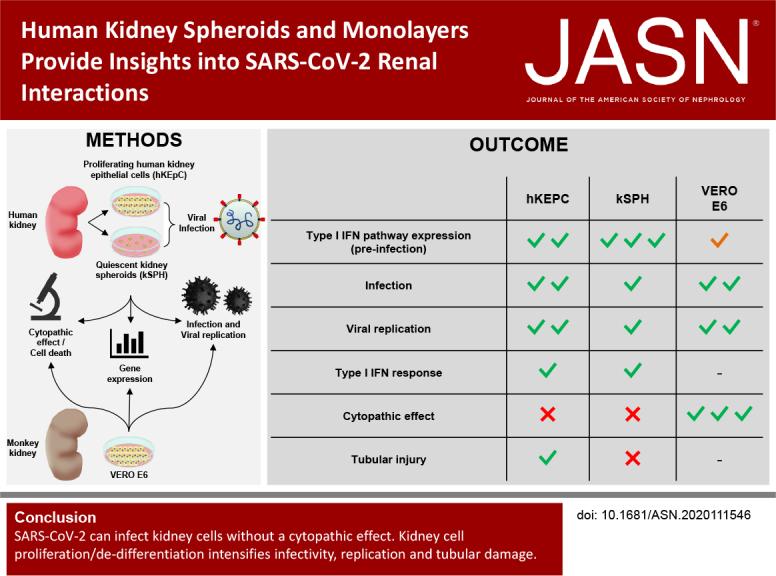
Using cell models, we sought to analyze SARS-CoV-2 interactions with kidney tubular cells and assess direct tubular injury. These models comprised primary human kidney epithelial cells (derived from nephrectomies) and grown as either proliferating monolayers or quiescent three-dimensional kidney spheroids.
RESULTS
We demonstrated that viral entry molecules and high baseline levels of type 1 IFN-related molecules were present in monolayers and kidney spheroids. Although both models support viral infection and replication, they did not exhibit a cytopathic effect and cell death, outcomes that were strongly present in SARS-CoV-2-infected controls (African green monkey kidney clone E6 [Vero E6] cultures). A comparison of monolayer and spheroid cultures demonstrated higher infectivity and replication of SARS-CoV-2 in actively proliferating monolayers, although the spheroid cultures exhibited high er levels of ACE2. Monolayers exhibited elevation of some tubular injury molecules-including molecules related to fibrosis (COL1A1 and STAT6) and dedifferentiation (SNAI2)-and a loss of cell identity, evident by reduction in megalin (LRP2). The three-dimensional spheroids were less prone to such injury.
CONCLUSIONS
SARS-CoV-2 can infect kidney cells without a cytopathic effect. AKI-induced cellular proliferation may potentially intensify infectivity and tubular damage by SARS-CoV-2, suggesting that early intervention in AKI is warranted to help minimize kidney infection.
背景
虽然 2019 年冠状病毒病(COVID-19)会导致显著的发病率,主要是肺部受累,但肺外症状也是疾病的主要组成部分。COVID-19 患者的肾脏疾病通常表现为急性肾损伤(AKI),尤其严重。然而,尚不清楚这种损伤是由 COVID-19 的致病病毒,即严重急性呼吸综合征冠状病毒 2(SARS-CoV-2)直接感染肾脏引起,还是由间接机制引起。
方法
我们使用细胞模型分析 SARS-CoV-2 与肾小管细胞的相互作用,并评估直接肾小管损伤。这些模型包括源自肾切除术的原代人肾脏上皮细胞,并培养为增殖单层或静止的三维肾球体。
结果
我们证明了病毒进入分子和高水平的 1 型干扰素相关分子存在于单层和肾球体中。尽管这两种模型都支持病毒感染和复制,但它们没有表现出细胞病变效应和细胞死亡,而这些结果在 SARS-CoV-2 感染对照(非洲绿猴肾克隆 E6[Vero E6]培养物)中非常明显。单层和球体培养物的比较表明,在活跃增殖的单层中 SARS-CoV-2 的感染性和复制性更高,尽管球体培养物表现出更高水平的 ACE2。单层表现出一些肾小管损伤分子的升高,包括与纤维化(COL1A1 和 STAT6)和去分化(SNAI2)相关的分子,以及细胞身份的丧失,表现为 megalin(LRP2)减少。三维球体则较少发生这种损伤。
结论
SARS-CoV-2 可以感染肾脏细胞而不产生细胞病变效应。AKI 诱导的细胞增殖可能会增强 SARS-CoV-2 的感染性和肾小管损伤,这表明需要早期干预 AKI,以帮助最大限度地减少肾脏感染。
 Zotero 插件