
一氧化碳传感器蛋白CooA中硫醇盐氢键的光谱学研究:对硫醇盐配位稳定性和细胞色素P450功能的影响
Spectroscopic Interrogation of Thiolate Hydrogen Bonding in the CO Sensor Protein CooA: Implications for Thiolate Ligation Stability and Cytochrome P450 Function.
作者信息
Weaver Brian R, Jodts Richard J, Hoffman Brian M, Telser Joshua, Burstyn Judith N
机构信息
Department of Chemistry, University of Wisconsin-Madison, Madison, WI, 53706, USA.
Departments of Chemistry and Molecular Biosciences, Northwestern University, Evanston, IL, 60208, USA.
出版信息
Chemistry. 2025 Jul 2;31(37):e202404504. doi: 10.1002/chem.202404504. Epub 2025 Jun 8.
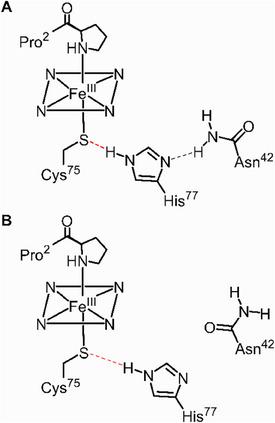
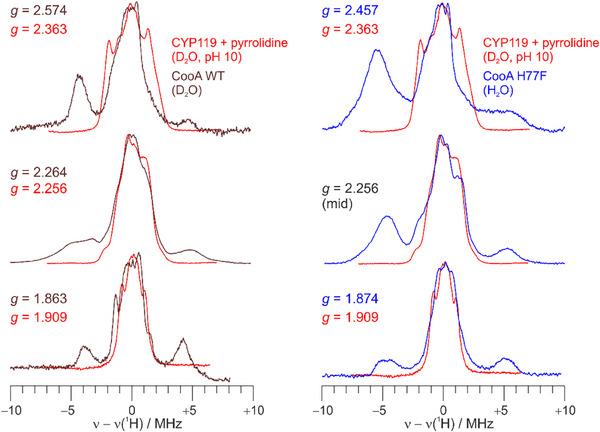
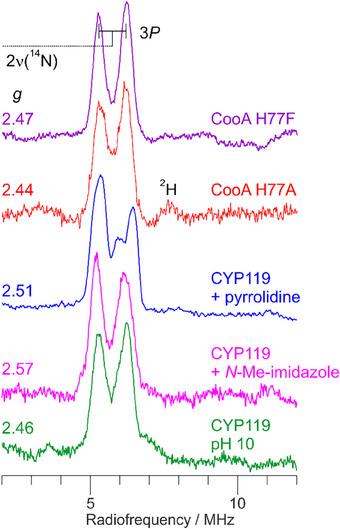
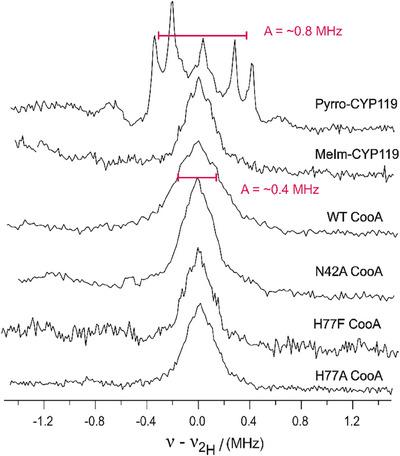
Cysteine (Cys) thiolate coordination in hemoproteins is a unique ligation motif found in enzymes and small molecule sensors. It is posited that divergence between these two functional classes of heme thiolate proteins is a result of distinct hydrogen bonding (H-bonding) interactions with the axial Cys(thiolate) ligand. To further test this hypothesis, we report a spectroscopic analysis of thiolate H-bonding in CooA, a carbon monoxide-sensing heme protein from Rhodospirillum rubrum that is known to switch between Cys(thiolate) and histidine coordination upon reduction. We generated CooA variants with alterations at two residues, Asn and His, which are postulated to influence H-bonding to Cys on the basis of an Fe(II) CooA structure. Using a combination of electronic absorption, electron paramagnetic resonance (EPR), and electron nuclear double resonance (ENDOR) spectroscopies, we identified several CooA variants that exhibit changes in thiolate donor strength and propose an H-bonding model in which Asn orients His for optimal H-bonding with Cys in Fe(III) CooA. Further, we spectroscopically characterize pyrrolidine-bound CYP119, a cytochrome P450, to mimic the first coordination sphere of Fe(III) CooA. Our data unequivocally show that CooA contains a stronger thiolate-Fe bond than the pyrrolidine-bound CYP119, suggesting that Cys(thiolate) H-bonding interactions in CooA are significantly weaker. These results support the hypothesis that thiolate H-bonding is a significant differentiator between the two classes of heme thiolate proteins.
血红素蛋白中的半胱氨酸(Cys)硫醇盐配位是在酶和小分子传感器中发现的独特配位基序。据推测,这两类血红素硫醇盐蛋白之间的差异是与轴向Cys(硫醇盐)配体形成不同氢键(H键)相互作用的结果。为了进一步验证这一假设,我们报告了对CooA中硫醇盐H键的光谱分析,CooA是一种来自红螺菌的一氧化碳传感血红素蛋白,已知在还原时会在Cys(硫醇盐)和组氨酸配位之间切换。我们生成了在两个残基Asn和His处有改变的CooA变体,根据Fe(II)CooA结构推测这两个残基会影响与Cys的H键。通过结合电子吸收、电子顺磁共振(EPR)和电子核双共振(ENDOR)光谱,我们鉴定了几个硫醇盐供体强度发生变化的CooA变体,并提出了一个H键模型,其中Asn使His定向,以便在Fe(III)CooA中与Cys实现最佳H键。此外,我们对结合吡咯烷的细胞色素P450 CYP119进行光谱表征,以模拟Fe(III)CooA的第一配位层。我们的数据明确表明,CooA中的硫醇盐 - Fe键比结合吡咯烷的CYP119更强,这表明CooA中Cys(硫醇盐)的H键相互作用明显较弱。这些结果支持了硫醇盐H键是这两类血红素硫醇盐蛋白之间重要区别因素的假设。
 Zotero 插件