
利用定性见解进行仪表板开发,以解决孕产妇、新生儿和围产期服务中的围产期健康不平等问题。
Leveraging Qualitative Insights for Dashboard Development to Address Perinatal Health Inequalities in Maternity, Neonatal and Perinatal Services.
作者信息
Olakotan Olufisayo, Lim Jennifer N W, Bhavsar Mina, Siddiqui Farah, Ayaz Rabina, Henry Gillian O'Brady, Pillay Tilly Thillagavathie
机构信息
Department of Neonatology, Women and Children's Directorate, University Hospitals Leicester NHS Trust, Leicester, UK.
Faculty of Education, Health and Wellbeing, University of Wolverhampton, Wolverhampton, UK.
出版信息
J Eval Clin Pract. 2025 Jun;31(4):e70130. doi: 10.1111/jep.70130.
INTRODUCTION
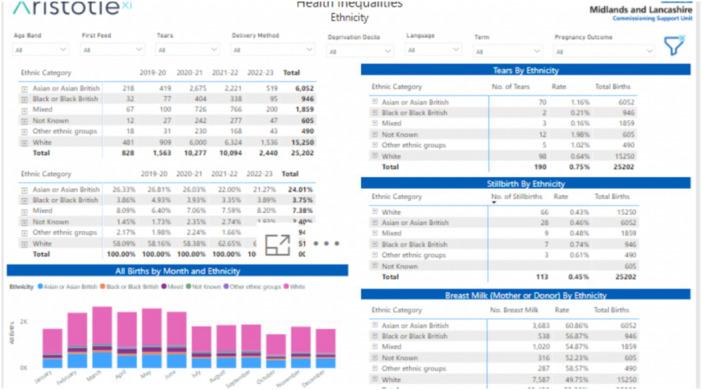
Perinatal health inequalities, referring to disparities in maternal and neonatal outcomes among different ethnic groups, persist despite numerous calls to action. A quality improvement initiative, such as the perinatal health inequality dashboard, could serve as a tool to provide real-time data, highlight trends and patterns, and capture and analyse disparities in maternal and neonatal outcomes across various population groups.
AIM
To explore the development process of the perinatal health inequality dashboard and conduct a preliminary evaluation of the barriers and facilitators in effectively presenting data and highlighting disparities in maternal and neonatal outcomes on the dashboard in the Leicester, Leicestershire, and Rutland (LLR) region in the United Kingdom.
METHOD
A qualitative study was conducted at the University Hospital of Leicester (UHL) involving the dashboard development team and end users, who are clinicians specializing in obstetrics, neonatal care, and perinatal mental health from the Leicester, Leicestershire, and Rutland (LLR) region. Ten clinicians were interviewed using a semi-structured approach over a 3-month period. The data were analysed using thematic analysis following Braun and Clarke's method.
RESULTS
The study findings are presented in two sections: the dashboard development process and dashboard evaluation. Key themes in the development process include data sourcing, integration, and accuracy in neonatal care. Evaluation themes focus on the potential impact of the dashboard, a user-friendly interface, balancing qualitative and quantitative data, sustainability through continuous oversight, and system integration and interoperability. These findings offer critical insights for the ongoing refinement and effective deployment of the dashboard.
CONCLUSION
The dashboard has the potential to improve health outcomes based on clinicians' insights. However, continuous refinement and modification of its functionality are necessary to address the challenges associated with its use.
引言
围产期健康不平等是指不同种族群体在孕产妇和新生儿结局方面存在的差异,尽管多次呼吁采取行动,但这种差异仍然存在。诸如围产期健康不平等仪表盘这样的质量改进举措,可以作为一种工具,提供实时数据,突出趋势和模式,并收集和分析不同人群在孕产妇和新生儿结局方面的差异。
目的
探讨围产期健康不平等仪表盘的开发过程,并对英国莱斯特、莱斯特郡和拉特兰(LLR)地区仪表盘在有效呈现数据以及突出孕产妇和新生儿结局差异方面的障碍和促进因素进行初步评估。
方法
在莱斯特大学医院(UHL)开展了一项定性研究,研究对象包括仪表盘开发团队和最终用户,最终用户是来自莱斯特、莱斯特郡和拉特兰(LLR)地区的产科、新生儿护理和围产期心理健康方面的临床医生。在3个月的时间里,采用半结构化方法对10名临床医生进行了访谈。按照布劳恩和克拉克的方法,使用主题分析法对数据进行了分析。
结果
研究结果分为两个部分呈现:仪表盘开发过程和仪表盘评估。开发过程中的关键主题包括新生儿护理中的数据来源、整合和准确性。评估主题集中在仪表盘的潜在影响、用户友好界面、定性和定量数据的平衡、通过持续监督实现可持续性以及系统整合和互操作性。这些发现为仪表盘的持续完善和有效部署提供了关键见解。
结论
根据临床医生的见解,仪表盘有潜力改善健康结局。然而,有必要对其功能进行持续完善和修改,以应对与使用相关的挑战。
 Zotero 插件