
探索十年间月相和天气对一家姑息治疗机构死亡率的影响。
Exploring the influence of moon phases and weather on mortality in a palliative care unit over a ten year period.
作者信息
Mueller Evelyn, Brönner Miriam, Schuster Frank, van Oorschot Birgitt, Roch Carmen
机构信息
Interdisciplinary Center for Palliative Medicine, Department of Radiation Oncology, University Hospital Wuerzburg, Josef-Schneider-Straße 11, 97080, Würzburg, Germany.
Department for Anaesthesiology and Intensive Care, Donau Isar Hospital Deggendorf, Perlasberger Str. 41, 94469, Deggendorf, Germany.
出版信息
Sci Rep. 2025 May 24;15(1):18059. doi: 10.1038/s41598-025-03184-4.
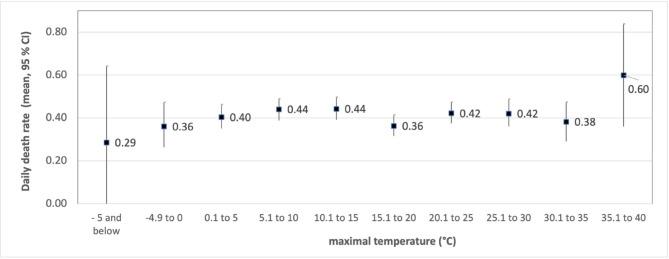
Despite a common belief among public and sometimes medical professionals that moon phases affect mortality rates, studies do not confirm generally higher mortality rates. However, periods of extreme heat or cold have been shown to cause fluctuations in mortality, especially in vulnerable patients. This study aimed to examine whether mortality rates in a 10-bed palliative care unit were influenced by moon phases or weather conditions (temperature, barometric pressure, humidity). Data were gathered from records of the Wuerzburg University Hospital palliative care unit, the Wuerzburg weather station, and the NASA lunar calendar. Daily death rates were calculated over a 10-year period (2010-2019). Bivariate analyses and linear multivariate regression analyses were used to explore potential relationships between moon phases, weather, and mortality. Linear associations, a prerequisite for regression analysis, were ensured using Box-Tidwell tests. Over 3652 days, 3120 patients were treated, with 1508 (48.4%) deaths recorded. The average daily death rate was 0.41 (SD = 0.65), with a maximum of five deaths per day. No deaths occurred on 2411 days (66%). The average death rates were similar across the moon phases: 0.40 (SD = 0.71) for the full moon, 0.42 (SD = 0.66) for the new moon, 0.40 (SD = 0.62) for the waxing moon, and 0.43 (SD = 0.66) for the waning moon, with no significant association (ANOVA: F(3, 3648) = 0.51, p = 0.67). Weather variations were not significantly associated with death rates. The multivariate linear regression analysis confirmed that no combined effects, e.g., of different weather aspects, were found (F(6, 3643) = 0.41, p = 0.87). Our findings align with those of previous studies, which revealed no associations between the moon phases and mortality rates. Unlike general mortality trends, temperature did not significantly impact death rates in the palliative care unit, possibly because of controlled environmental factors. Limitations included a low incidence of extreme weather, which may have reduced the statistical power. Trial registration This study did not involve any health care interventions for human participants and, therefore, did not require registration.
尽管公众乃至一些医学专业人员普遍认为月相会影响死亡率,但研究并未证实死亡率普遍更高。然而,极端炎热或寒冷时期已被证明会导致死亡率波动,尤其是在脆弱患者中。本研究旨在探讨一个拥有10张床位的姑息治疗病房的死亡率是否受月相或天气状况(温度、气压、湿度)影响。数据收集自维尔茨堡大学医院姑息治疗病房的记录、维尔茨堡气象站以及美国国家航空航天局的农历。在10年期间(2010 - 2019年)计算每日死亡率。采用双变量分析和线性多变量回归分析来探索月相、天气和死亡率之间的潜在关系。使用Box - Tidwell检验确保回归分析的前提条件——线性关联。在3652天里,共治疗了3120名患者,记录到死亡患者1508例(48.4%)。平均每日死亡率为0.41(标准差 = 0.65),每日最多有5例死亡。2411天(66%)无死亡发生。各月相的平均死亡率相似:满月时为0.40(标准差 = 0.71),新月时为0.42(标准差 = 0.66),上弦月时为0.40(标准差 = 0.62),下弦月时为0.43(标准差 = 0.66),无显著关联(方差分析:F(3, 3648) = 0.51,p = 0.67)。天气变化与死亡率无显著关联。多变量线性回归分析证实未发现不同天气因素的综合影响(F(6, 3643) = 0.41,p = 0.87)。我们的研究结果与先前研究一致,先前研究表明月相与死亡率之间无关联。与一般死亡率趋势不同,温度对姑息治疗病房的死亡率无显著影响,可能是由于环境因素得到了控制。局限性包括极端天气发生率低,这可能降低了统计效力。试验注册本研究未涉及对人类参与者的任何医疗保健干预,因此无需注册。

 Zotero 插件