
0.25%与0.375%罗哌卡因用于足踝手术后腘窝坐骨神经和隐神经阻滞镇痛的非劣效性:一项随机自身配对非劣效性试验
Noninferiority of 0.25% versus 0.375% Ropivacaine in Popliteal Sciatic and Saphenous Nerve Blocks for Analgesia After Foot and Ankle Surgery: A Randomized Self-Paired Noninferiority Trial.
作者信息
Wu Lili, Xi Chunhua, Lei Guiyu, Li He, Yin Yue, Wan Meixuan, Wu Haiyao, Wang Yue, Hu Chunhua, Wang Guyan
机构信息
Department of Anesthesiology, Beijing Tongren Hospital, Capital Medical University, Beijing, People's Republic of China.
出版信息
Drug Des Devel Ther. 2025 May 19;19:4093-4104. doi: 10.2147/DDDT.S508528. eCollection 2025.
PURPOSE
Peripheral nerve blocks are an important part of postoperative analgesia for the extremities. Previously, we reported that a single shot of 0.375% ropivacaine (20 mL) via ultrasound-guided popliteal sciatic and saphenous nerve blocks provided satisfactory analgesia after foot and ankle surgery; however, toe and ankle weakness in the early postoperative period became a concern for patients. Our preliminary data indicate that 0.25% ropivacaine may be effective for postoperative analgesia. Hence, we hypothesized that the analgesic effect of 0.25% ropivacaine would be noninferior to that of 0.375% ropivacaine at the same volume and would reduce the degree of weakness.
PATIENTS AND METHODS
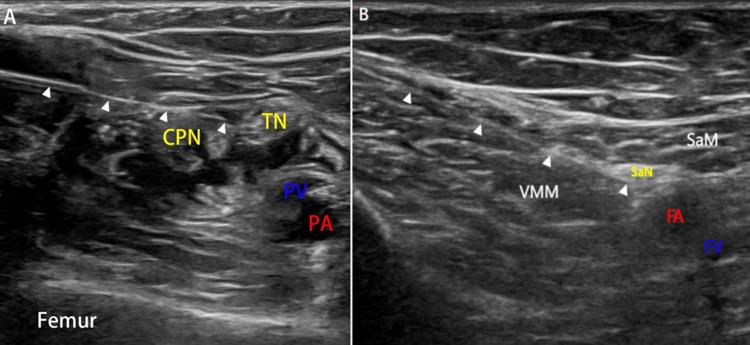
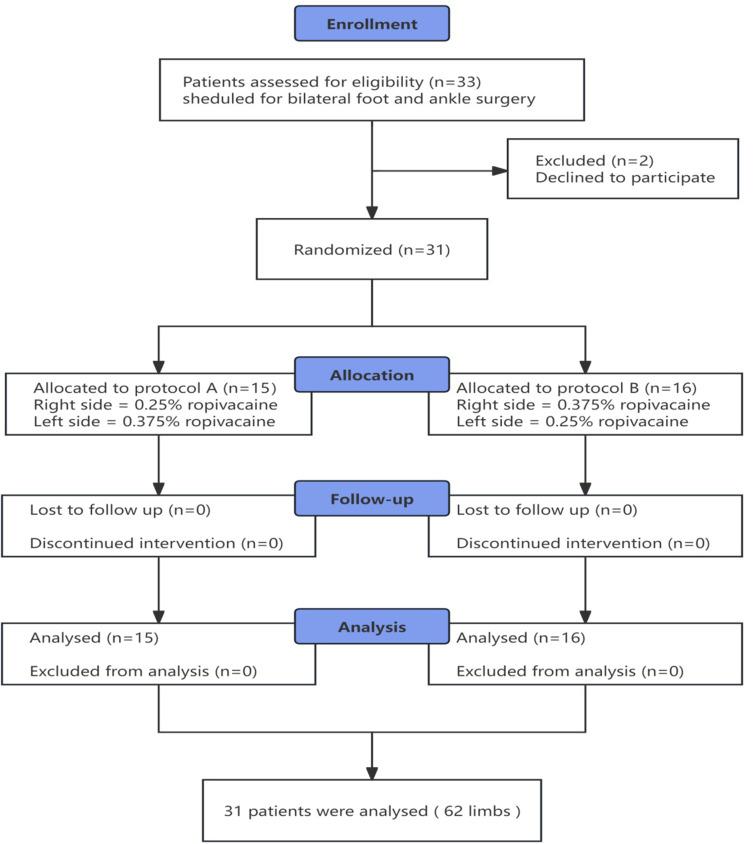
In this randomized, double-blind, self-paired, noninferiority trial, 31 patients who were scheduled for similar, elective, bilateral foot and ankle surgeries under general anesthesia combined with popliteal sciatic and saphenous nerve blocks were enrolled. Each patient was randomly assigned to receive 0.25% ropivacaine on one side and 0.375% ropivacaine on the other side. The primary outcome was the duration of analgesia, which was defined as the time from the end of the nerve blocks until the first sensation of pain in the surgical area, as indicated by a patient-reported visual analog scale (VAS) score ≥ 1. The secondary outcomes included static VAS scores, motor and sensory block grades, patient satisfaction scores, and the incidence of adverse effects.
RESULTS
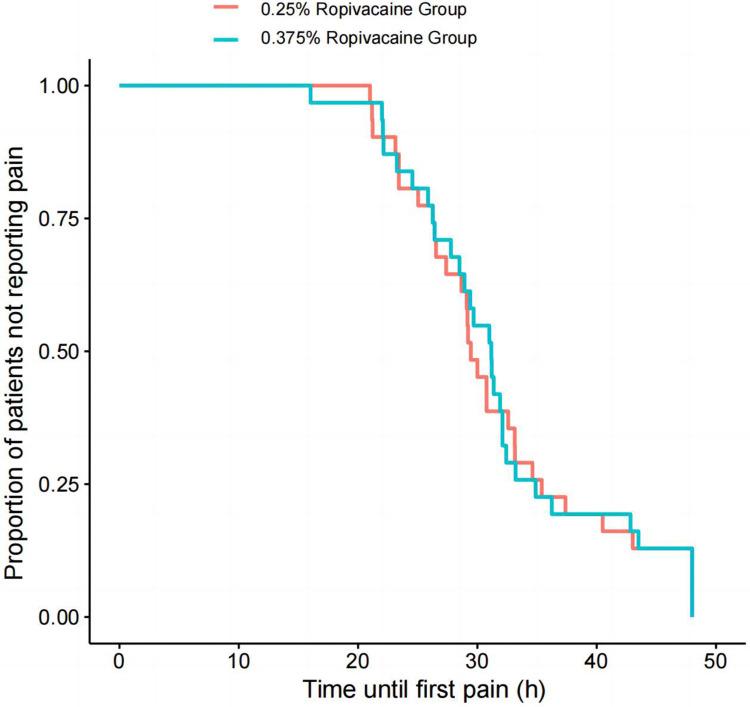
The mean duration of analgesia was 31.7 ± 8.3 h for 0.25% ropivacaine, and 31.9 ± 8.5 h for 0.375% ropivacaine (duration difference, -0.16; 95% CI, -1.5 to 1.2; = 0.812). Compared with 0.375% ropivacaine, 0.25% ropivacaine resulted in a lower incidence of motor block at 0, 2, 6 and 12 hours postoperatively ( < 0.05). No differences in static VAS, sensory block or patient satisfaction scores were observed between the two concentrations within 48 hours postoperatively. Furthermore, no nerve block-related adverse events were reported.
CONCLUSION
The results revealed that 0.25% ropivacaine is not inferior to 0.375% ropivacaine in terms of the analgesic duration of popliteal sciatic and saphenous nerve blocks for bilateral foot and ankle surgery. Moreover, 0.25% ropivacaine reduced the incidence of motor block. Therefore, we recommend 0.25% ropivacaine for postoperative analgesia for foot and ankle surgery.
目的
外周神经阻滞是肢体术后镇痛的重要组成部分。此前,我们报道过经超声引导行腘窝坐骨神经和隐神经阻滞,单次注射0.375%罗哌卡因(20毫升)可为足踝手术后提供满意的镇痛效果;然而,术后早期出现的脚趾及踝关节无力成为患者关注的问题。我们的初步数据表明,0.25%罗哌卡因可能对术后镇痛有效。因此,我们推测,同等容量下0.25%罗哌卡因的镇痛效果不劣于0.375%罗哌卡因,且能减轻无力程度。
患者与方法
在这项随机、双盲、自身配对、非劣效性试验中,纳入了31例计划在全身麻醉联合腘窝坐骨神经和隐神经阻滞下进行类似择期双侧足踝手术的患者。每位患者随机分配在一侧接受0.25%罗哌卡因,另一侧接受0.375%罗哌卡因。主要结局指标为镇痛持续时间,定义为从神经阻滞结束至患者报告视觉模拟量表(VAS)评分≥1表明手术区域首次出现疼痛感觉的时间。次要结局指标包括静态VAS评分、运动和感觉阻滞分级、患者满意度评分以及不良反应发生率。
结果
0.25%罗哌卡因的平均镇痛持续时间为31.7±8.3小时,0.375%罗哌卡因的平均镇痛持续时间为31.9±8.5小时(持续时间差异为-0.16;95%置信区间为-1.5至1.2;P=0.812)。与0.375%罗哌卡因相比,0.25%罗哌卡因在术后0、2、6和12小时运动阻滞的发生率较低(P<0.05)。术后48小时内,两种浓度在静态VAS、感觉阻滞或患者满意度评分方面未观察到差异。此外,未报告与神经阻滞相关的不良事件。
结论
结果显示,对于双侧足踝手术的腘窝坐骨神经和隐神经阻滞,0.25%罗哌卡因在镇痛持续时间方面不劣于0.375%罗哌卡因。此外,0.25%罗哌卡因降低了运动阻滞的发生率。因此,我们推荐0.25%罗哌卡因用于足踝手术的术后镇痛。
 Zotero 插件