
在健康年轻人群中应用各种干眼管理方案后泪膜稳定性和泪液量的短期变化
Short-Term Changes in Tear Film Stability and Tear Volume Following the Application of Various DED Management Options in a Healthy Young Population.
作者信息
Sabucedo-Villamarin Belén, Garcia-Queiruga Jacobo, Cacabelos-Torres Laura, Giraldez Maria J, Yebra-Pimentel Eva, Pena-Verdeal Hugo
机构信息
GI-2092-Optometry, Departamento de Fisica Aplicada (Area de Optometria), Universidade de Santiago de Compostela, Campus Vida s/n, 15701 Santiago de Compostela, Spain.
Instituto de Investigacion Sanitaria (IDIS), Travesia da Choupana S/N, 15701 Santiago de Compostela, Spain.
出版信息
J Pers Med. 2025 Apr 27;15(5):173. doi: 10.3390/jpm15050173.
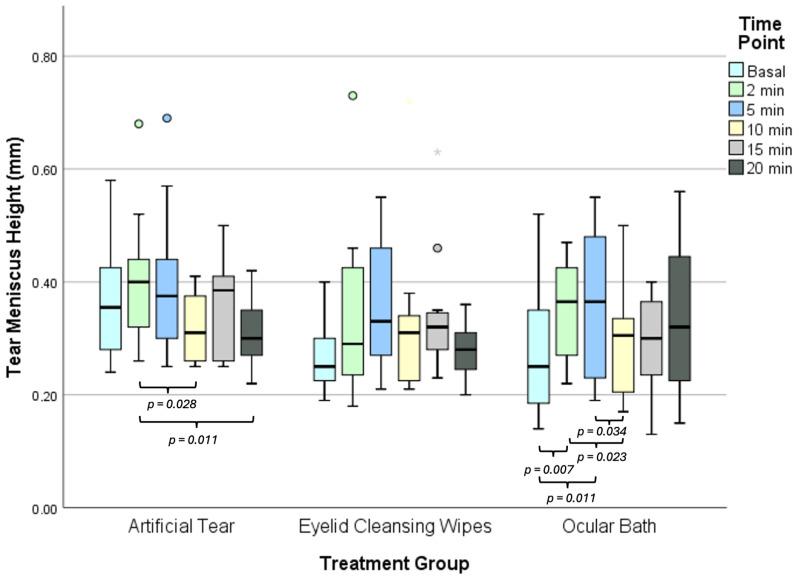
To determine short-term changes in tear film volume and stability after various treatments for dry eye disease in healthy participants. 36 healthy participants aged from 18 to 35 years were recruited for a single-session examination and randomly assigned to one of three treatment groups (1:1:1 treatment, 1:1 eye): Group 1 (artificial tears 'Comfort Drops'), Group 2 (eyelid wipes 'Systane Lid Wipes'), and Group 3 (ocular bath 'Acuaiss'). Tear Meniscus Height (TMH) was assessed at baseline, 2, 5, 10, 15, and 20 min, and Non-Invasive Break-Up Time (NIBUT) at baseline, 2, 10, and 20 min, all using the OCULUS Keratograph 5M by one examiner. Of the initially recruited participants, 35 were analyzed; one was excluded for reflex tearing. Group 1 (n = 12) showed a significant TMH increase at 2 min compared to 10 and 20 min (Friedman, = 0.004; Bonferroni, ≤ 0.028). Group 3 (n = 12) showed a significant increase at 2 and 5 min compared to baseline and decrease at 10 min against 2 and 5 min (Friedman, < 0.001; Bonferroni, ≤ 0.034). Group 2 (n = 11) showed no significant changes over time (Friedman, = 0.108). NIBUT showed no significant differences at any time-point in any group (Friedman, ≥ 0.231). Basal TMH differed between groups (ANOVA, = 0.048), but post hoc analysis found no significance (Bonferroni, all ≥ 0.088). No significant differences in TMH at other time-points (Kruskal-Wallis/ANOVA, ≥ 0.265) or in NIBUT between groups (Kruskal-Wallis/ANOVA, = 0.108) were found. : In healthy participants, artificial tears and ocular baths temporarily increase TMH, while eyelid wipes do not. Neither has an immediate impact on NIBUT.
为确定健康参与者干眼症经各种治疗后泪膜体积和稳定性的短期变化。招募了36名年龄在18至35岁的健康参与者进行单节段检查,并随机分配到三个治疗组之一(1:1:1治疗,1:1眼):第1组(人工泪液“舒适滴眼液”)、第2组(眼睑擦拭“思然眼睑擦拭巾”)和第3组(眼部冲洗“爱可丽思”)。由一名检查人员使用OCULUS Keratograph 5M在基线、2分钟、5分钟、10分钟、15分钟和20分钟时评估泪河高度(TMH),并在基线、2分钟、10分钟和20分钟时评估非侵入性泪膜破裂时间(NIBUT)。在最初招募的参与者中,对35人进行了分析;1人因反射性流泪被排除。第1组(n = 12)与10分钟和20分钟相比,在2分钟时TMH显著增加(弗里德曼检验,P = 0.004;邦费罗尼检验,P ≤ 0.028)。第3组(n = 12)与基线相比,在2分钟和5分钟时显著增加,与2分钟和5分钟相比,在10分钟时下降(弗里德曼检验,P < 0.001;邦费罗尼检验,P ≤ 0.034)。第2组(n = 11)随时间未显示出显著变化(弗里德曼检验,P = 0.108)。在任何组的任何时间点,NIBUT均未显示出显著差异(弗里德曼检验,P ≥ 0.231)。各组间基础TMH存在差异(方差分析,P = 0.048),但事后分析未发现显著差异(邦费罗尼检验,所有P ≥ 0.088)。在其他时间点的TMH(克鲁斯卡尔 - 沃利斯检验/方差分析,P ≥ 0.265)或各组间的NIBUT(克鲁斯卡尔 - 沃利斯检验/方差分析,P = 0.108)均未发现显著差异。结论:在健康参与者中,人工泪液和眼部冲洗可暂时增加TMH,而眼睑擦拭则不能。两者对NIBUT均无即时影响。

 Zotero 插件