
胰高血糖素样肽-1受体激动剂对2型糖尿病患者胃肠道有益:一项真实世界研究。
Glucagon-Like Peptide-1 Receptor Agonists Lead to Gastrointestinal Benefits in Patients with Type 2 Diabetes: A Real-World Study.
作者信息
Hsu Jung-Hui, Bai Hsueh-Fen, Chen Mon-Ting, Fang Yu-Wei, Wang Jing-Tong, Liu Chieh-Yu, Tsai Ming-Hsein
机构信息
Division of Gastroenterology, Department of Internal Medicine, Shin-Kong Wu Ho-Su Memorial Hospital, Taipei, Taiwan.
Department of Intensive Care Medicine, Shin-Kong Wu Ho-Su Memorial Hospital, Taipei, Taiwan.
出版信息
Med Sci Monit. 2025 May 27;31:e946935. doi: 10.12659/MSM.946935.
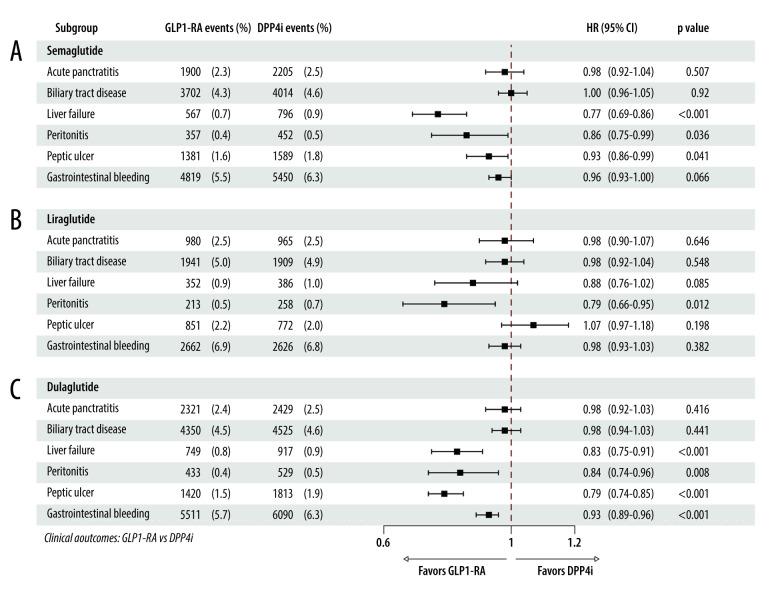
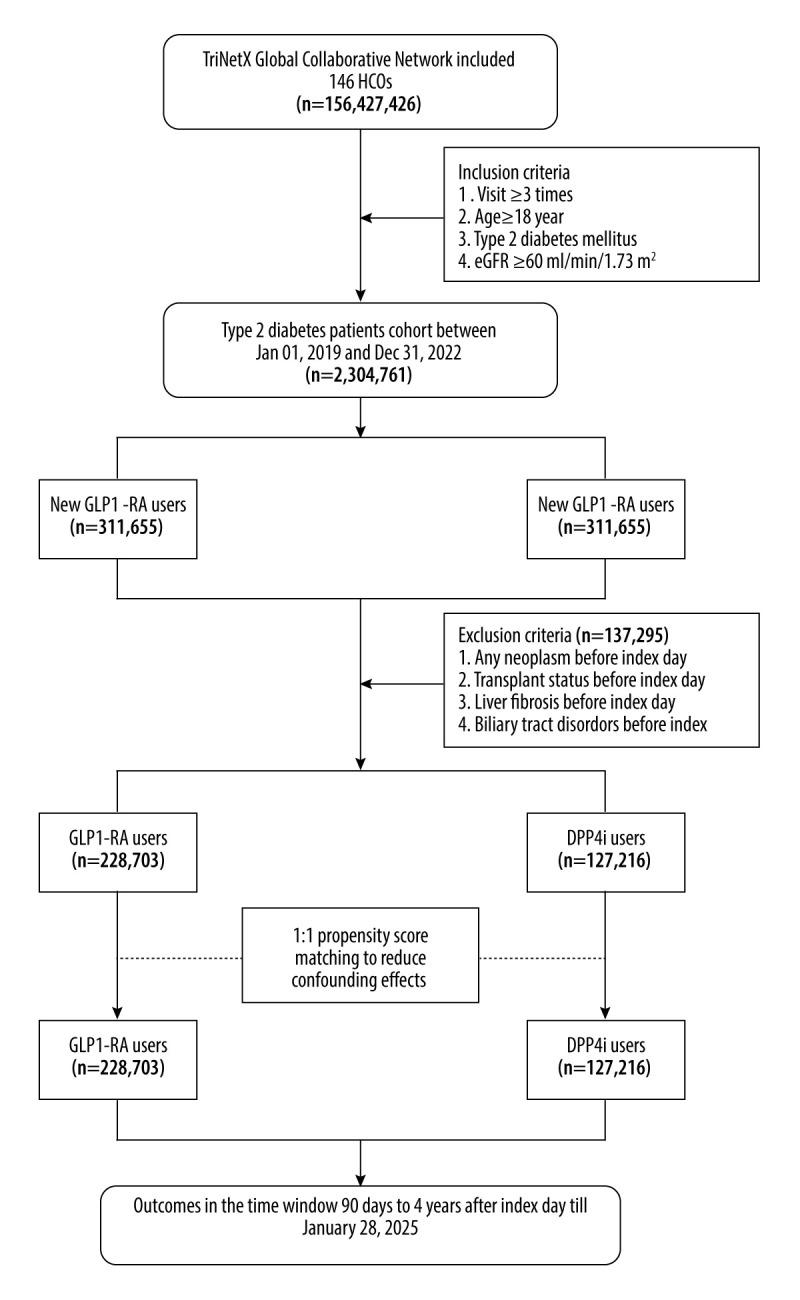
BACKGROUND Glucagon-like peptide-1 receptor agonist (GLP1-RA) is a promising therapy for heart and kidney health in type 2 diabetes mellitus (T2DM). However, information on its GI benefits is limited. This study aimed to investigate the gastrointestinal (GI) outcomes of GLP1-RA use in patients with T2DM. MATERIAL AND METHODS This retrospective cohort study utilized the TriNetX Dataset with a new-user and active-comparator design. The study included 2 304 761 adult patients diagnosed with T2DM and an estimated glomerular filtration rate of ≥60 mL/min/1.73 m² from January 2019 to December 2022. To establish cohorts, we designated users of dipeptidyl peptidase-4 inhibitors (DPP4i) as the control group. Two cohorts were formed for analysis after propensity score matching by baseline characteristics, each comprising 127 216 patients - one using GLP1-RA and the other DPP4i. Cox proportional hazards regression models were used to evaluate GI outcomes over 4 years between groups. RESULTS After matching, the average age of the population was about 60 years, with approximately 55% male and 63% identifying as White people. GLP1-RA users demonstrated a lower risk of acute pancreatitis (hazard ratio [HR]: 0.90, 95% confidence interval [CI]: 0.83-0.97), liver failure (HR: 0.81, 95% CI: 0.75-0.88), peritonitis (HR: 0.85, 95% CI: 0.76-0.94), peptic ulcer (HR: 0.89, 95% CI: 0.84-0.94), and GI bleeding (HR: 0.95, 95% CI: 0.92-0.98) compared to DPP4i users, indicating significant GI-protective effects. Furthermore, the GI advantages of GLP14A over DPP4i were consistently observed across various propensity score matching models. CONCLUSIONS GLP1-RA treatment in T2DM has some GI advantages compared to DPP4, which should be considered when personalizing T2DM treatment.
背景 胰高血糖素样肽-1受体激动剂(GLP1-RA)是2型糖尿病(T2DM)患者心脏和肾脏健康方面一种很有前景的治疗方法。然而,关于其胃肠道益处的信息有限。本研究旨在调查T2DM患者使用GLP1-RA后的胃肠道(GI)结局。
材料与方法 这项回顾性队列研究使用了具有新用户和活性对照设计的TriNetX数据集。该研究纳入了2304761例在2019年1月至2022年12月期间被诊断为T2DM且估计肾小球滤过率≥60 mL/min/1.73 m²的成年患者。为建立队列,我们将二肽基肽酶-4抑制剂(DPP4i)使用者指定为对照组。根据基线特征进行倾向得分匹配后形成两个队列进行分析,每个队列包含127216例患者——一个使用GLP1-RA,另一个使用DPP4i。使用Cox比例风险回归模型评估两组在4年期间的胃肠道结局。
结果 匹配后,人群的平均年龄约为60岁,男性约占55%,63%为白人。与DPP4i使用者相比,GLP1-RA使用者发生急性胰腺炎(风险比[HR]:0.90,95%置信区间[CI]:0.83-0.97)、肝衰竭(HR:0.81,95%CI:0.75-0.88)、腹膜炎(HR:0.85,95%CI:0.76-0.94)、消化性溃疡(HR:0.89,95%CI:0.84-0.94)和胃肠道出血(HR:0.95,95%CI:0.92-0.98)的风险较低,表明具有显著的胃肠道保护作用。此外,在各种倾向得分匹配模型中均一致观察到GLP1-RA相对于DPP4i的胃肠道优势。
结论 与DPP4相比,T2DM患者使用GLP1-RA治疗具有一些胃肠道优势,在T2DM治疗个性化时应予以考虑。

 Zotero 插件