
奥雷巴替尼(HQP1351)用于复发或难治性费城染色体阳性急性淋巴细胞白血病或急变期慢性髓性白血病成人患者的治疗:一项真实世界研究的结果
Olverembatinib (HQP1351)-based therapy in adults with relapsed or refractory Philadelphia chromosome-positive acute lymphoblastic leukemia or chronic myeloid leukemia in blast phase: results from a real-world study.
作者信息
Wen Ziyu, Liu Zhi, Ye Xu, Fan Zhiping, Lin Ren, Huang Fen, Xuan Li, Li Xiaofang, Jin Hua, Dai Min, Sun Jing, Zhou Xuan, Wang Qiang, Liu Xiaoli, Liu Qifa, Zhou Hongsheng, Xu Na
机构信息
Department of Hematology, Nanfang Hospital, Southern Medical University, Guangzhou, China.
Department of Hematology, Guangdong Second Provincial General Hospital, Guangzhou, China.
出版信息
Front Immunol. 2025 May 14;16:1546371. doi: 10.3389/fimmu.2025.1546371. eCollection 2025.
BACKGROUND
Relapsed or refractory Philadelphia chromosome-positive acute lymphoblastic leukemia (R/R Ph ALL) and chronic myeloid leukemia in the blast phase (CML-BP) are associated with poor prognoses. Olverembatinib (HQP1351), a novel third-generation tyrosine kinase inhibitor (TKI), has shown promising efficacy and safety in clinical trials against nearly all BCR-ABL1 kinase mutations, including .
METHODS
Data were collected and analyzed to evaluate the efficacy and safety of olverembatinib-based therapy for advanced Ph leukemia. The primary outcome was the overall response rate at 28 days. Secondary outcomes included overall survival (OS), event-free survival (EFS), disease-free survival (DFS), the proportion of patients undergoing allo-HSCT, and adverse events.
RESULTS
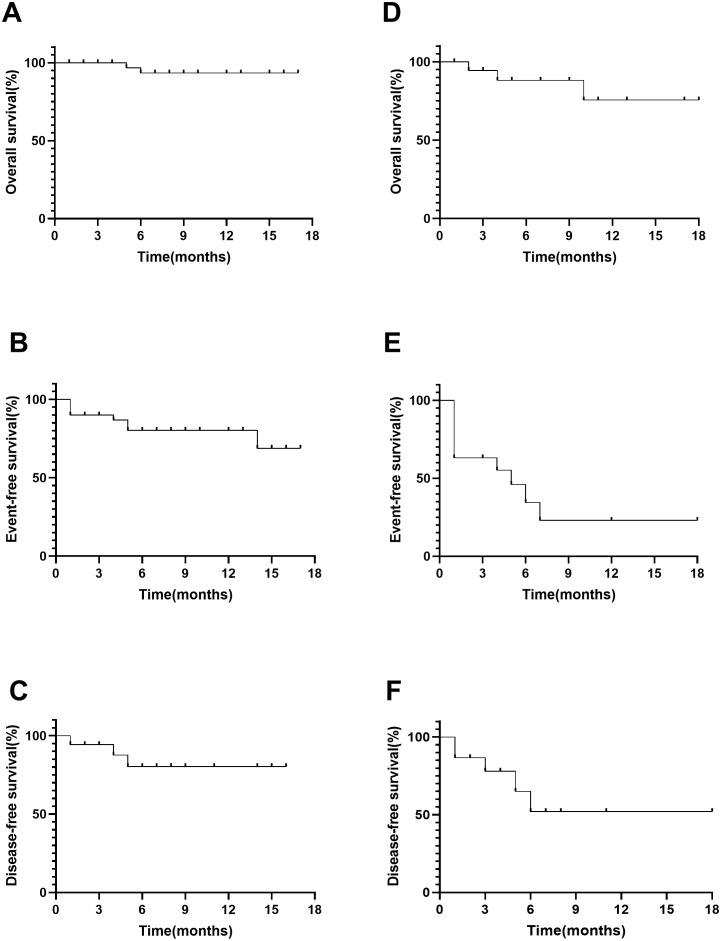
A total of 59 patients participated in the study, including 40 patients with Ph ALL and 19 with CML-BP. Among them, 36 (61.0%) were men, and 23 (39.0%) were women. The median age was 39 years (interquartile range [IQR], 30-48), and the median follow-up duration was 7.8 months (IQR, 4.1-11.3). A total of 16 (27.1%) and 11 patients (18.6%) had received treatment with two and ≥ 3 prior TKIs, respectively. Additionally, 19 patients (33.9%) had been treated with ponatinib. In a cohort of 19 CML patients, 12 (63.2%) achieved CR/CRi by day 28. Five (26.3%) achieved a complete cytogenetic response with a median duration of 2.9 months, and two (10.5%) achieved a major molecular response with a median duration of 5.5 months. Among 40 evaluated ALL patients, 37 (92.5%) achieved CR/CRi by day 28, 30 (75.0%) attained MRD negativity, and 22 (55.0%) achieved CMR. The probabilities of DFS, EFS, and OS at 12 months were 80.3% (95% confidence interval [CI]: 61.0%-90.7%), 80.2% (95% CI: 61.0%-90.7%), and 93.3% (95% CI: 75.8%-98.3%) for patients with R/R Ph ALL, compared to 52.0% (95% CI: 17.7%-78.0%), 23.0% (95%CI, 4.2%-50.6%), and 75.6% (95% CI: 37.7%-92.3%) for those with CML-BP. The prevalent treatment-related nonhematologic adverse events, primarily classified as grade 1/2, included skin hyperpigmentation, proteinuria, increased liver enzyme levels, and hypertriglyceridemia.
CONCLUSIONS
Olverembatinib-based therapy demonstrated significant efficacy and manageable toxicity in patients with advanced Ph leukemia.
背景
复发或难治性费城染色体阳性急性淋巴细胞白血病(R/R Ph ALL)和急变期慢性髓性白血病(CML-BP)的预后较差。奥雷巴替尼(HQP1351)是一种新型第三代酪氨酸激酶抑制剂(TKI),在针对几乎所有BCR-ABL1激酶突变的临床试验中显示出有前景的疗效和安全性,包括……
方法
收集并分析数据,以评估基于奥雷巴替尼的疗法对晚期Ph白血病的疗效和安全性。主要结局是28天时的总缓解率。次要结局包括总生存期(OS)、无事件生存期(EFS)、无病生存期(DFS)、接受异基因造血干细胞移植(allo-HSCT)的患者比例以及不良事件。
结果
共有59例患者参与研究,其中40例为Ph ALL患者,19例为CML-BP患者。其中,男性36例(61.0%),女性23例(39.0%)。中位年龄为39岁(四分位间距[IQR],30 - 48岁),中位随访时间为7.8个月(IQR,4.1 - 11.3个月)。共有16例(27.1%)和11例患者(18.6%)分别接受过两种及≥3种既往TKI治疗。此外,19例患者(33.9%)接受过波纳替尼治疗。在19例CML患者队列中,12例(63.2%)在第28天时达到完全缓解(CR)/血细胞计数不完全恢复的完全缓解(CRi)。5例(26.3%)达到完全细胞遗传学缓解,中位持续时间为2.9个月,2例(10.5%)达到主要分子学缓解,中位持续时间为5.5个月。在40例评估的ALL患者中,37例(92.5%)在第28天时达到CR/CRi,30例(75.0%)实现微小残留病(MRD)阴性,22例(55.0%)达到完全分子学缓解(CMR)。R/R Ph ALL患者12个月时的DFS、EFS和OS概率分别为80.3%(95%置信区间[CI]:61.0% - 90.7%)、80.2%(95% CI:61.0% - 9j0.7%)和93.3%(95% CI:75.8% - 98.3%),而CML-BP患者分别为52.0%(95% CI:17.7% - 78.0%)、23.0%(95% CI:4.2% - 50.6%)和75.6%(95% CI:37.7% -92.3%)。常见的治疗相关非血液学不良事件主要分类为1/2级,包括皮肤色素沉着、蛋白尿、肝酶水平升高和高甘油三酯血症。
结论
基于奥雷巴替尼的疗法在晚期Ph白血病患者中显示出显著疗效且毒性可控。
 Zotero 插件