
缺氧诱导因子-1α通过调控秀丽白虾的糖酵解来调节肌肉生长和蜕皮过程。
Hypoxia-inducible factor-1 alpha modulates muscle growth and the molting process through its regulation of glycolysis in Neocaridina davidi.
作者信息
Li Ran, Hu Lezhen, Zhou Runlin, Zhou Jialu, Yang Jiale, Wang Moran, Sun Jinsheng
机构信息
Tianjin Key Laboratory of Animal and Plant Resistance, College of Life Science, Tianjin Normal University, Tianjin, China.
College of Fishery, Tianjin Agricultural University, Tianjin, China.
出版信息
J Biol Chem. 2025 May 27;301(7):110298. doi: 10.1016/j.jbc.2025.110298.
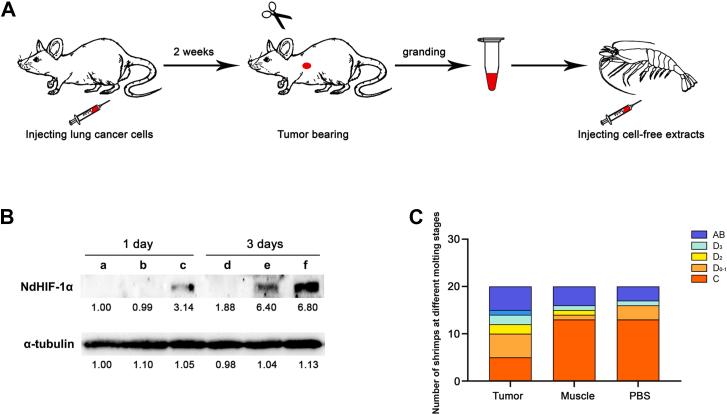
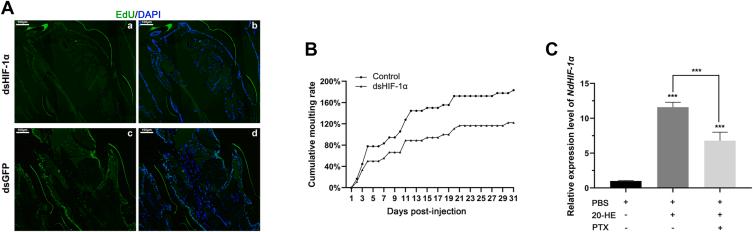
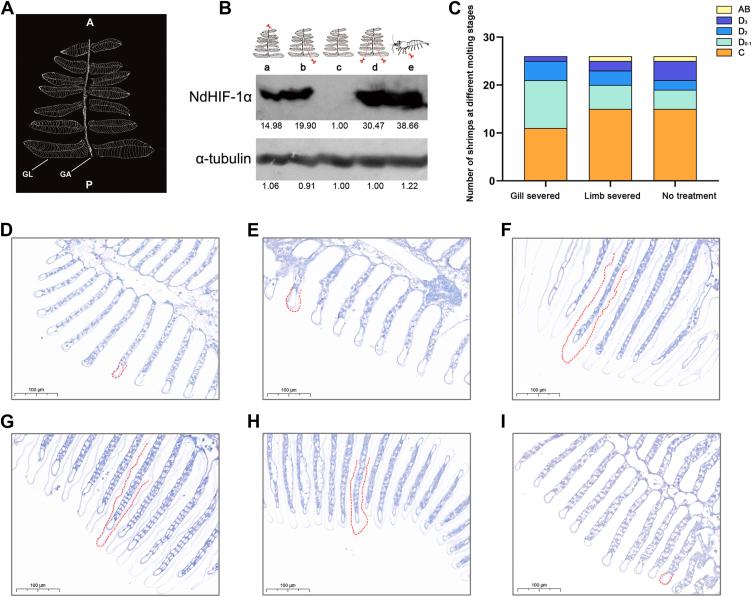
Molting is a characteristic feature of crustaceans, closely associated with their growth. Following the molting process, crustaceans experience an explosive increase in muscle mass; however, the specific mechanisms underlying this rapid growth remain to be fully elucidated. This study aims to analyze the mechanisms of accelerated muscle proliferation from the perspective of sugar metabolism. The relationship between glycolysis and HIF-1α expression in shrimp muscle during different molting stages was investigated, revealing decreased glucose levels and elevated lactate concentrations in the D0-1 subphase. These findings suggest a Warburg-like effect occurring during pre-molting. Notably, HIF-1α expression was consistently higher in the D0-1, D2, and D3 subphases compared to other stages, indicating its pivotal role in muscle cell proliferation and molting regulation. Knockdown of HIF-1α significantly reduced the expression of glycolytic enzymes and inhibited both muscle growth and molting processes. Additionally, this study explored the effects of gill removal on HIF-1α expression; it was found that mechanical injury increased HIF levels, potentially mimicking hypoxic conditions. Specifically, tumor cell-free extracts were observed to enhance the molting rate, likely linked to upregulation of HIF expression. These results imply that such extracts may create a favorable environment for molting by influencing physiological mechanisms associated with HIF activity, thereby facilitating the molting process in shrimp. Overall, these findings suggest a complex interplay between glycolysis, HIF expression, and physiological processes during shrimp molting while highlighting the potential role of HIF as a regulator within these metabolic pathways.
蜕皮是甲壳类动物的一个特征,与它们的生长密切相关。在蜕皮过程之后,甲壳类动物的肌肉质量会出现爆发式增长;然而,这种快速生长背后的具体机制仍有待充分阐明。本研究旨在从糖代谢的角度分析肌肉加速增殖的机制。研究了对虾肌肉在不同蜕皮阶段糖酵解与HIF-1α表达之间的关系,结果显示在D0-1亚阶段葡萄糖水平降低而乳酸浓度升高。这些发现表明在蜕皮前出现了类似瓦伯格效应的现象。值得注意的是,与其他阶段相比,HIF-1α在D0-1、D2和D3亚阶段的表达始终较高,表明其在肌肉细胞增殖和蜕皮调节中起关键作用。敲低HIF-1α会显著降低糖酵解酶的表达,并抑制肌肉生长和蜕皮过程。此外,本研究还探讨了切除鳃对HIF-1α表达的影响;发现机械损伤会增加HIF水平,可能类似于缺氧状态。具体而言,观察到无肿瘤细胞提取物可提高蜕皮率,这可能与HIF表达上调有关。这些结果意味着此类提取物可能通过影响与HIF活性相关的生理机制为蜕皮创造有利环境,从而促进对虾的蜕皮过程。总体而言,这些发现表明对虾蜕皮过程中糖酵解、HIF表达和生理过程之间存在复杂的相互作用,同时突出了HIF作为这些代谢途径中调节因子的潜在作用。



 Zotero 插件