
度普利尤单抗、曲罗芦单抗和乌帕替尼在特应性皮炎患者中的真实世界有效性和安全性:一项为期52周的国际多中心回顾性队列研究。
Real-World Effectiveness and Safety of Dupilumab, Tralokinumab, and Upadacitinib in Patients with Atopic Dermatitis: A 52-Week International, Multicenter Retrospective Cohort Study.
作者信息
Torres Tiago, Yeung Jensen, Prajapati Vimal H, Ribero Simone, Balato Anna, Marzano Angelo Valerio, Cruz Maria João, Paiva Lopes Maria João, Lazaridou Elizabeth, Carrascosa Jose-Manuel, Alvarenga José Miguel, Farinha Pedro, Duarte Bruno, Munera-Campos Monica, Sood Siddhartha, Rankin Brian D, Ortoncelli Michela, Caccavale Stefano, Ferrucci Silvia Mariel, Pires Rosa Gilberto, Daponte Athina Ioanna, Silvi Gianmarco, Peris Ketty, Gori Niccolò, Prignano Francesca, Kolios Antonio, Herranz Pedro, Gregoriou Stamatios, Rompoti Natalia, Gkalpakiotis Spyridon, Chiricozzi Andrea
机构信息
Department of Dermatology, Centro Hospitalar Universitário de Santo António Porto, Rua de Dom Manuel II 57, 4050-342, Porto, Portugal.
Instituto de Ciências Biomédicas Abel Salazar, University of Porto, Porto, Portugal.
出版信息
Dermatol Ther (Heidelb). 2025 Aug;15(8):2295-2305. doi: 10.1007/s13555-025-01453-8. Epub 2025 Jun 3.
INTRODUCTION
Evaluating the real-world effectiveness, safety, and tolerability of targeted biologic and non-biologic therapies in patients with atopic dermatitis (AD) treated in routine clinical practice remains crucial. In this international, multicenter, retrospective, comparative study we aimed to evaluate the 52-week effectiveness, safety, and tolerability of dupilumab, tralokinumab, and upadacitinib in patients with AD aged ≥ 12 years.
METHODS
Effectiveness was assessed at weeks 16, 24, and 52 using Eczema Area and Severity Index (EASI) and itch Numerical Rating Scale (NRS) scores. Safety was measured via adverse events (AEs).
RESULTS
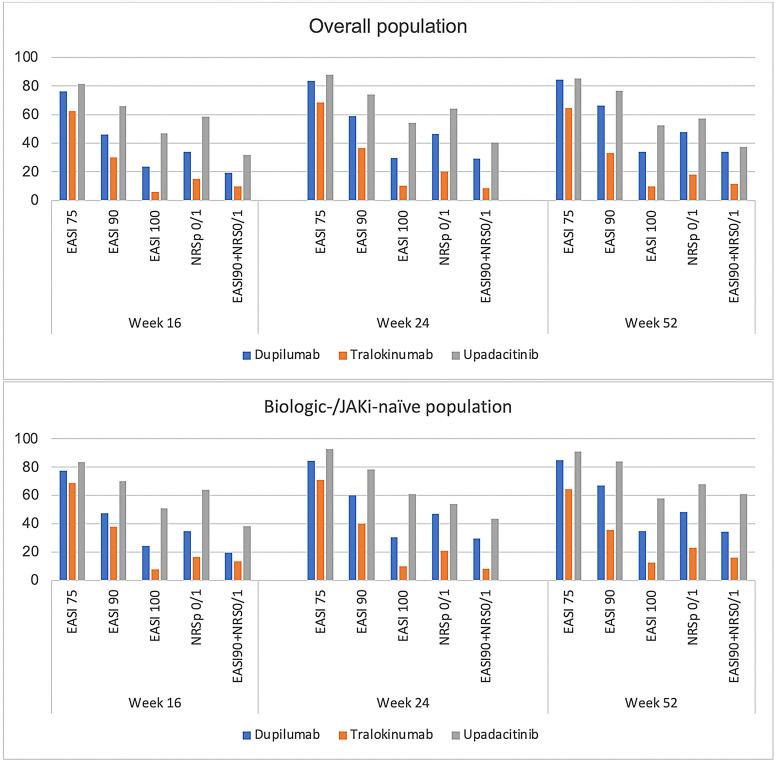
A total of 1286 treatment courses were included: 62.5% received dupilumab, 24.3% received upadacitinib, and 13.1% received tralokinumab. Upadacitinib demonstrated higher effectiveness than dupilumab and tralokinumab across all time points and most evaluated outcomes both on the overall population and the biologic-/JAKi-naïve population, including stringent treatment targets such as EASI 90 response and combined EASI 90 + itch NRS 0/1 response. While upadacitinib demonstrated superior effectiveness, it was associated with a higher incidence of AEs, both leading to and not leading to treatment discontinuation, including thromboembolic events, lipid abnormalities, and hematologic abnormalities. In contrast, conjunctivitis was the most frequently observed AE among patients receiving biologics.
CONCLUSION
This study provides a comprehensive real-world comparison of dupilumab, tralokinumab, and upadacitinib in AD, highlighting upadacitinib's superior effectiveness in achieving stringent treatment targets, both in the short and long term, but also a higher incidence of AEs. However, the considerable heterogeneity of the study population, an inherent limitation of real-world studies, must be acknowledged when interpreting these findings.
引言
评估在常规临床实践中接受治疗的特应性皮炎(AD)患者中,靶向生物疗法和非生物疗法的真实世界有效性、安全性和耐受性仍然至关重要。在这项国际多中心回顾性比较研究中,我们旨在评估度普利尤单抗、曲罗芦单抗和乌帕替尼在≥12岁AD患者中的52周有效性、安全性和耐受性。
方法
在第16、24和52周使用湿疹面积和严重程度指数(EASI)和瘙痒数字评定量表(NRS)评分评估有效性。通过不良事件(AE)衡量安全性。
结果
共纳入1286个治疗疗程:62.5%接受度普利尤单抗,24.3%接受乌帕替尼,13.1%接受曲罗芦单抗。在所有时间点以及总体人群和初治生物制剂/JAK抑制剂人群的大多数评估结局方面,乌帕替尼均显示出比度普利尤单抗和曲罗芦单抗更高的有效性,包括严格的治疗目标,如EASI 90反应和联合EASI 90+瘙痒NRS 0/1反应。虽然乌帕替尼显示出卓越的有效性,但它与导致和未导致治疗中断的AE发生率较高相关,包括血栓栓塞事件、脂质异常和血液学异常。相比之下,结膜炎是接受生物制剂治疗患者中最常观察到的AE。
结论
本研究对度普利尤单抗、曲罗芦单抗和乌帕替尼在AD中的应用进行了全面的真实世界比较,突出了乌帕替尼在实现严格治疗目标方面的卓越有效性,无论短期还是长期,但AE发生率也更高。然而,在解释这些结果时,必须承认研究人群存在相当大的异质性,这是真实世界研究固有的局限性。
 Zotero 插件