
供体来源的微生物植入及与粪便微生物群移植后体重减轻相关的肠道微生物群变化
Donor-derived microbial engraftment and gut microbiota shifts associated with weight loss following fecal microbiota transplantation.
作者信息
Ruan Yuting, Zhu Tongxi, Yang Rui, Su Fugui, An Chiying, Hu Zhuping, Li Xiaoli, Li Yue, Chen Peizhao, Shao Xueni, Qin Junjie, Chen Hong, Chen Rongping
机构信息
Department of Endocrinology and Metabolism, Zhujiang Hospital, Southern Medical University, Guangzhou, China.
Southern Medical University, Guangzhou, China.
出版信息
Appl Environ Microbiol. 2025 Jul 23;91(7):e0012025. doi: 10.1128/aem.00120-25. Epub 2025 Jun 4.
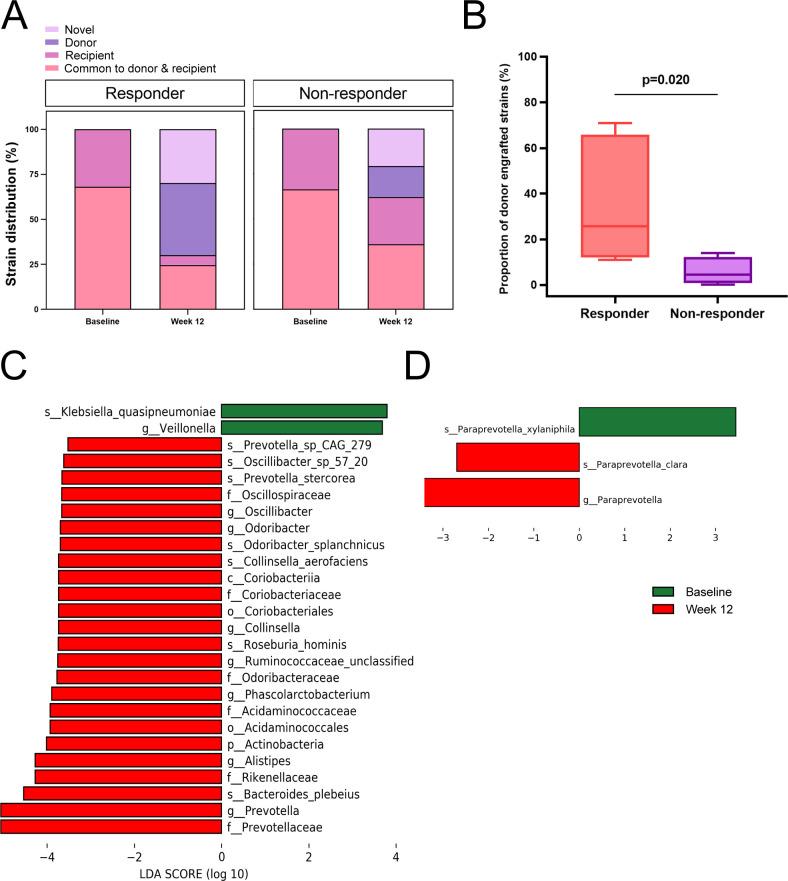
Fecal microbiota transplantation (FMT) is a promising treatment for microbiota dysbiosis and may provide metabolic benefits for obesity. However, its mechanisms and variability in clinical outcomes remain poorly understood. This 12-week multicenter, single-arm study evaluated the efficacy of FMT for weight loss and explored the role of donor-derived microbial engraftment and functional shifts in mediating weight loss among overweight and obese individuals. Twenty-three participants (body mass index ≥24 kg/m²) without diabetes received three biweekly FMT sessions via a nasojejunal tube. Fecal samples from participants and donors were analyzed using metagenomic sequencing. By week 12, 52% of participants were classified as responders, achieving significant weight loss of ≥5% from baseline, with an average weight loss of 7.98 ± 2.69 kg ( < 0.001). In contrast, non-responders lost 2.90 ± 1.89 kg ( < 0.001). Responders exhibited a significantly higher proportion of donor-derived microbial strains post-FMT compared to non-responders (37.8% vs 15.2%, = 0.020). Notably, key taxa, including ( = 0.034) and ( = 0.012), increased significantly in abundance in responders post-FMT, indicating successful microbial engraftment as a critical determinant of therapeutic success. These findings suggest that FMT is a viable intervention for weight loss in obese individuals. Successful donor-derived microbial engraftment strongly correlates with weight loss efficacy, highlighting the potential of microbiota-targeted therapies in obesity management and providing insights into the mechanisms underlying FMT outcomes.IMPORTANCEPrior research indicates that fecal microbiota transplantation (FMT) is a promising treatment for diseases related to microbiota imbalance, potentially providing metabolic benefits for obesity. However, the specific role of donor-derived microbial engraftment in driving clinical efficacy has remained unclear. In this study, we evaluated the efficacy of FMT in promoting weight loss and explored the role of donor-derived bacterial strains in this process. Our findings demonstrate that the successful engraftment of specific donor-derived taxa, such as and , is strongly associated with significant weight loss. This highlights the critical interplay between donor microbiota and recipient gut environment. These findings underscore the potential of microbiota-targeted therapies as a novel strategy for obesity management.CLINICAL TRIALSThis study is registered with the Chinese Clinical Trial Registry as ChiCTR1900024760.
粪便微生物群移植(FMT)是一种治疗微生物群失调的有前景的疗法,可能为肥胖症带来代谢益处。然而,其机制以及临床结果的变异性仍知之甚少。这项为期12周的多中心单臂研究评估了FMT对体重减轻的疗效,并探讨了供体来源的微生物植入和功能转变在超重和肥胖个体体重减轻中的作用。23名无糖尿病的参与者(体重指数≥24kg/m²)通过鼻空肠管接受了每两周一次的三次FMT治疗。使用宏基因组测序分析参与者和供体的粪便样本。到第12周时,52%的参与者被归类为有反应者,自基线体重显著减轻≥5%,平均体重减轻7.98±2.69kg(P<0.001)。相比之下,无反应者体重减轻2.90±1.89kg(P<0.001)。与无反应者相比,有反应者在FMT后供体来源的微生物菌株比例显著更高(37.8%对15.2%,P=0.020)。值得注意的是,包括双歧杆菌属(P=0.034)和粪杆菌属(P=0.012)在内的关键分类群在FMT后有反应者中的丰度显著增加,表明成功的微生物植入是治疗成功的关键决定因素。这些发现表明FMT是肥胖个体体重减轻的一种可行干预措施。供体来源的微生物成功植入与体重减轻疗效密切相关,突出了微生物群靶向疗法在肥胖管理中的潜力,并为FMT结果的潜在机制提供了见解。重要性先前的研究表明,粪便微生物群移植(FMT)是一种治疗与微生物群失衡相关疾病的有前景的疗法,可能为肥胖症带来代谢益处。然而,供体来源的微生物植入在推动临床疗效方面的具体作用仍不清楚。在本研究中,我们评估了FMT促进体重减轻的疗效,并探讨了供体来源的细菌菌株在此过程中的作用。我们的研究结果表明,特定供体来源的分类群如双歧杆菌属和粪杆菌属的成功植入与显著的体重减轻密切相关。这突出了供体微生物群与受体肠道环境之间的关键相互作用。这些发现强调了微生物群靶向疗法作为肥胖管理新策略的潜力。临床试验本研究已在中国临床试验注册中心注册,注册号为ChiCTR1900024760。


 Zotero 插件