
小细胞肺癌患者的端粒长度与氧化应激:与健康对照相比化疗周期中的变化
Telomere length and oxidative stress in small cell lung cancer patients: changes through chemotherapy cycles compared to healthy controls.
作者信息
Guzonjić Azra, Jovanović Dragana, Simić Ivana, Ćeriman Krstić Vesna, Samardzić Natalija, Ostanek Barbara, Marc Janja, Sopić Miron, Kotur Stevuljević Jelena
机构信息
Department for Medical Biochemistry, Faculty of Pharmacy, University of Belgrade, Belgrade, Serbia.
Internal Medicine Clinic "Akta Medica", Belgrade, Serbia.
出版信息
Biochem Med (Zagreb). 2025 Jun 15;35(2):020705. doi: 10.11613/BM.2025.020705. Epub 2025 Apr 15.
INTRODUCTION
Small cell lung cancer (SCLC) is an aggressive malignant disease with poor survival outcomes. The aim of this study was to investigate leukocyte telomere length (LTL) and redox status parameters during chemotherapy and evaluate their prognostic potential based on the hypothesis that shorter LTL and oxidative stress burden correlate with poorer survival.
MATERIALS AND METHODS
This longitudinal study included 60 SCLC patients and 73 healthy controls. Leukocyte telomere length was measured by quantitative PCR (qPCR) method, while redox status parameters (MDA - malondialdehyde, IMA - ischemia-modified albumin, PON1 - paraoxonase 1, redox index) were determined by spectrophotometric methods before, after two and after four cycles of chemotherapy.
RESULTS
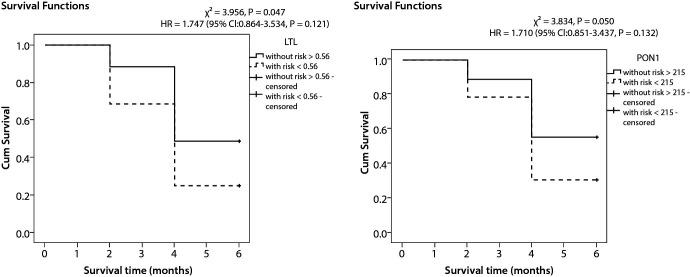
All measured parameters showed significant differences between patients and controls, except the oxy-score (P < 0.001). Significant differences in IMA, PON1 and redox index were observed between SCLC patient groups at different time points (P < 0.001). Significant differences in IMA and PON1 were observed between SCLC survival groups, with higher values found in survivors after two chemotherapy cycles (P < 0.001). Redox index was the highest in the pre-chemo group (P = 0.019). Among patients who died, PON1 activity differed significantly between those who died within 2 months and after 4 months (P = 0.028). Kaplan-Meier analysis showed that LTL and PON1 were significant predictors of survival, with values below the 25th percentile associated with a higher risk of death.
CONCLUSIONS
Leukocyte telomere length and PON1 are potential prognostic biomarkers for SCLC survival, suggesting their potential use in non-invasive biomarker panels for improved patient stratification.
引言
小细胞肺癌(SCLC)是一种侵袭性恶性疾病,生存结果较差。本研究的目的是调查化疗期间的白细胞端粒长度(LTL)和氧化还原状态参数,并基于较短的LTL和氧化应激负担与较差的生存率相关这一假设,评估它们的预后潜力。
材料与方法
这项纵向研究纳入了60例SCLC患者和73名健康对照。采用定量PCR(qPCR)方法测量白细胞端粒长度,而氧化还原状态参数(丙二醛-MDA、缺血修饰白蛋白-IMA、对氧磷酶1-PON1、氧化还原指数)在化疗两个周期后和四个周期后通过分光光度法测定。
结果
除氧评分外,所有测量参数在患者和对照之间均显示出显著差异(P<0.001)。在不同时间点的SCLC患者组之间观察到IMA、PON1和氧化还原指数存在显著差异(P<0.001)。在SCLC生存组之间观察到IMA和PON1存在显著差异,在两个化疗周期后的幸存者中发现其值较高(P<0.001)。氧化还原指数在化疗前组中最高(P=0.019)。在死亡患者中,在2个月内死亡和4个月后死亡的患者之间PON1活性存在显著差异(P=0.028)。Kaplan-Meier分析表明,LTL和PON1是生存的显著预测指标,低于第25百分位数的值与较高的死亡风险相关。
结论
白细胞端粒长度和PON1是SCLC生存的潜在预后生物标志物,表明它们在非侵入性生物标志物组中用于改善患者分层的潜在用途。
 Zotero 插件