
血流感染患者中万古霉素耐药的危险因素:慕尼黑多中心肠球菌队列分析
Risk factors for vancomycin resistance in patients with bloodstream infections: an analysis of the Munich Multicentric Enterococci Cohort.
作者信息
Wagner Laura, Wurst Milena, Erber Johanna, Bachfischer Tobias, Haller Bernhard, Gleich Sabine, Dichtl Karl, Schmid Roland M, Triebelhorn Julian, Voit Florian, Seybold Ulrich, Busch Dirk H, Rämer Patrick C, Spinner Christoph D, Schneider Jochen, Rothe Kathrin
机构信息
Department of Internal Medicine II, TUM School of Medicine and Health, TUM University Hospital, Technical University of Munich, Munich, Germany.
German Centre for Infection Research (DZIF), partner site Munich, Munich, Germany.
出版信息
Microbiol Spectr. 2025 Jul;13(7):e0005225. doi: 10.1128/spectrum.00052-25. Epub 2025 Jun 5.
UNLABELLED
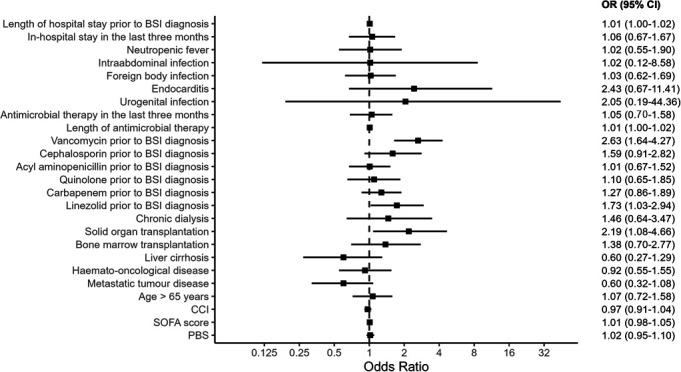
is difficult to treat owing to its intrinsic and acquired resistance to antibiotics, particularly vancomycin. Vancomycin-resistant is an important cause of bloodstream infections in healthcare settings with limited treatment options. This study aimed to analyze the risk factors for vancomycin-resistant bloodstream infection. This retrospective analysis of data from the Munich Multicentric Enterococci Cohort analyzed 200 episodes of nonrecurrent vancomycin-susceptible bloodstream infection and 196 episodes of nonrecurrent vancomycin-resistant bloodstream infection from six hospitals in Munich, Germany, between 2010 and 2019. Logistic regression was used to identify risk factors for vancomycin-resistant bloodstream infection. In the unadjusted analysis, the risk factors for vancomycin-resistant bloodstream infection included the length of hospital stay, previous treatment with vancomycin or linezolid, and solid organ transplantation. In the multivariable analysis, prior treatment with vancomycin and solid organ transplantation were independent risk factors for vancomycin-resistant bloodstream infection. Vancomycin resistance was not significantly associated with the severity of underlying diseases. This study identified prior vancomycin treatment and solid organ transplantation as key independent risk factors for vancomycin-resistant bloodstream infection.
IMPORTANCE
Vancomycin-resistant is a growing threat in healthcare settings, challenging the management of enterococcal infections. This study identified prior treatment with vancomycin and solid organ transplantation as risk factors for vancomycin-resistant bloodstream infections. Based on the analysis of five disease severity scores for acute and chronic illness, the severity of underlying diseases could not be demonstrated to be a risk factor for the occurrence of vancomycin resistance in bloodstream infections.
未标注
由于其对抗生素,尤其是万古霉素的固有和获得性耐药性,[具体细菌名称]难以治疗。耐万古霉素[具体细菌名称]是医疗环境中血流感染的一个重要原因,且治疗选择有限。本研究旨在分析耐万古霉素[具体细菌名称]血流感染的危险因素。这项对慕尼黑多中心肠球菌队列数据的回顾性分析,分析了2010年至2019年间德国慕尼黑六家医院的200例非复发性万古霉素敏感[具体细菌名称]血流感染病例和196例非复发性耐万古霉素[具体细菌名称]血流感染病例。采用逻辑回归来确定耐万古霉素[具体细菌名称]血流感染的危险因素。在未调整分析中,耐万古霉素[具体细菌名称]血流感染的危险因素包括住院时间、先前使用万古霉素或利奈唑胺治疗以及实体器官移植。在多变量分析中,先前使用万古霉素治疗和实体器官移植是耐万古霉素[具体细菌名称]血流感染的独立危险因素。万古霉素耐药性与基础疾病的严重程度无显著相关性。本研究确定先前使用万古霉素治疗和实体器官移植是耐万古霉素[具体细菌名称]血流感染的关键独立危险因素。
重要性
耐万古霉素[具体细菌名称]在医疗环境中构成的威胁日益增加,对肠球菌感染的管理提出了挑战。本研究确定先前使用万古霉素治疗和实体器官移植是耐万古霉素[具体细菌名称]血流感染的危险因素。基于对急性和慢性疾病的五种疾病严重程度评分的分析,基础疾病的严重程度未被证明是[具体细菌名称]血流感染中发生万古霉素耐药性的危险因素。


 Zotero 插件