
调查新冠疫情期间情绪体验与行为反应之间的关系:一项横断面调查。
Investigating the relationships between emotional experiences and behavioral responses amid the Covid-19 pandemic: A cross-sectional survey.
作者信息
Wang Tingting, Zheng Xin, Niu Zhaomeng, Hu Pengwei, Dong Ruiqi, Tang Zhihan
机构信息
School of Business Guangdong University of Foreign Studies Guangzhou Guangdong China.
School of Business Sun Yat-Sen University Guangzhou Guangdong China.
出版信息
Health Care Sci. 2022 Sep 6;2(1):25-35. doi: 10.1002/hcs2.13. eCollection 2023 Feb.
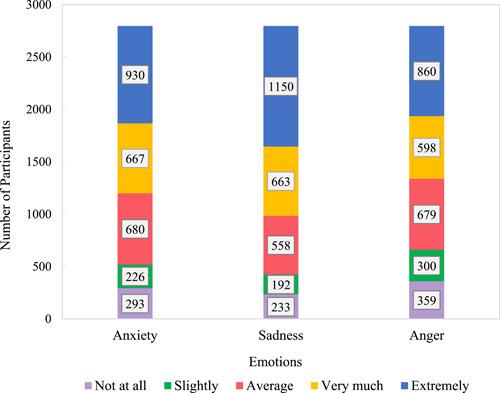
The Covid-19 pandemic produced a complex combination of intense negative emotions among the general public, influencing people's coping reactions toward the pandemic. Yet each discrete emotion may affect people's behaviors in different ways. Unveiling the specific emotion-behavior relationships can provide valuable implications for designing effective intervention programs. Through the lens of the appraisal theory of emotion, we assessed the relationships between negative emotions and pandemic-related behaviors among the Chinese population midst the early outbreak of the pandemic. An anonymous online survey was distributed to mainland Chinese participants ( = 2976), which assessed individuals' emotional states and behavioral reactions to the pandemic. Consistent with the differential appraisal theme underlying each negative emotion as delineated by the appraisal theory, mixed relationships between emotions and pandemic-related behaviors were revealed. Specifically, anxiety was positively associated with behaviors of seeking pandemic-related information, sharing such information, and stockpiling preventive goods, yet, contrary to prediction, anxious people were reluctant to adopt preventive measures, which is maladaptive. Sad people sought information less frequently and exhibited lower intention to stockpile preventive goods; but, opposing prediction, they shared information less frequently. Angry people were more active in sharing information and in stockpiling preventive goods. These findings suggest that public health practitioners can utilize the emotion-behavior relationships to identify the vulnerable individuals who tend to adopt maladaptive coping behaviors, help them address emotional distress, and encourage their adoption of effective coping behaviors.
新冠疫情在普通公众中引发了一系列强烈负面情绪的复杂组合,影响着人们应对疫情的反应。然而,每一种离散情绪可能以不同方式影响人们的行为。揭示特定的情绪与行为之间的关系,可为设计有效的干预方案提供有价值的启示。通过情绪评估理论的视角,我们评估了在疫情早期爆发期间中国人群中负面情绪与疫情相关行为之间的关系。我们向中国大陆参与者(n = 2976)开展了一项匿名在线调查,该调查评估了个体对疫情的情绪状态和行为反应。与评估理论所描绘的每种负面情绪背后的差异评估主题一致,研究揭示了情绪与疫情相关行为之间的复杂关系。具体而言,焦虑与寻求疫情相关信息、分享此类信息以及囤积预防用品的行为呈正相关,但与预测相反,焦虑的人不愿意采取预防措施,这是适应不良的表现。悲伤的人较少寻求信息,囤积预防用品的意愿也较低;但与预测相反,他们较少分享信息。愤怒的人在分享信息和囤积预防用品方面更为积极。这些发现表明,公共卫生从业者可以利用情绪与行为之间的关系,识别那些倾向于采取适应不良应对行为的脆弱个体,帮助他们解决情绪困扰,并鼓励他们采取有效的应对行为。

 Zotero 插件