
金纳米团簇性质的分子工程——肽配体电荷状态与拓扑结构调控
Molecular engineering of gold nanocluster properties peptide ligand charge state and topological modulation.
作者信息
Toomjeen Pakawat, Srikulwong Unnop, Chuaephon Adulvit, Phanchai Witthawat, Choodet Cherdpong, Puangmali Theerapong
机构信息
Department of Physics, Faculty of Science, Khon Kaen University Khon Kaen 40002 Thailand
出版信息
Nanoscale Adv. 2025 May 26. doi: 10.1039/d5na00324e.
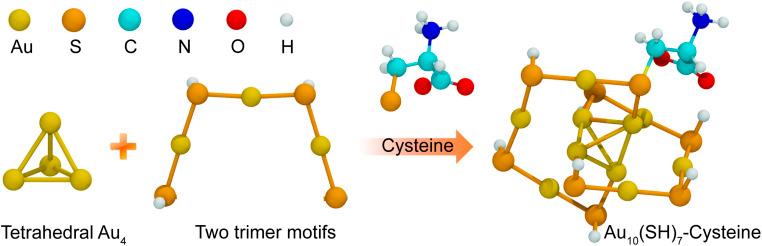
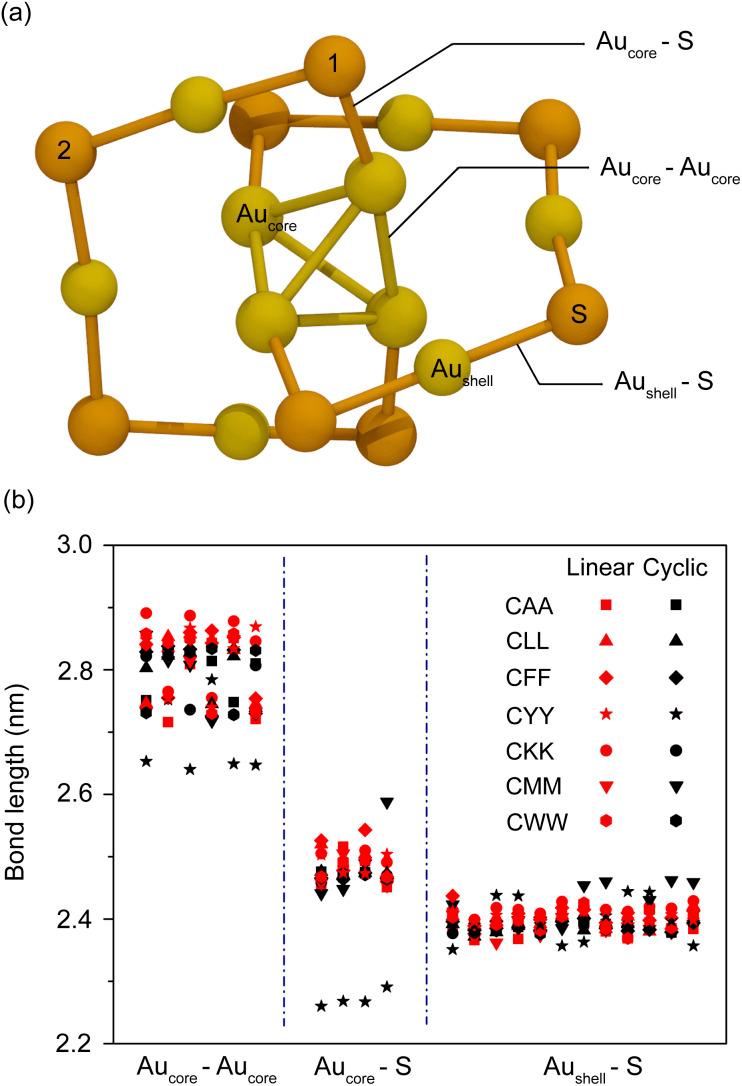
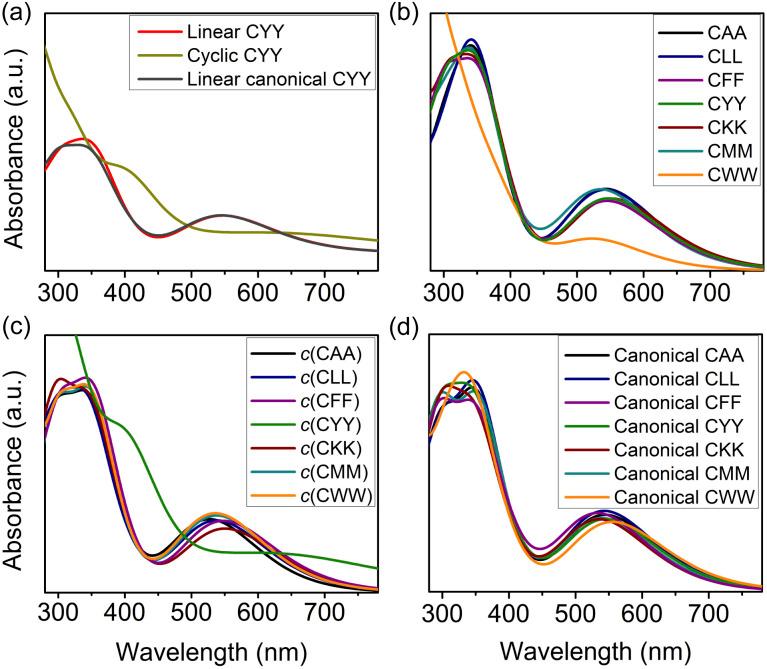
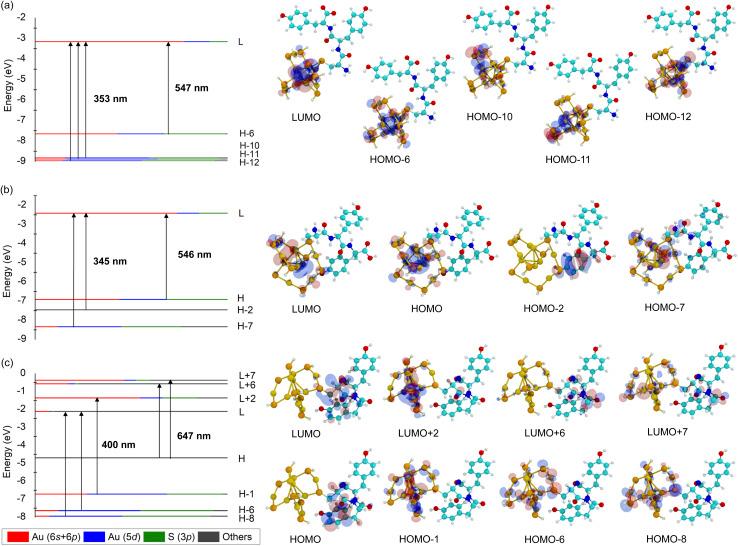
The functionalization of gold nanoclusters (AuNCs) with peptides offers a promising strategy for tuning their electronic and optical properties, making them suitable for applications in bioimaging, sensing, and photodynamic therapy. However, the influence of peptide structure, charge state, and length on ligand-to-metal charge transfer (LMCT) and electronic transitions is not yet fully comprehended. In this study, we employ density functional theory (DFT) calculations to systematically investigate the role of linear and cyclic peptides in modulating the optical and electronic properties of AuNCs. In addition, interfragment charge transfer (IFCT) analysis is performed to quantify the charge redistribution between the peptide ligands and the AuNC core. Our findings reveal that zwitterionic peptides exhibit the most significant LMCT, leading to red-shifted absorption peaks and enhanced charge delocalization, while canonical and cyclic peptides display more localized electronic states with reduced charge transfer. Moreover, longer peptide chains, particularly in zwitterionic forms, facilitate increased electronic coupling with the AuNC core, amplifying their optical response. Despite variations in the peptide structure, the AuNC core remains structurally stable, ensuring consistent ligand-core electronic interactions. The IFCT results further confirm that peptide length and structural forms strongly influence charge transfer dynamics, with tetrapeptides exhibiting greater charge redistribution compared to tripeptides. These insights provide a fundamental foundation for the rational design of peptide-functionalized AuNCs with tailored optical and electronic properties. The ability to fine-tune the peptide structure to optimize charge transfer makes these nanoclusters highly promising for biomedical applications, including fluorescence imaging, targeted drug delivery, and molecular sensing. This study advances our understanding of the interactions between peptides and AuNCs and provides the basis for future experimental validation and application-driven modifications.
用肽对金纳米团簇(AuNCs)进行功能化修饰为调节其电子和光学性质提供了一种很有前景的策略,使其适用于生物成像、传感和光动力治疗等应用。然而,肽的结构、电荷状态和长度对配体到金属电荷转移(LMCT)和电子跃迁的影响尚未完全理解。在本研究中,我们采用密度泛函理论(DFT)计算系统地研究线性和环状肽在调节AuNCs光学和电子性质中的作用。此外,进行了片段间电荷转移(IFCT)分析以量化肽配体和AuNCs核心之间的电荷重新分布。我们的研究结果表明,两性离子肽表现出最显著的LMCT,导致吸收峰红移和电荷离域增强,而典型肽和环状肽表现出更多局域化的电子态,电荷转移减少。此外,更长的肽链,特别是两性离子形式的肽链,有助于增强与AuNCs核心的电子耦合,放大其光学响应。尽管肽结构存在差异,但AuNCs核心在结构上保持稳定,确保了配体 - 核心电子相互作用的一致性。IFCT结果进一步证实,肽的长度和结构形式强烈影响电荷转移动力学,与三肽相比,四肽表现出更大的电荷重新分布。这些见解为合理设计具有定制光学和电子性质的肽功能化AuNCs提供了基础。通过微调肽结构来优化电荷转移的能力使这些纳米团簇在生物医学应用中极具前景,包括荧光成像、靶向药物递送和分子传感。本研究推进了我们对肽与AuNCs之间相互作用的理解,并为未来的实验验证和应用驱动的修饰提供了基础。





 Zotero 插件