
动态屏障:疟原虫封闭有丝分裂期间核膜的重塑
A dynamic barrier: remodeling of the nuclear envelope during closed mitosis in malaria parasites.
作者信息
Absalon Sabrina
机构信息
Department of Pharmacology and Toxicology, Indiana University School of Medicine, Indianapolis, Indiana, USA.
出版信息
mSphere. 2025 Jul 29;10(7):e0099924. doi: 10.1128/msphere.00999-24. Epub 2025 Jun 9.
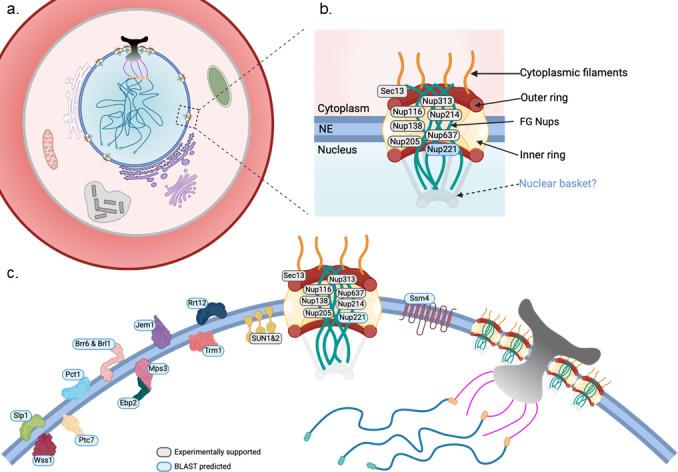
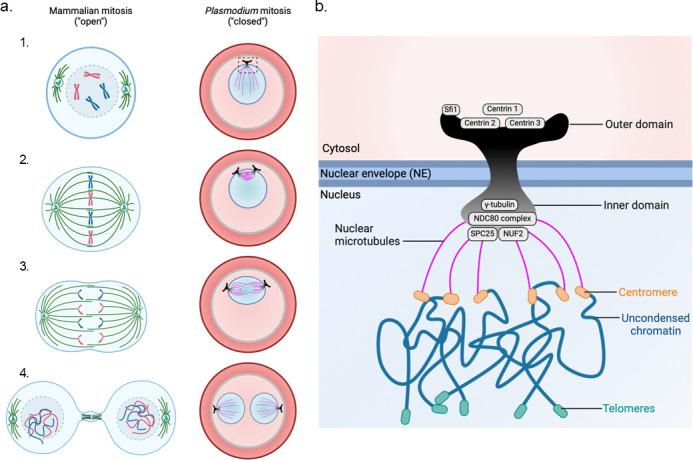
, the protozoan parasite responsible for the most severe form of human malaria, replicates through an unconventional mode of closed mitosis, where the nuclear envelope (NE) remains intact across multiple asynchronous nuclear divisions. This Full Circle minireview illustrates how a decade-long journey-from early electron microscopy observations of nuclear pore dynamics-has evolved into a broader investigation of NE composition, architecture, and regulation across the parasite life cycle. Advances in imaging, including ultrastructure expansion microscopy and cryo-electron tomography, revealed key features such as the bipartite microtubule organizing center, nuclear pore complex rosettes, and specialized NE scaffolds. Structure-guided and proteomic approaches identified divergent SUN-domain proteins, SUN1 and SUN2, as essential for NE integrity, genome stability, and chromatin positioning during schizogony. Hi-C analyses further uncovered species- and stage-specific chromatin organization, linking peripheral heterochromatin clustering to virulence gene regulation and life cycle progression. Despite lacking lamins, 's NE functions as a dynamic architectural hub that bridges chromatin, spindle microtubules, and organelle inheritance. Open questions remain about the full NE proteome, organelle-NE contact sites, and the possibility that mechanical deformation of the nucleus during red blood cell invasion could influence gene expression. These insights not only redefine cell biology but also position NE-associated components as attractive therapeutic targets. By coupling methodological innovation with conceptual inquiry, the study of NE dynamics in offers a powerful model for uncovering general principles of nuclear organization and adaptation in divergent eukaryotes.
疟原虫是导致人类最严重疟疾形式的原生动物寄生虫,它通过一种非常规的封闭有丝分裂模式进行复制,在多个异步核分裂过程中核膜(NE)保持完整。这篇全面综述阐述了长达十年的历程——从早期对核孔动态的电子显微镜观察——如何演变成对疟原虫整个生命周期中核膜组成、结构和调控的更广泛研究。成像技术的进步,包括超微结构扩展显微镜和冷冻电子断层扫描,揭示了关键特征,如二分体微管组织中心、核孔复合体玫瑰花结和特殊的核膜支架。基于结构和蛋白质组学方法确定了不同的SUN结构域蛋白SUN1和SUN2,它们对于裂殖生殖过程中的核膜完整性、基因组稳定性和染色质定位至关重要。Hi-C分析进一步揭示了物种和阶段特异性的染色质组织,将外周异染色质聚集与毒力基因调控和生命周期进程联系起来。尽管缺乏核纤层蛋白,疟原虫的核膜作为一个动态的结构枢纽,连接染色质、纺锤体微管和细胞器遗传。关于完整的核膜蛋白质组、细胞器 - 核膜接触位点以及红细胞入侵期间细胞核的机械变形是否会影响基因表达等问题仍然存在。这些见解不仅重新定义了疟原虫细胞生物学,还将与核膜相关的成分定位为有吸引力的治疗靶点。通过将方法创新与概念探究相结合,疟原虫核膜动态的研究为揭示不同真核生物中核组织和适应的一般原则提供了一个强大的模型。
 Zotero 插件