
因急性心肌梗死住院的外周动脉疾病患者的住院结局
Inpatient Outcomes for Patients With Peripheral Artery Disease Hospitalized for Acute Myocardial Infarction.
作者信息
Gusdorf Jason, Faridi Kamil F, Wang Tracy Y, Mena-Hurtado Carlos, Smolderen Kim G, Rymer Jennifer A, Curtis Jeptha P, Li Shuang, Secemsky Eric A
机构信息
Department of Internal Medicine Beth Israel Deaconess Medical Center Boston MA USA.
The Richard A. and Susan F. Smith Center for Outcomes Research in Cardiology, Division of Cardiovascular Medicine Beth Israel Deaconess Medical Center Boston MA USA.
出版信息
J Am Heart Assoc. 2025 Jun 17;14(12):e040526. doi: 10.1161/JAHA.124.040526. Epub 2025 Jun 11.
BACKGROUND
Patients with both peripheral artery disease (PAD) and coronary artery disease are at heightened risk for adverse cardiovascular outcomes. Although long-term risk has been well documented, contemporary in-hospital outcomes for patients with PAD presenting with acute myocardial infarction (AMI) are less well characterized.
METHODS
We analyzed 493 740 AMI hospitalizations from 670 US sites in the NCDR (National Cardiovascular Data Registry) Chest Pain-MI Registry between January 2019 and March 2023. Primary outcomes were in-hospital mortality and major bleeding; secondary end points included cardiac arrest, cardiogenic shock, heart failure, stroke, and new dialysis initiation. Subgroup analyses were conducted by age, sex, race, AMI type, revascularization status, and extent of coronary disease. We used the NCDR validated risk model for multivariable adjustment.
RESULTS
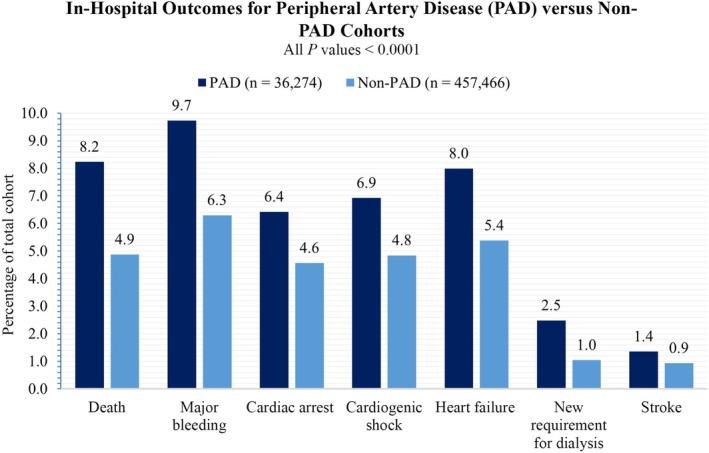
PAD was present in 36 274 patients with AMI (7.4%). In-hospital mortality was significantly higher in patients with PAD compared with those without (8.23% versus 4.87%; adjusted odds ratio [aOR], 1.25 [95% CI, 1.19-1.31]). Increased mortality persisted across age groups (<65 years: aOR, 1.42; ≥65 years: aOR, 1.18) and AMI type (non-ST-segment-elevation MI: aOR, 1.14; ST-segment-elevation MI: aOR, 1.46), with significant interactions by both age and AMI type. Among revascularized patients, mortality was elevated in those with PAD (aOR, 1.49). PAD was associated with increased rates of major bleeding (aOR, 1.23), particularly among revascularized patients (aOR, 1.31), as well as cardiac arrest, shock, heart failure, stroke, and new dialysis.
CONCLUSIONS
PAD was independently associated with markedly worse in-hospital outcomes in AMI, highlighting the need for risk mitigation strategies in this high-risk population.
背景
外周动脉疾病(PAD)和冠状动脉疾病患者发生不良心血管结局的风险更高。尽管长期风险已有充分记录,但PAD合并急性心肌梗死(AMI)患者的当代住院结局特征尚不明确。
方法
我们分析了2019年1月至2023年3月期间美国国家心血管数据注册库(NCDR)胸痛-心肌梗死注册库中670个美国站点的493740例AMI住院病例。主要结局为住院死亡率和大出血;次要终点包括心脏骤停、心源性休克、心力衰竭、中风和开始新的透析治疗。按年龄、性别、种族、AMI类型、血运重建状态和冠状动脉疾病程度进行亚组分析。我们使用NCDR验证的风险模型进行多变量调整。
结果
36274例AMI患者(7.4%)存在PAD。与无PAD的患者相比,有PAD的患者住院死亡率显著更高(8.23%对4.87%;调整后的优势比[aOR],1.25[95%CI,1.19-1.31])。各年龄组(<65岁:aOR,1.42;≥65岁:aOR,1.18)和AMI类型(非ST段抬高型心肌梗死:aOR,1.14;ST段抬高型心肌梗死:aOR,1.46)的死亡率均持续升高,年龄和AMI类型均有显著交互作用。在接受血运重建的患者中,有PAD的患者死亡率升高(aOR,1.49)。PAD与大出血发生率增加相关(aOR,1.23),特别是在接受血运重建的患者中(aOR,1.31),以及心脏骤停、休克、心力衰竭、中风和新透析治疗。
结论
PAD与AMI患者明显更差的住院结局独立相关,突出了在这一高危人群中采取风险缓解策略的必要性。
 Zotero 插件