
因新型免疫接种避免的呼吸道合胞病毒住院病例的情景预测。
Scenario Projections of Respiratory Syncytial Virus Hospitalizations Averted Due to New Immunizations.
作者信息
Hansen Chelsea L, Lee Lawrence, Bents Samantha J, Perofsky Amanda C, Sun Kaiyuan, Starita Lea M, Adler Amanda, Englund Janet A, Chow Eric J, Chu Helen Y, Viboud Cécile
机构信息
Brotman Baty Institute, University of Washington, Seattle.
Fogarty International Center, National Institutes of Health, Bethesda, Maryland.
出版信息
JAMA Netw Open. 2025 Jun 2;8(6):e2514622. doi: 10.1001/jamanetworkopen.2025.14622.
IMPORTANCE
In 2023, new immunization strategies became available for preventing respiratory syncytial virus (RSV) hospitalizations in infants and older adults. Modeling studies to understand the population-level impact of their use are important for public health planning.
OBJECTIVE
To estimate the number of hospitalizations averted in 2023 to 2024 due to new RSV immunization strategies and provide scenario projections for future seasons.
DESIGN, SETTING, AND PARTICIPANTS: This decision analytical model examined RSV hospitalizations in King County, Washington, from October 7, 2023, through April 26, 2025. The population of King County was disaggregated into infants younger than 6 months, infants aged 6 to 11 months, children aged 1 to 4 years, children/adults aged 5 to 59 years, adults aged 60 to 74 years, and adults aged 75 years or older.
EXPOSURES
Respiratory syncytial virus vaccination for adults aged 60 years or older, maternal RSV vaccination, and long-acting monoclonal antibodies (nirsevimab) for infants younger than 8 months.
MAIN OUTCOMES AND MEASURES
The proportion of RSV hospitalizations averted in adults aged 60 years or older and infants younger than 1 year were estimated using an RSV transmission model calibrated to RSV hospitalizations.
RESULTS
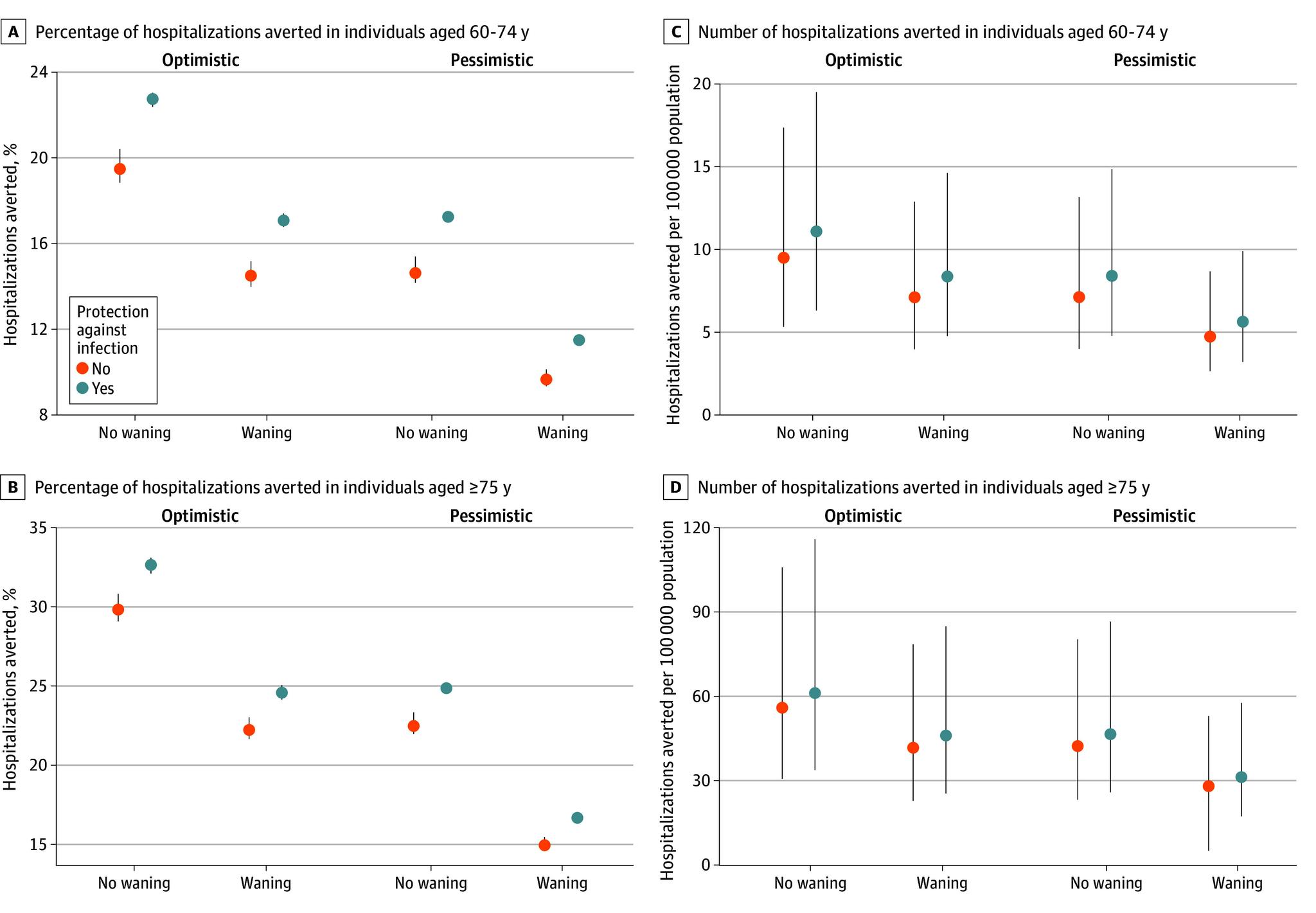
The RSV transmission model simulated the population of King County, which includes approximately 2.3 million individuals, with 23 700 infants younger than 1 year and 446 500 adults aged 60 years or older. During the 2023 to 2024 RSV season, 21.2% of adults aged 60 to 74 years, 32.7% of adults aged 75 years or older, and 33.0% of infants were protected through active or passive immunization. A total of 125 (95% projection interval [PI], 77-192) RSV hospitalizations were averted, with most of the benefit observed in infants younger than 6 months (28.6% [95% PI, 26.9%-30.5%] reduction from baseline) and adults aged 75 years or older (14.8% [95% PI, 14.3%-15.5%] reduction from baseline). For the 2024 to 2025 season, optimistic scenarios of high immunization coverage (50% in older adults and 80% in infants) projected reductions of 29.8% (95% PI, 29.1%-30.8%) in adults aged 75 years or older and 68.8% (95% PI, 66.0%-71.7%) in infants younger than 6 months compared with a counterfactual scenario with no immunizations. Targeting infants eligible for catch-up doses of nirsevimab early in the season increased the proportion of RSV hospitalizations averted in infants aged 6 to 11 months from 31.7% (95% PI, 29.4%-33.9%) to 40.4% (95% PI, 39.0%-42.1%). If vaccine protection in adults aged 75 years or older waned by 50% in the second year after immunization, the proportion of RSV hospitalizations averted was projected to decrease to 22.2% (95% PI, 21.7%-23.0%).
CONCLUSIONS AND RELEVANCE
In this decision analytical model of RSV immunizations, the results suggest a modest reduction in RSV-diagnosed hospitalizations during the 2023 to 2024 season due to limited availability of immunization products, particularly for infants. A higher uptake earlier in the season may lead to substantial reductions in RSV hospitalizations in the 2024 to 2025 season.
重要性
2023年,出现了预防婴儿和老年人呼吸道合胞病毒(RSV)住院的新免疫策略。开展建模研究以了解其使用对人群水平的影响,对公共卫生规划很重要。
目的
估计2023年至2024年因新的RSV免疫策略避免的住院人数,并为未来季节提供情景预测。
设计、设置和参与者:该决策分析模型研究了华盛顿州金县2023年10月7日至2025年4月26日期间的RSV住院情况。金县人口被细分为6个月以下婴儿、6至11个月婴儿、1至4岁儿童、5至59岁儿童/成人、60至74岁成人以及75岁及以上成人。
暴露因素
60岁及以上成人接种RSV疫苗、孕妇接种RSV疫苗以及8个月以下婴儿使用长效单克隆抗体(nirsevimab)。
主要结局和测量指标
使用根据RSV住院情况校准的RSV传播模型,估计60岁及以上成人和1岁以下婴儿中避免的RSV住院比例。
结果
RSV传播模型模拟了金县约230万人口,其中包括23700名1岁以下婴儿和446500名60岁及以上成人。在2023年至2024年RSV季节,60至74岁成人中有21.2%、75岁及以上成人中有32.7%、婴儿中有33.0%通过主动或被动免疫得到保护。共避免了125例(95%预测区间[PI],77 - 192)RSV住院,大部分益处见于6个月以下婴儿(较基线减少28.6%[95%PI,26.9% - 30.5%])和75岁及以上成人(较基线减少14.8%[95%PI,14.3% - 15.5%])。对于2024年至2025年季节,高免疫覆盖率的乐观情景(老年人中为50%,婴儿中为80%)预计75岁及以上成人与无免疫的反事实情景相比减少29.8%(95%PI,29.1% - 30.8%),6个月以下婴儿减少68.8%(95%PI,66.0% - 71.7%)。在季节早期针对有资格接种nirsevimab补种剂量的婴儿,可使6至11个月婴儿中避免的RSV住院比例从31.7%(95%PI,29.4% - 33.9%)增至40.4%(95%PI,39.0% - 42.1%)。如果75岁及以上成人的疫苗保护在免疫后第二年减弱50%,预计避免的RSV住院比例将降至22.2%(95%PI,21.7% - 23.0%)。
结论和相关性
在这个RSV免疫的决策分析模型中,结果表明由于免疫产品供应有限,2023年至2024年季节RSV诊断的住院人数略有减少,尤其是对婴儿而言。在季节早期更高的接种率可能会导致2024年至2025年季节RSV住院人数大幅减少。


 Zotero 插件