
二维与三维培养中人类骨骼肌细胞成熟的比较:一项定量蛋白质组学研究。
A comparison of human skeletal muscle cell maturation in 2D versus 3D culture: A quantitative proteomic study.
作者信息
Tollitt Benjamin R, Jones Samantha W, Ohana Jessica, Henstock James R, Jackson Malcolm J, McArdle Anne
机构信息
MRC-Versus Arthritis Centre for Integrated Research into Musculoskeletal Ageing (CIMA), Department of Musculoskeletal and Ageing Science, Institute of Life Course and Medical Sciences, University of Liverpool, Liverpool, UK.
MyoLine Platform, Sorbonne Université, Inserm, Institut de Myologie, Centre de Recherche en Myologie, Paris, France.
出版信息
Physiol Rep. 2025 Jun;13(12):e70420. doi: 10.14814/phy2.70420.
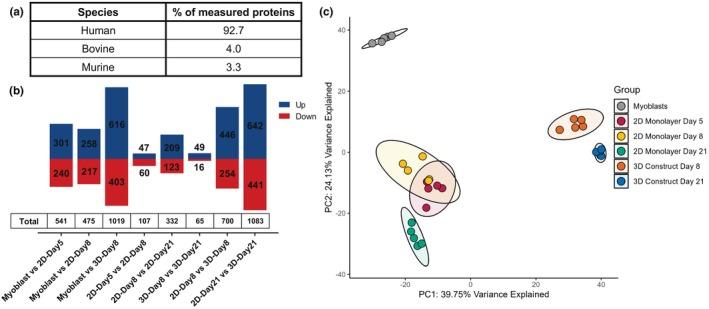
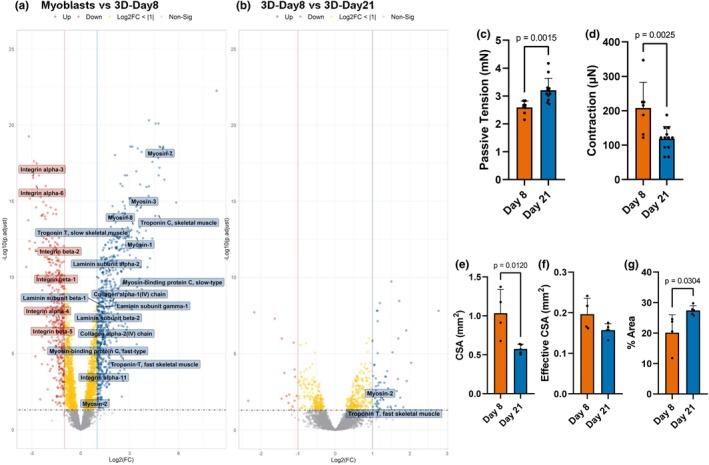
Compared with 2D monolayers, 3D models more closely mimic native muscle tissue and allow functional measurements. A more complete understanding of how culture conditions and duration affect myotube maturity/function is crucial for validating the transition to 3D systems. Human skeletal muscle cells were cultured as 2D monolayers or within 3D hydrogels for up to 21 days. Quantitative proteomic analysis and functional measurements were conducted to evaluate muscle cell differentiation. Myoblasts differentiated into myotubes by 8 days in both environments; however, at Day 8, 3D constructs exhibited a predominantly slow-twitch phenotype, compared with the mixed fiber type of 2D monolayers. By Day 21, 3D constructs demonstrated enhanced mitochondrial maturity, extracellular matrix remodeling, and a fast-twitch phenotype, indicated by increased myosin-2 abundance (Log2(FC)>1.29, p <0.05). Passive tension increased by >20% following prolonged culture of 3D muscle constructs, but contractile forces reduced by >40%. This study provides a comprehensive proteomic profile of human skeletal muscle cells in 2D and 3D, demonstrating that 3D culture promoted myotube maturity and highlighting the importance of selecting appropriate culture conditions. Data suggest 8 days of differentiation as ideal for achieving peak contractile force in 3D constructs, providing optimal models for testing interventions aimed at preserving muscle function.
与二维单层细胞相比,三维模型更能紧密模拟天然肌肉组织并允许进行功能测量。更全面地了解培养条件和培养持续时间如何影响肌管成熟度/功能对于验证向三维系统的转变至关重要。将人类骨骼肌细胞培养成二维单层细胞或在三维水凝胶中培养长达21天。进行了定量蛋白质组学分析和功能测量以评估肌肉细胞分化。在两种环境中,成肌细胞在8天时都分化为肌管;然而,在第8天,与二维单层细胞的混合纤维类型相比,三维构建体表现出主要为慢肌纤维的表型。到第21天,三维构建体显示出线粒体成熟度增强、细胞外基质重塑以及快肌纤维表型,这由肌球蛋白-2丰度增加所表明(Log2(FC)>1.29,p<0.05)。三维肌肉构建体长时间培养后被动张力增加了>20%,但收缩力降低了>40%。本研究提供了二维和三维环境下人类骨骼肌细胞的全面蛋白质组概况,表明三维培养促进了肌管成熟,并突出了选择合适培养条件的重要性。数据表明,8天的分化时间是在三维构建体中实现最大收缩力的理想时间,为测试旨在保留肌肉功能的干预措施提供了最佳模型。




 Zotero 插件