
甘丙肽系统和胰岛素抵抗参数作为预测工具在长新冠患者诊断中的作用。
Role of Galanin system and insulin resistance parameters as predictive tools for diagnosis of Long-COVID patients.
作者信息
Al Masoodi Wasim Talib, Radhi Sami Waheed, Abdalsada Habiba Khdair, Al-Hakeim Hussein Kadhem
机构信息
Department of Chemistry, College of Science, University of Kufa, Najaf, Iraq.
Department of Chemistry, Faculty of Medicine, University of Al-Ameed, Karbala, 56001, Iraq.
出版信息
Biochem Biophys Rep. 2025 Jun 3;43:102068. doi: 10.1016/j.bbrep.2025.102068. eCollection 2025 Sep.
BACKGROUND
COVID-19 patients may have long-lasting symptoms known as long-COVID (LC) without any underlying medical issues or obvious organ damage. Much research suggested that these issues are attributed to cytokine storm, lung and nerve injury, and glucose homeostasis disruption. Galanin (Gal), a neuropeptide in the peripheral and central nervous systems, has several physiological activities connected to illnesses. The current case-control research hypothesized the role of insulin resistance (IR) and the Gal system in LC pathophysiology.
METHODS
This research included 30 healthy controls and 60 LC patients. Insulin, Gal, and GalR1 were determined using the enzyme-linked immunosorbent assay (ELISA). The HOMA2 calculator determined β-cell function (HOMA%B), insulin sensitivity (HOMA%S), and insulin resistance (HOMA2IR) by analyzing fasting serum insulin and glucose levels.
RESULTS
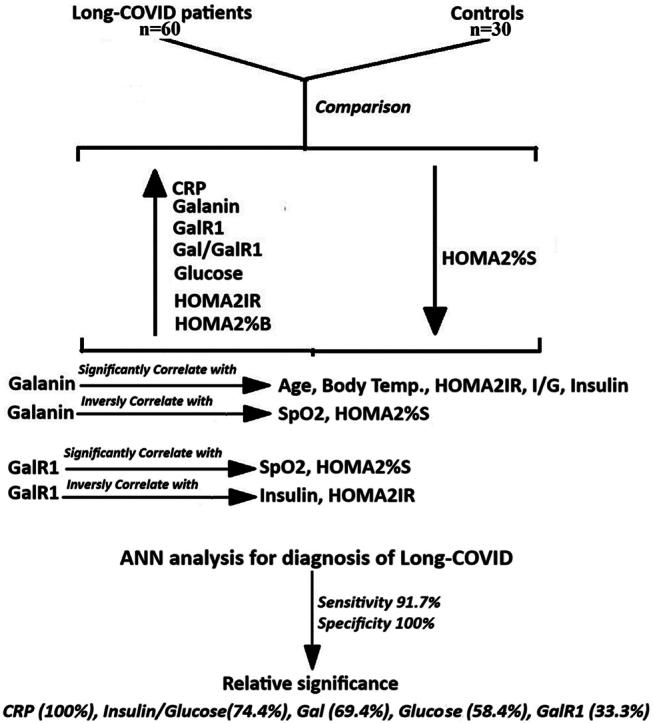
LC patients showed higher Gal, GalR1, and Gal/GalR1 concentrations than controls, suggesting Gal system activation. LC patients likely have an IR state. The correlation study showed a negative link between Gal, GalR1, and SpO2. Gal level was positively correlated with insulin, insulin/glucose, and HOMA2IR and negatively correlated with HOMA%S. With an AUC-ROC of 0.939, artificial neural networks (ANN) predicted a sensitivity of 71.4 % and a specificity of 87.5 %. In LC, IR parameters and Gal system biomarkers were strongly correlated, suggesting they may contribute to disease.
CONCLUSION
Galanin system and IR parameters are altered in LC patients and can predict LC in suspicious subjects with 91.7 % sensitivity and 100.0 % specificity using the neural network model. The top five predictors were CRP, insulin/glucose, Gal, glucose, and GalR1. CRP had the greatest importance (100.0 %), indicating the importance of inflammation, IR, and Gal system biomarkers in the pathophysiology of LC.
背景
新冠病毒感染(COVID-19)患者可能会出现被称为“长新冠”(LC)的长期症状,且没有任何潜在的医学问题或明显的器官损伤。许多研究表明,这些问题归因于细胞因子风暴、肺和神经损伤以及葡萄糖稳态破坏。甘丙肽(Gal)是一种存在于外周和中枢神经系统的神经肽,具有多种与疾病相关的生理活性。当前的病例对照研究假设了胰岛素抵抗(IR)和甘丙肽系统在长新冠病理生理学中的作用。
方法
本研究纳入了30名健康对照者和60名长新冠患者。使用酶联免疫吸附测定(ELISA)法测定胰岛素、甘丙肽和甘丙肽受体1(GalR1)。HOMA2计算器通过分析空腹血清胰岛素和葡萄糖水平来确定β细胞功能(HOMA%B)、胰岛素敏感性(HOMA%S)和胰岛素抵抗(HOMA2IR)。
结果
长新冠患者的甘丙肽、甘丙肽受体1以及甘丙肽/甘丙肽受体1浓度均高于对照组,提示甘丙肽系统被激活。长新冠患者可能处于胰岛素抵抗状态。相关性研究表明,甘丙肽、甘丙肽受体1与血氧饱和度(SpO2)之间呈负相关。甘丙肽水平与胰岛素、胰岛素/葡萄糖以及HOMA2IR呈正相关,与HOMA%S呈负相关。人工神经网络(ANN)预测的曲线下面积(AUC-ROC)为0.939,敏感性为71.4%,特异性为87.5%。在长新冠中,胰岛素抵抗参数与甘丙肽系统生物标志物密切相关,表明它们可能与疾病的发生有关。
结论
长新冠患者的甘丙肽系统和胰岛素抵抗参数发生了改变,使用神经网络模型可对可疑受试者的长新冠进行预测,敏感性为91.7%,特异性为100.0%。前五位预测因子为C反应蛋白(CRP)、胰岛素/葡萄糖、甘丙肽、葡萄糖和甘丙肽受体1。CRP的重要性最高(100.0%),表明炎症、胰岛素抵抗和甘丙肽系统生物标志物在长新冠病理生理学中的重要性。


 Zotero 插件