
痴呆症的一种新风险因素:长期接触微塑料。
A novel risk factor for dementia: chronic microplastic exposure.
作者信息
Gecegelen Elif, Ucdal Mete, Dogu Burcu Balam
机构信息
Division of Geriatric Medicine, Department of Internal Medicine, Hacettepe University, Ankara, Türkiye.
Department of Internal Medicine, Hacettepe University, Ankara, Türkiye.
出版信息
Front Neurol. 2025 May 30;16:1581109. doi: 10.3389/fneur.2025.1581109. eCollection 2025.
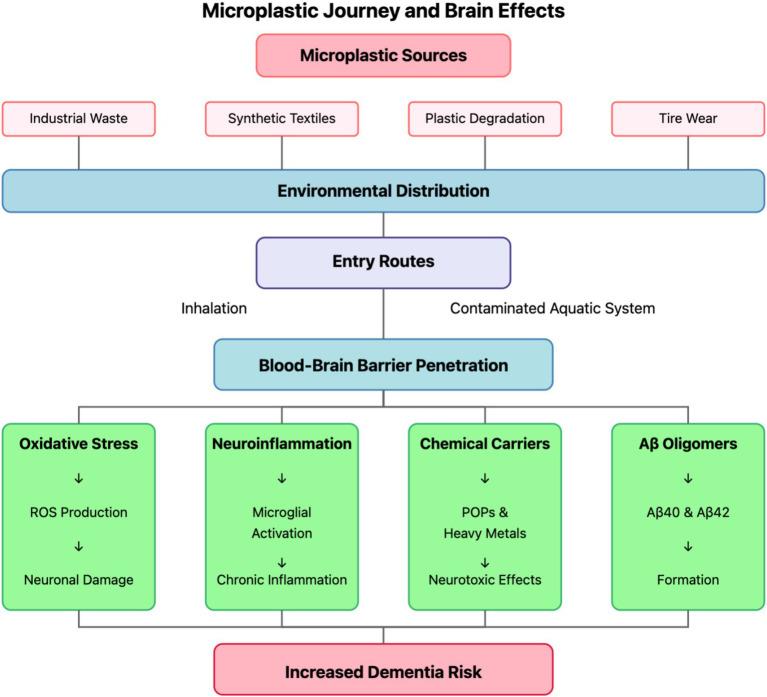
Recent advances in dementia research have expanded our understanding of modifiable risk factors, with air pollution being a well-established contributor. However, microplastics-plastic particles smaller than 5 mm-represent an understudied component of environmental pollution that may significantly impact neurological health. This review examines emerging evidence linking chronic microplastic exposure to increased dementia risk. Microplastics enter the human body through multiple routes, including ingestion of contaminated food and water, inhalation, and dermal absorption, with demonstrated ability to cross the blood-brain barrier and initiate several pathogenic pathways. Four primary mechanisms appear to mediate microplastic-induced neurodegeneration: increased oxidative stress through reactive oxygen species (ROS) production; neuroinflammation via microglial activation and chronic inflammatory responses; neurotoxicity from transported persistent organic pollutants (POPs) and heavy metals; and accelerated amyloid-beta pathology through enhanced Aβ40 and Aβ42 nucleation. Recent bioaccumulation studies have revealed significantly elevated microplastic concentrations in the brains of dementia patients compared to non-dementia controls, supporting a potential dose-dependent relationship. Sources of environmental microplastics include industrial waste, synthetic textiles, plastic degradation products, and tire wear particles, creating a ubiquitous exposure risk through contaminated air, food, and water. While preliminary evidence supports a mechanistic link between microplastics and neurodegeneration, comprehensive epidemiological studies with larger datasets are needed to quantify this relationship and establish dose-response patterns. Future research should focus on identifying which microplastic types pose the greatest neurological risks, determining threshold exposure levels, and developing interventions to mitigate exposure.
痴呆症研究的最新进展拓宽了我们对可改变风险因素的理解,空气污染就是一个已被充分证实的促成因素。然而,微塑料(小于5毫米的塑料颗粒)是环境污染中一个研究不足的组成部分,可能会对神经健康产生重大影响。这篇综述探讨了将长期接触微塑料与痴呆症风险增加联系起来的新证据。微塑料通过多种途径进入人体,包括摄入受污染的食物和水、吸入以及皮肤吸收,并且已证明它有能力穿过血脑屏障并引发多种致病途径。四种主要机制似乎介导了微塑料诱导的神经退行性变:通过产生活性氧(ROS)增加氧化应激;通过小胶质细胞激活和慢性炎症反应引发神经炎症;来自运输的持久性有机污染物(POPs)和重金属的神经毒性;以及通过增强Aβ40和Aβ42成核加速淀粉样蛋白β病理过程。最近的生物蓄积研究表明,与非痴呆症对照组相比,痴呆症患者大脑中的微塑料浓度显著升高,这支持了一种潜在的剂量依赖关系。环境微塑料的来源包括工业废物、合成纺织品、塑料降解产物和轮胎磨损颗粒,通过污染空气、食物和水造成无处不在的接触风险。虽然初步证据支持微塑料与神经退行性变之间的机制联系,但需要更大数据集的全面流行病学研究来量化这种关系并建立剂量反应模式。未来的研究应侧重于确定哪些微塑料类型对神经风险最大,确定接触阈值水平,并制定减少接触的干预措施。

 Zotero 插件