
根据最新提议的TNM系统版本,非小细胞肺癌系统性淋巴结清扫术后的生存结果。
Survival outcome after systematic lymphadenectomy in non-small cell lung cancer according to the latest proposed edition of the TNM system.
作者信息
Haj Khalaf Mohamed, Kikoyan Hayk, Trufa Denis, Higaze Mostafa, Khamitov Koblandy, Parjiea Chirag, Romaniwna Olena Stets, Hartmann Arndt, Rieker Ralf, Sirbu Horia
机构信息
Department of Thoracic Surgery, Erlangen University Hospital, Erlangen, Germany.
Erlangen University Hospital, Faculty of Medicine, Friedrich-Alexander University Erlangen-Nürnberg (FAU), Erlangen, Germany.
出版信息
J Thorac Dis. 2025 May 30;17(5):3128-3137. doi: 10.21037/jtd-2024-2086. Epub 2025 May 27.
BACKGROUND
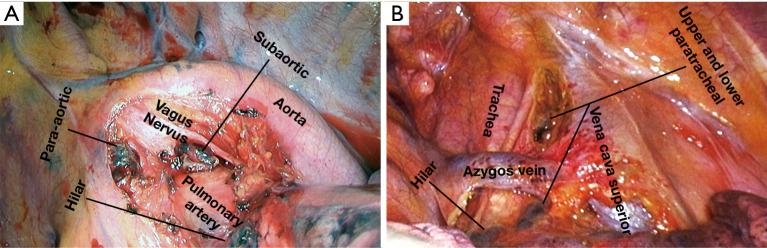
While systematic lymphadenectomy (SLND) provides critical information for accurate staging, its direct impact on survival outcomes remains unclear and subject to ongoing debate. This study presents survival outcomes across various nodal stages to clarify the potential role of SLND in improving prognosis. SLND is routinely performed during the resection of non-small cell lung cancer (NSCLC) to assess lymph node involvement and determine the nodal stage.
METHODS
We retrospectively analyzed data from 367 patients who underwent curative surgery for NSCLC between 2008 and 2019. The Chi-squared test has been employed to compare the distribution of categorical variables between groups. We used a Cox proportional hazards regression model for multivariable survival analysis to identify independent prognostic factors, including sex, histologic type, N factor, and type of surgical procedure. We evaluated these variables based on 5-year post-surgery survival rates. Additionally, we used the log-rank test and Kaplan-Meier curve analysis.
RESULTS
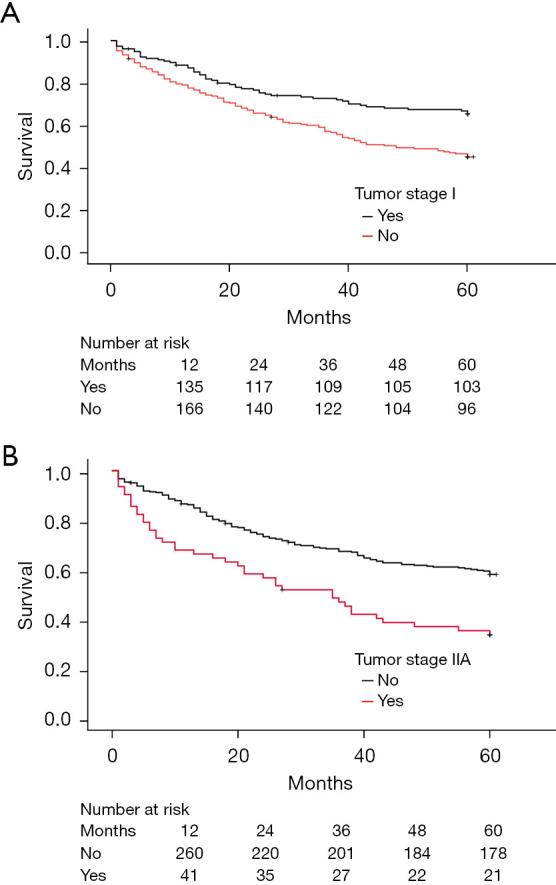
In 367 patients (228 male and 139 female), SLND was performed. Out of these patients were N0 (n=267, 72.8%), N1 (n=61, 16.6%) and N2 (n=39, 10.6%). The overall 5-year survival rate for the entire cohort was 54.2%. There was a significant difference in survival rates between genders (P<0.001). Females showed a higher survival rate (69.1%) than males (45.2%). The 5-year survival is 66% for stage I (P<0.001) and 33.9% for stage IIA (P<0.001) in NSCLC patients. The multi-level N1 situation did not significantly affect survival (44.4%, P=0.66). The multi-level N2 was associated with a much lower survival rate of 10.0% (P<0.001). An analysis of each lymph node revealed that the paraesophageal group (Group 8) had a survival rate of 14.3% (P<0.001).
CONCLUSIONS
Our study indicates that SLND does not directly impact 5-year survival rates, particularly in early-stage NSCLC. However, SLND may play a critical role in achieving accurate tumor staging, which is essential for guiding subsequent treatment strategies. Despite its utility in staging, the current staging system demonstrates variability in predicting survival outcomes, especially when considering specific N stages or nodal groups involved.
背景
虽然系统性淋巴结清扫术(SLND)为准确分期提供了关键信息,但其对生存结局的直接影响仍不明确,且仍在持续争论中。本研究展示了不同淋巴结分期的生存结局,以阐明SLND在改善预后方面的潜在作用。SLND在非小细胞肺癌(NSCLC)切除术中常规进行,以评估淋巴结受累情况并确定淋巴结分期。
方法
我们回顾性分析了2008年至2019年间367例行NSCLC根治性手术患者的数据。采用卡方检验比较组间分类变量的分布。我们使用Cox比例风险回归模型进行多变量生存分析,以确定独立的预后因素,包括性别、组织学类型、N分期和手术方式。我们根据术后5年生存率评估这些变量。此外,我们使用对数秩检验和Kaplan-Meier曲线分析。
结果
367例患者(228例男性和139例女性)接受了SLND。这些患者中N0期(n = 267,72.8%)、N1期(n = 61,16.6%)和N2期(n = 39,10.6%)。整个队列的总体5年生存率为54.2%。性别之间的生存率存在显著差异(P < 0.001)。女性的生存率(69.1%)高于男性(45.2%)。NSCLC患者中I期的5年生存率为66%(P < 0.001),IIA期为33.9%(P < 0.001)。多水平N1情况对生存没有显著影响(44.4%,P = 0.66)。多水平N2与低得多的10.0%的生存率相关(P < 0.001)。对每个淋巴结的分析显示,食管旁组(第8组)的生存率为14.3%(P < 0.001)。
结论
我们的研究表明,SLND不会直接影响5年生存率,特别是在早期NSCLC中。然而,SLND可能在实现准确的肿瘤分期方面发挥关键作用,这对于指导后续治疗策略至关重要。尽管其在分期方面有用,但当前的分期系统在预测生存结局方面存在差异,尤其是在考虑特定的N分期或受累的淋巴结组时。


 Zotero 插件