
优化超顺磁性铁氧体纳米颗粒:微波辅助热分解合成方法。
Optimizing superparamagnetic ferrite nanoparticles: microwave-assisted thermal decomposition synthesis methods.
作者信息
Moghaddari Kimia, Schumacher Lars, Pöttgen Rainer, Kickelbick Guido
机构信息
Inorganic Solid-State Chemistry, Saarland University Campus, Building C4 1 66123 Saarbrücken Germany
Institut für Anorganische und Analytische Chemie, Universität Münster Corrensstrasse 30 48149 Münster Germany.
出版信息
Nanoscale Adv. 2025 May 26;7(15):4563-4576. doi: 10.1039/d5na00244c. eCollection 2025 Jul 22.
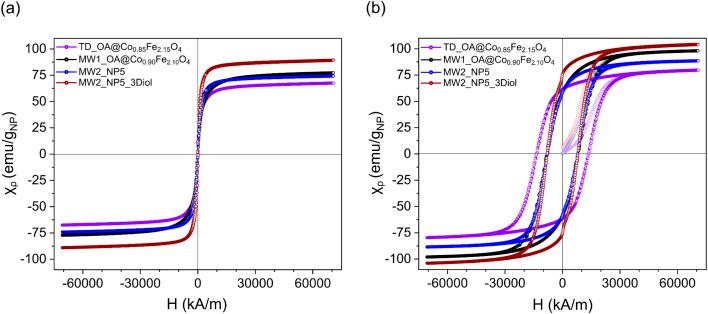
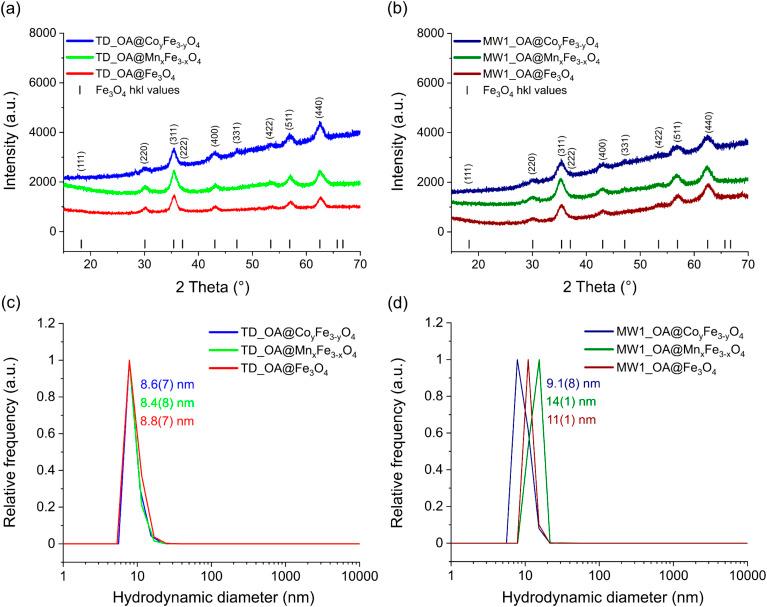
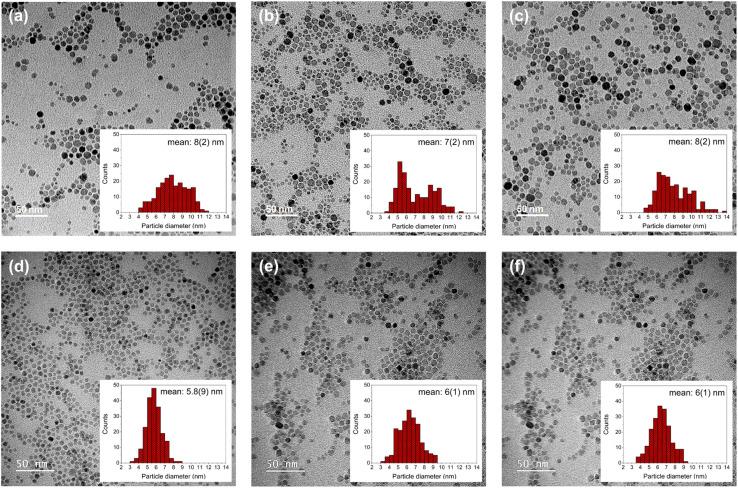
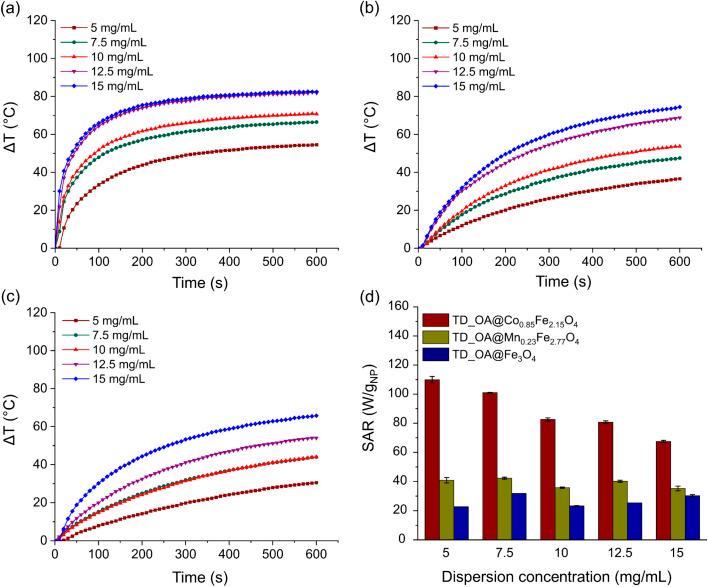
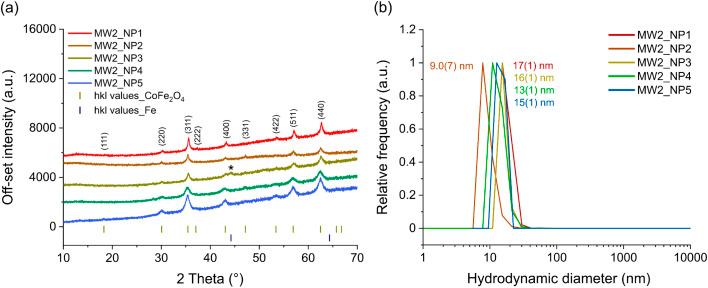
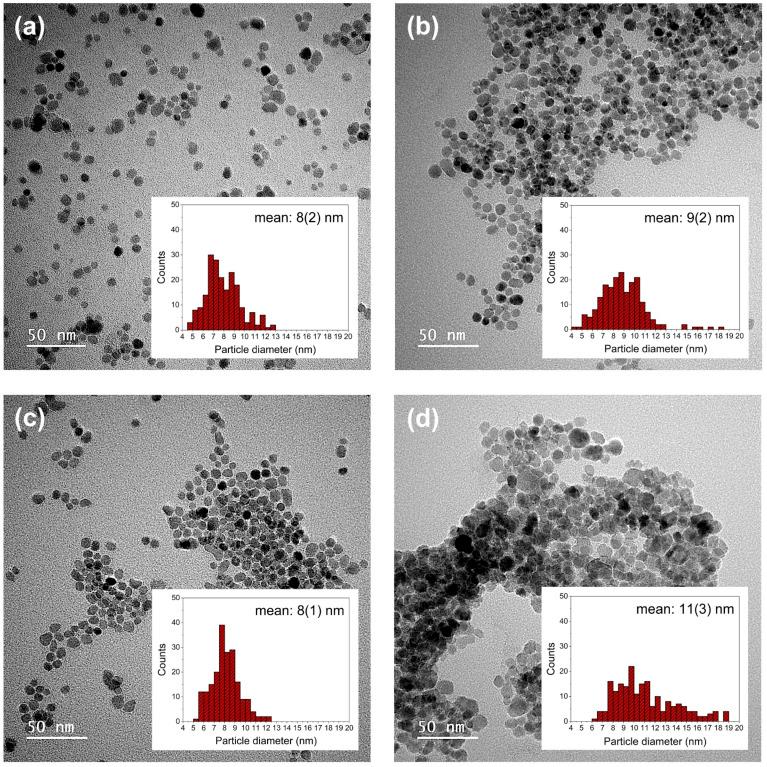
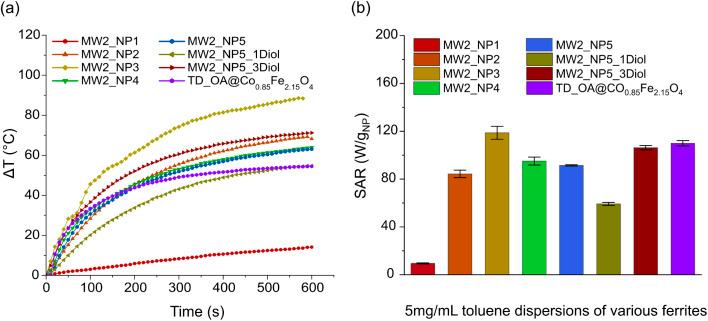
Superparamagnetic iron oxide nanoparticles are of crucial importance for various applications in medicine and biology as well as in materials science, where properties such as magnetism and inductive heating are advantageous. In this study, we systematically compare the synthesis methods for ferrite nanoparticles with those of pure iron oxide, focusing on their final properties. We synthesized superparamagnetic substituted ferrite nanoparticles with an average diameter of 5 to 8 nm with the general formula of M Fe O (M = Fe, Mn, Co) using both conventional thermal decomposition (TD) method and microwave-assisted (MW) methods. Although the manganese-substituted particles obtained through both methods exhibited a narrow size distribution and high surface coverage with oleic acid, they demonstrated lower heating efficiency in an induction field compared to the cobalt-substituted particles. In particular, the replacement of Fe ions with Co ions significantly improved the self-heating ability and increased the specific absorption rate (SAR) from 22.7 for FeO to 106.3 W g for CoFeO nanoparticles. In addition, the concentration of 1,2-dodecanediol in the reaction mixture significantly influenced the shape and size distribution of the particles. Microwave-assisted synthesis resulted in higher incorporation of M ions, as confirmed by ICP-MS and EDX spectroscopy, and more uniform particle sizes due to homogeneous nucleation. By optimizing the microwave method, we were able to produce small size superparamagnetic particles with high saturation magnetization (89.2 emu g at 300 K), capable of generating more heat in the magnetic field, making these particles suitable candidates for induction heating in materials.
超顺磁性氧化铁纳米粒子在医学、生物学以及材料科学的各种应用中至关重要,在这些领域中,磁性和感应加热等特性具有优势。在本研究中,我们系统地比较了铁氧体纳米粒子与纯氧化铁的合成方法,重点关注它们的最终性能。我们使用传统热分解(TD)方法和微波辅助(MW)方法,合成了平均直径为5至8 nm、通式为MFeO(M = Fe、Mn、Co)的超顺磁性取代铁氧体纳米粒子。尽管通过这两种方法获得的锰取代粒子均表现出窄尺寸分布和高油酸表面覆盖率,但与钴取代粒子相比,它们在感应场中的加热效率较低。特别是,用Co离子取代Fe离子显著提高了自热能力,并将比吸收率(SAR)从FeO的22.7提高到CoFeO纳米粒子的106.3 W g。此外,反应混合物中1,2 - 十二烷二醇的浓度显著影响粒子的形状和尺寸分布。如通过ICP - MS和EDX光谱所证实的,微波辅助合成导致更高的M离子掺入率,并且由于均匀成核而使粒径更均匀。通过优化微波方法,我们能够制备出具有高饱和磁化强度(300 K时为89.2 emu g)的小尺寸超顺磁性粒子,能够在磁场中产生更多热量,使这些粒子成为材料感应加热的合适候选者。


 Zotero 插件