
社会经济地位对慢性阻塞性肺疾病预后的影响:一项全国队列研究。
Impact of socioeconomic status on chronic obstructive pulmonary disease prognosis: a national cohort study.
作者信息
Lee Hyewon, Jung Jiyun, Yoon Hee-Young
机构信息
Department of Health Administration and Management, College of Medical Sciences, Soonchunhyang University, Asan, Republic of Korea.
Department of Software Convergence, Soonchunhyang University Graduate School, Asan, Republic of Korea.
出版信息
Front Med (Lausanne). 2025 Jun 4;12:1584945. doi: 10.3389/fmed.2025.1584945. eCollection 2025.
BACKGROUND
Chronic obstructive pulmonary disease (COPD) is a major cause of global morbidity and mortality, with socioeconomic status (SES) playing a significant role in disease outcomes. While the impact of individual SES on COPD has been reported, the influence of both individual and neighborhood SES on clinical outcomes remains unclear. We aimed to evaluate the association between SES and COPD outcomes.
METHOD
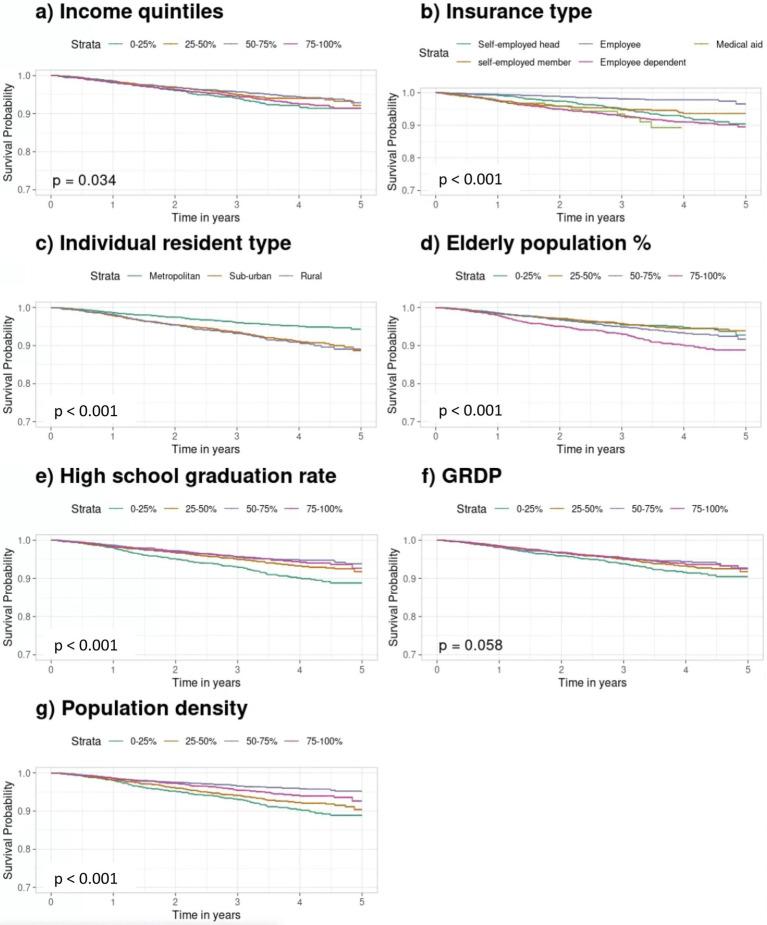
We conducted a retrospective cohort study using 2015-2018 data from the Korean National Health Insurance Service-National Sample Cohort, linked with census data. SES was assessed at both individual (income, insurance type) and neighborhood levels (residential area, elderly proportion, education level, gross regional domestic product, and total population density). Outcomes included overall mortality and hospitalization, which were evaluated using Cox proportional hazard models adjusted for demographic and air pollution.
RESULTS
Among 12,820 patients (mean age 63.5 years, 47.2% male), higher income was significantly associated with lower mortality risk (hazard ratio [HR] = 0.961, 95% confidence interval [CI] = 0.936-0.986) in the adjusted model. Suburban residence was associated with increased mortality risk (HR = 1.432, 95% CI = 1.089-1.884), while rural residence was not significant after adjustment. For hospitalization, higher income was also significantly associated with a lower risk (HR = 0.987, 95% CI = 0.979-0.995). Suburban (HR = 1.097, 95% CI = 1.013-1.187) and rural (HR = 1.138, 95% CI = 1.046-1.239) residence also remained significantly associated with increased hospitalization risk in the adjusted models. Additionally, a higher proportion of older adults (HR = 1.010, 95% CI = 1.004-1.016) and lower educational attainment (HR = 0.992, 95% CI = 0.989-0.995) were also significantly associated with hospitalization risk.
CONCLUSION
These findings suggest that individual SES is associated with both mortality and hospitalization among patients with COPD, while neighborhood SES influences hospitalization but not mortality after adjustment.
背景
慢性阻塞性肺疾病(COPD)是全球发病和死亡的主要原因,社会经济地位(SES)在疾病转归中起重要作用。虽然已有报道个体SES对COPD的影响,但个体和社区SES对临床结局的影响仍不清楚。我们旨在评估SES与COPD结局之间的关联。
方法
我们使用韩国国民健康保险服务-全国样本队列2015 - 2018年的数据并结合人口普查数据进行了一项回顾性队列研究。SES在个体(收入、保险类型)和社区层面(居住地区、老年人口比例、教育水平、地区生产总值和总人口密度)进行评估。结局包括全因死亡率和住院率,使用针对人口统计学和空气污染因素进行调整的Cox比例风险模型进行评估。
结果
在12,820例患者(平均年龄63.5岁,47.2%为男性)中,在调整模型中,较高收入与较低死亡风险显著相关(风险比[HR]=0.961,95%置信区间[CI]=0.936 - 0.986)。郊区居住与死亡风险增加相关(HR = 1.432,95% CI = 1.089 - 1.884),而农村居住在调整后无显著关联。对于住院率,较高收入也与较低风险显著相关(HR = 0.987,95% CI = 0.979 - 0.995)。在调整模型中,郊区(HR = 1.097,95% CI = 1.013 - 1.187)和农村(HR = 1.


 Zotero 插件