
非小细胞肺癌患者合并 融合基因时的内脏危象:通过 L2026M 突变对恩曲替尼产生内在耐药性——病例报告
Visceral crisis in a patient with non-small cell lung cancer and fusion: intrinsic resistance to entrectinib via L2026M mutation-a case report.
作者信息
Avila Rodriguez Vaneza, Wagner-Gutiérrez Nicolle, Zuluaga León Jairo Andrés, Rojas Leonardo, Viola Lucia, Martínez Jaramillo Stella Isabel, Carvajal Fierro Carlos Andrés, Ruiz-Patiño Alejandro, Arrieta Oscar, Corrales Luis, Martin Claudio, Cardona Andrés F
机构信息
Thoracic Oncology Unit, Luis Carlos Sarmiento Angulo Cancer Treatment and Research Center (CTIC), Bogotá, Colombia.
GIGA/TERA Research Groups, CTIC/Bosque University, Bogotá, Colombia.
出版信息
Transl Lung Cancer Res. 2025 May 30;14(5):1862-1869. doi: 10.21037/tlcr-2024-1149. Epub 2025 May 28.
BACKGROUND
rearrangements are identified in approximately 1-2% of non-small cell lung cancer (NSCLC) cases, predominantly in younger, non-smoking patients. Targeted therapies such as entrectinib, a second-generation tyrosine kinase inhibitor (TKI), have demonstrated efficacy, particularly in managing brain metastases. However, intrinsic and acquired resistance mechanisms remain poorly understood, limiting long-term treatment success.
CASE DESCRIPTION
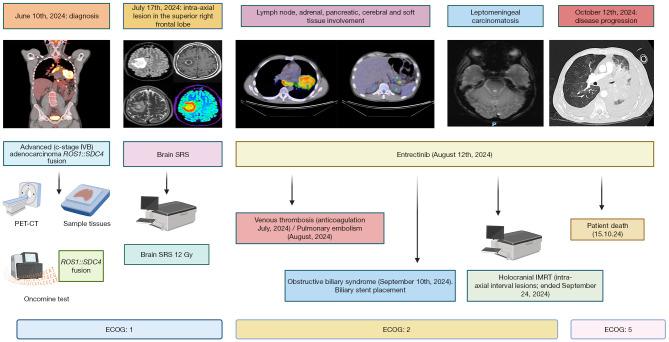
We report a unique case of early entrectinib resistance due to a gatekeeper mutation in the ROS1 kinase domain, underscoring the importance of molecular profiling in optimizing therapeutic strategies. We report a case of a 50-year-old male, a non-smoker, who was diagnosed with ROS1-rearranged NSCLC harboring an fusion. First-line treatment with entrectinib was initiated, resulting in an initial partial response. However, rapid disease progression was observed within a few months. Retrospective molecular analysis identified the L2026M mutation in the kinase domain, a known gatekeeper mutation that reduces TKI binding affinity and enhances tumor cell survival. This case highlights the clinical impact of resistance mutations in ROS1-positive NSCLC and underscores the critical role of comprehensive molecular profiling in guiding treatment decisions.
CONCLUSIONS
The emergence of the L2026M mutation suggests a need for next-generation TKIs and combination strategies to overcome resistance. Future studies should explore novel inhibitors targeting ROS1 resistance pathways to improve outcomes in this subset of NSCLC patients.
背景
在大约1%-2%的非小细胞肺癌(NSCLC)病例中发现了重排,主要发生在年轻的非吸烟患者中。靶向治疗,如第二代酪氨酸激酶抑制剂(TKI)恩曲替尼,已显示出疗效,特别是在治疗脑转移方面。然而,内在和获得性耐药机制仍知之甚少,限制了长期治疗的成功。
病例描述
我们报告了一例由于ROS1激酶结构域中的守门基因突变导致早期恩曲替尼耐药的独特病例,强调了分子谱分析在优化治疗策略中的重要性。我们报告了一例50岁男性非吸烟患者,被诊断为携带融合的ROS1重排NSCLC。开始使用恩曲替尼进行一线治疗,最初产生了部分缓解。然而,几个月内观察到疾病迅速进展。回顾性分子分析在激酶结构域中鉴定出L2026M突变,这是一种已知的守门基因突变,可降低TKI结合亲和力并提高肿瘤细胞存活率。该病例突出了ROS1阳性NSCLC中耐药突变的临床影响,并强调了全面分子谱分析在指导治疗决策中的关键作用。
结论
L2026M突变的出现表明需要新一代TKI和联合策略来克服耐药性。未来的研究应探索针对ROS1耐药途径的新型抑制剂,以改善这一NSCLC患者亚组的治疗结果。

 Zotero 插件