
牛奶摄入量和饮食模式对盆腔器官脱垂的影响:一项孟德尔随机化研究。
Impact of Milk Consumption and Dietary Patterns on Pelvic Organ Prolapse: A Mendelian Randomization Study.
作者信息
Xia Xinglu, Hu Yiqin, Xu Jingui, Fan Suhong, Zhang Yunfeng
机构信息
Department of Gynaecology, The Quzhou Affiliated Hospital of Wenzhou Medical University, Quzhou People's Hospital, Quzhou, 324000, People's Republic of China.
Department of Anaesthesiology, The Quzhou Affiliated Hospital of Wenzhou Medical University, Quzhou People's Hospital, Quzhou, 324000, People's Republic of China.
出版信息
Int J Womens Health. 2025 Jun 19;17:1837-1847. doi: 10.2147/IJWH.S519596. eCollection 2025.
BACKGROUND
Pelvic organ prolapse (POP) severely impacts women's quality of life and disrupts their daily routines. This study uses two-sample Mendelian randomization (MR) to explore the causal link between dietary habits and POP, providing useful insights for its treatment.
MATERIALS AND METHODS
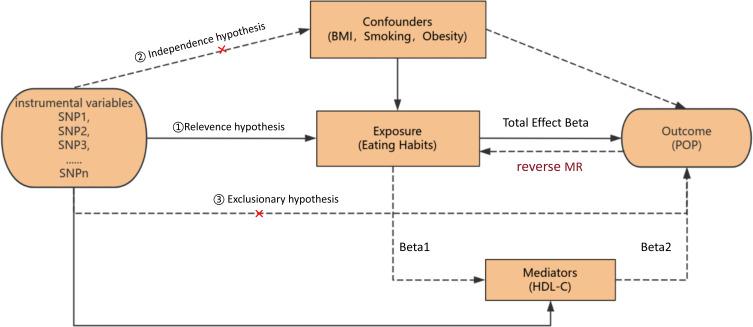
We used genome-wide association (GWAS) data from Europeans for our study. Two-sample MR analysis was utilized to explore the potential causal relationship between dietary habits and the risk of POP. Five distinct MR methods were applied, with the primary results derived from the inverse variance weighted (IVW) method. Additional sensitivity analyses were performed to assess potential horizontal pleiotropy and heterogeneity in the findings. Moreover, a two-step MR design was used to examine possible mediating factors within dietary habits.
RESULTS
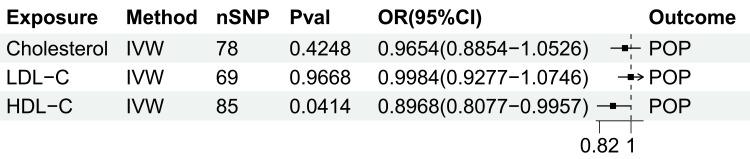
Seventeen dietary habits were identified as having a significant causal relationship with the risk of POP (p < 0.05). Notably, consumption of processed meat and dairy intake, including both whole and skim milk, were found to be associated with an increased risk of POP. Two-step MR analysis indicated that high-density lipoprotein cholesterol (HDL-C) may play a crucial role as a mediating factor between regular milk consumption and POP, contributing to 7.5% of the effect of whole milk consumption and 4.1% of the effect of skim milk consumption. Importantly, sensitivity analyses further validated the robustness of our findings.
CONCLUSION
Our findings offer compelling evidence of the causal relationship between dietary habits (especially dairy and processed meats) and the risk of POP, providing valuable recommendations for POP patients in making informed dietary decisions.
背景
盆腔器官脱垂(POP)严重影响女性的生活质量并扰乱其日常生活。本研究采用两样本孟德尔随机化(MR)方法来探索饮食习惯与POP之间的因果关系,为其治疗提供有益见解。
材料与方法
我们在研究中使用了来自欧洲人的全基因组关联(GWAS)数据。采用两样本MR分析来探索饮食习惯与POP风险之间的潜在因果关系。应用了五种不同的MR方法,主要结果来自逆方差加权(IVW)方法。进行了额外的敏感性分析,以评估研究结果中潜在的水平多效性和异质性。此外,采用两步MR设计来检验饮食习惯中可能的中介因素。
结果
确定了17种饮食习惯与POP风险存在显著因果关系(p < 0.05)。值得注意的是,加工肉类的消费以及包括全脂和脱脂牛奶在内的乳制品摄入,都与POP风险增加有关。两步MR分析表明,高密度脂蛋白胆固醇(HDL-C)可能作为经常饮用牛奶与POP之间的中介因素发挥关键作用,分别占全脂牛奶消费影响的7.5%和脱脂牛奶消费影响的4.1%。重要的是,敏感性分析进一步验证了我们研究结果的稳健性。
结论
我们的研究结果为饮食习惯(尤其是乳制品和加工肉类)与POP风险之间的因果关系提供了有力证据,为POP患者做出明智的饮食决策提供了有价值的建议。



 Zotero 插件