
通过在刺孢菌素氨基末端引入精氨酸残基增强其抗菌活性:阳离子-π相互作用的可能作用
Augmentation of Antimicrobial Activity of Spiniferin by Introducing an Arginine Residue Toward Its Amino Terminus: A Possible Role of Cation-π Interaction.
作者信息
Saroj Jyotshana, Verma Rahul Dev, Akhtar Sariyah, Verma Neeraj Kumar, Gupta Arvind, Tripathi Arsh, Sharma Juhi, Mitra Kalyan, Siddiqi Mohammad Imran, Ghosh Jimut Kanti
机构信息
Biochemistry and Structural Biology Division, CSIR-Central Drug Research Institute, Lucknow 226031 India.
Academy of Scientific and Innovative Research (AcSIR), Ghaziabad 201002 India.
出版信息
ACS Bio Med Chem Au. 2025 Mar 20;5(3):387-402. doi: 10.1021/acsbiomedchemau.4c00119. eCollection 2025 Jun 18.
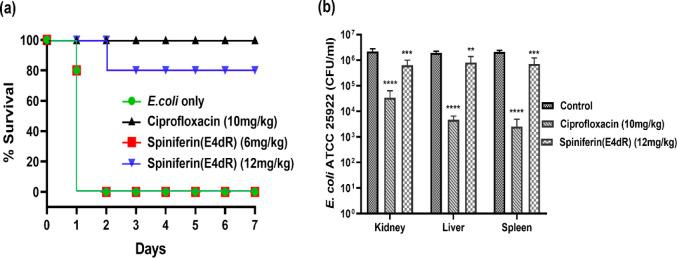
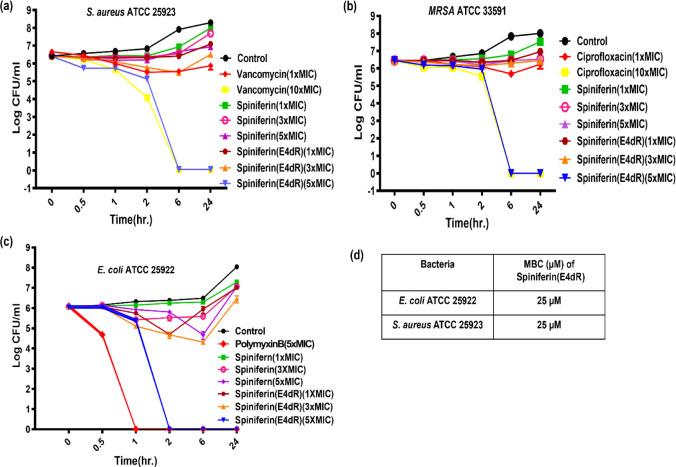
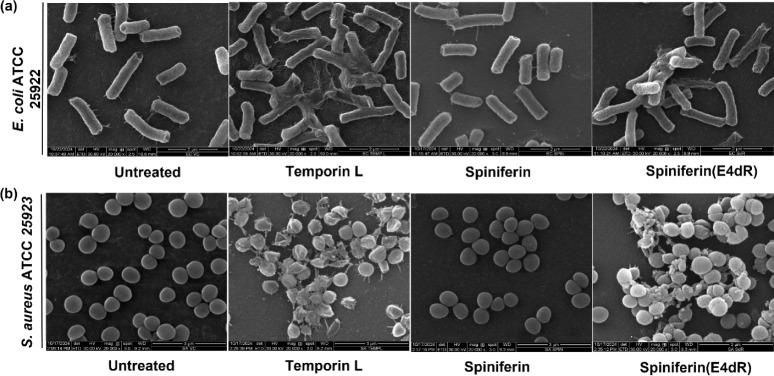
Spiniferin is a 13-mer scorpion-origin antimicrobial peptide having poor antimicrobial activity. To augment Spiniferin's antimicrobial activity, we enhanced its net positive charge by replacing a glutamic acid residue with an arginine residue toward its amino terminus. We envisaged that a cation-π interaction could be introduced between this arginine residue and the tryptophan residue located near the middle of Spiniferin. This cation-π interaction could promote stronger interaction of the peptide with a negatively charged bacterial membranes, resulting in its increased antimicrobial activity. Though glutamic acid-to-arginine substitution [Spiniferin-(E4R)] enhanced both the antimicrobial and toxic properties of Spiniferin, the same replacement with a d-arginine residue [Spiniferin-(E4dR)] significantly enhanced its antimicrobial activity against selected Gram-negative/positive bacteria and a MRSA strain while maintaining low hemolytic/cytotoxic properties. Interestingly, Spiniferin-(E4dR) analogs, with its aromatic-tryptophan residue substituted with an aromatic phenylalanine or an aliphatic valine residue, and its d-arginine residue replaced with a d-lysine residue, showed much lesser antibacterial activity than Spiniferin-(E4dR) or Spiniferin-(E4R). The results indicated a crucial role of the tryptophan and l-/d-arginine combination in augmenting the antimicrobial activity of Spiniferin analogs, Spiniferin-(E4R) and Spiniferin-(E4dR). Spiniferin-(E4dR) showed bactericidal properties against selected Gram-positive/negative bacteria. It permeabilized bacterial membranes and induced damages in bacterial membrane organization, suggesting that the bacterial plasma membrane is its target for exhibiting antimicrobial activity. Further, Spiniferin-(E4dR) in the intravenous route demonstrated the survival of E. coli ATCC 25922-infected mice and the clearance of bacteria from the visceral organs of these mice. Computational studies showed the requisite distance between the arginine's cationic side chain and the π-electron site of the tryptophan residue for a possible intramolecular cation-π interaction in Spiniferin-(E4dR)/Spiniferin-(E4R).
刺孢菌素是一种由13个氨基酸组成的源自蝎子的抗菌肽,其抗菌活性较差。为了增强刺孢菌素的抗菌活性,我们通过将一个谷氨酸残基替换为精氨酸残基,朝着其氨基末端增加了它的净正电荷。我们设想在这个精氨酸残基和位于刺孢菌素中部附近的色氨酸残基之间可以引入阳离子-π相互作用。这种阳离子-π相互作用可以促进该肽与带负电荷的细菌膜之间更强的相互作用,从而提高其抗菌活性。虽然谷氨酸到精氨酸的替换[刺孢菌素-(E4R)]增强了刺孢菌素的抗菌和毒性特性,但用d-精氨酸残基进行同样的替换[刺孢菌素-(E4dR)]显著增强了其对选定的革兰氏阴性/阳性细菌和一株耐甲氧西林金黄色葡萄球菌(MRSA)的抗菌活性,同时保持了低溶血/细胞毒性特性。有趣的是,刺孢菌素-(E4dR)类似物,其芳香族色氨酸残基被芳香族苯丙氨酸或脂肪族缬氨酸残基取代,并且其d-精氨酸残基被d-赖氨酸残基取代,显示出比刺孢菌素-(E4dR)或刺孢菌素-(E4R)小得多的抗菌活性。结果表明色氨酸和l-/d-精氨酸组合在增强刺孢菌素类似物刺孢菌素-(E4R)和刺孢菌素-(E4dR)的抗菌活性中起关键作用。刺孢菌素-(E4dR)对选定的革兰氏阳性/阴性细菌表现出杀菌特性。它使细菌膜通透性增加,并导致细菌膜结构受损,这表明细菌质膜是其发挥抗菌活性的靶点。此外,静脉注射途径的刺孢菌素-(E4dR)证明了感染大肠杆菌ATCC 25922的小鼠的存活以及这些小鼠内脏器官中细菌的清除。计算研究表明,在刺孢菌素-(E4dR)/刺孢菌素-(E4R)中,精氨酸的阳离子侧链与色氨酸残基的π电子位点之间存在可能的分子内阳离子-π相互作用所需的距离。



 Zotero 插件