
日本宫颈癌筛查评估:阴性上皮内病变或恶性肿瘤/高危型人乳头瘤病毒阳性病例管理面临的挑战与未来方向
Evaluation of Cervical Cancer Screening in Japan: Challenges and Future Directions for Negative Intraepithelial Lesion or Malignancy/High-Risk Human Papillomavirus Positive Case Management.
作者信息
Umezaki Yasushi, Fukuda Asako, Kurihara Makiko, Hashiguchi Mariko, Okugawa Kaoru, Yokoyama Masatoshi
机构信息
Department of Obstetrics and Gynecology, Faculty of Medicine, Saga University, Saga 840-8502, Japan.
出版信息
Curr Oncol. 2025 May 23;32(6):295. doi: 10.3390/curroncol32060295.
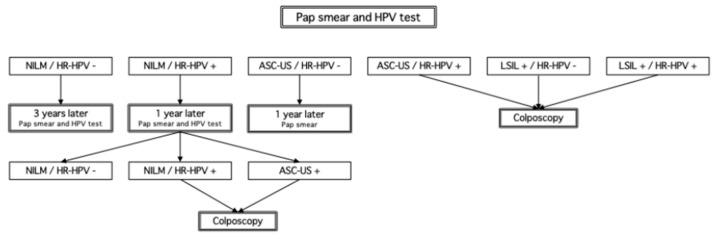
Cervical cancer screening is crucial for early detection and prevention. In Japan, women with negative intraepithelial lesion or malignancy (NILM) and high-risk human papillomavirus (HR-HPV) positivity are recommended retest for 12 months, rather than immediate colposcopy. International guidelines differ, and often prioritize early colposcopy for persistent HPV16/18 infections. This study evaluates Japan's current screening approach, and identifies areas for improvement. A retrospective cohort study analyzed cervical cancer screening data from Saga Prefecture (2019-2021), assessing follow-up adherence, colposcopy referral rates, and CIN2+ and CIN3+ detection among NILM/HR-HPV+ cases. Among 27,789 individuals screened, 2248 (8.1%) were NILM/HR-HPV+. Follow-up adherence after 12 months was 54.4%. Of these, 132 with cytological abnormalities underwent colposcopy, revealing CIN2+ in 27.3% of cases. Additionally, 561 women with persistent NILM/HR-HPV+ underwent colposcopy, with CIN2+ in 7.6% and CIN3+ in 3.9% of cases. Japan's current NILM/HR-HPV+ management strategy could delay the detection of high-grade cervical lesions. International guidelines favor earlier colposcopy referrals, particularly for HPV16/18+ cases. To improve cervical cancer prevention, Japan should consider a risk-based stratification model, enhance follow-up adherence, expand colposcopy access, and develop a national patient tracking system. Adopting primary HPV-based screening could attain the best global practices, facilitating earlier detection and reducing cervical cancer.
宫颈癌筛查对于早期发现和预防至关重要。在日本,上皮内病变或恶性肿瘤阴性(NILM)且高危型人乳头瘤病毒(HR-HPV)阳性的女性建议进行12个月的复查,而非立即进行阴道镜检查。国际指南则有所不同,通常优先对持续性HPV16/18感染进行早期阴道镜检查。本研究评估了日本目前的筛查方法,并确定了需要改进的领域。一项回顾性队列研究分析了佐贺县(2019 - 2021年)的宫颈癌筛查数据,评估了NILM/HR-HPV+病例的随访依从性、阴道镜转诊率以及CIN2+和CIN3+的检出情况。在27789名接受筛查的个体中,2248人(8.1%)为NILM/HR-HPV+。12个月后的随访依从率为54.4%。其中,132名细胞学异常的患者接受了阴道镜检查,27.3%的病例发现了CIN2+。此外,561名持续性NILM/HR-HPV+的女性接受了阴道镜检查,7.6%的病例发现了CIN2+,3.9%的病例发现了CIN3+。日本目前的NILM/HR-HPV+管理策略可能会延迟高级别宫颈病变的检测。国际指南倾向于更早进行阴道镜转诊,特别是对于HPV16/18+的病例。为了改善宫颈癌预防,日本应考虑基于风险的分层模型,提高随访依从性,扩大阴道镜检查的可及性,并建立全国患者跟踪系统。采用基于HPV的初筛可以达到最佳全球实践,促进早期发现并减少宫颈癌。

 Zotero 插件