
无脊椎动物骨骼中广泛存在类似骨髓的造血干细胞生态位。
Widespread presence of bone marrow-like hematopoietic stem cell niche in invertebrate skeletons.
作者信息
Lian Shanshan, Hu Naina, Chen Xiaomei, Dai Xiaoting, Zhu Xuan, Qiao Runyu, Liu Sinuo, Lu Yuan, Zhang Fengmei, Sun Fengzhi, Pu Zhongqi, Yang Zujing, Xu Runjia, Wang Hao, Zhao Liang, Xing Qiang, Li Shoujie, Wang Wei, Dong Bo, Zhang Lingling, Hu Jingjie, Wang Jing, Bao Zhenmin, Wang Shi
机构信息
Fang Zongxi Center for Marine Evo-Devo, MOE Key Laboratory of Marine Genetics and Breeding & Shandong Key Laboratory of Marine Seed Industry, College of Marine Life Sciences, Ocean University of China, Qingdao, 266003, China.
Laboratory for Marine Biology and Biotechnology, Qingdao Marine Science and Technology Center, Qingdao, 266237, China.
出版信息
Sci Adv. 2025 Jun 27;11(26):eadw0958. doi: 10.1126/sciadv.adw0958. Epub 2025 Jun 25.
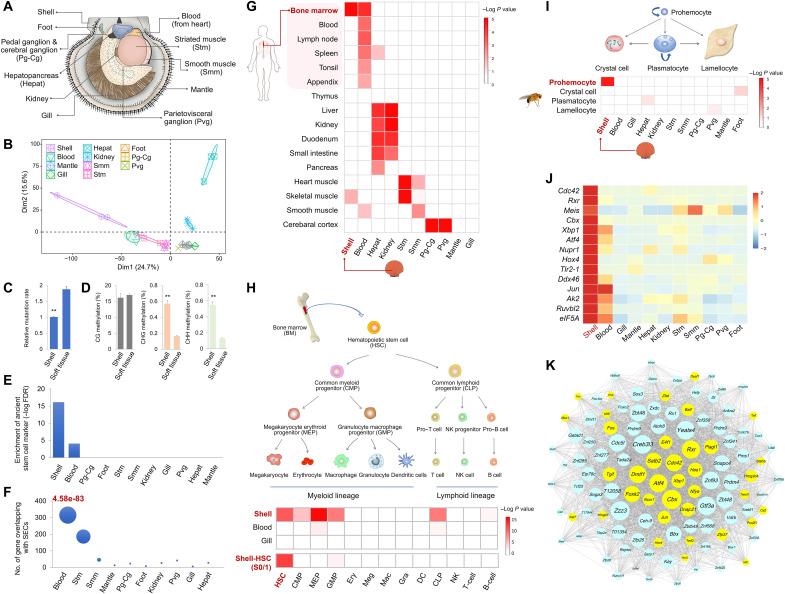
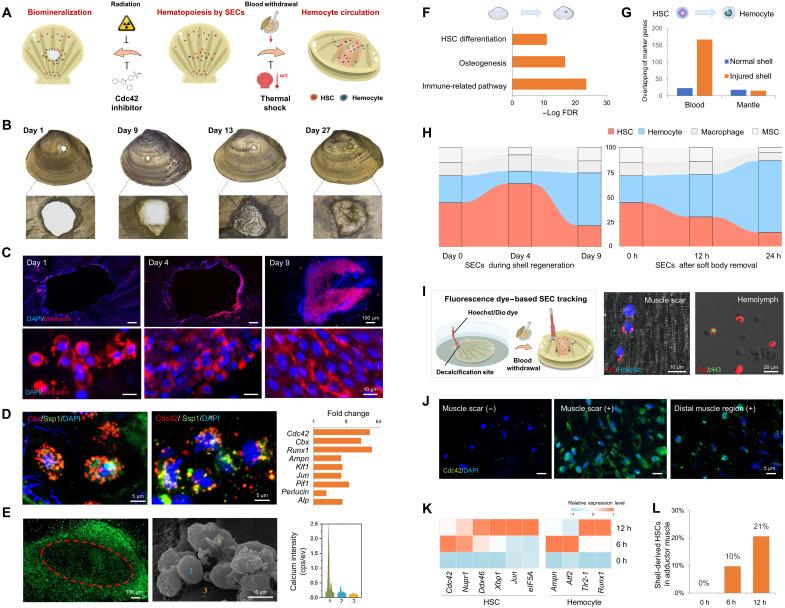
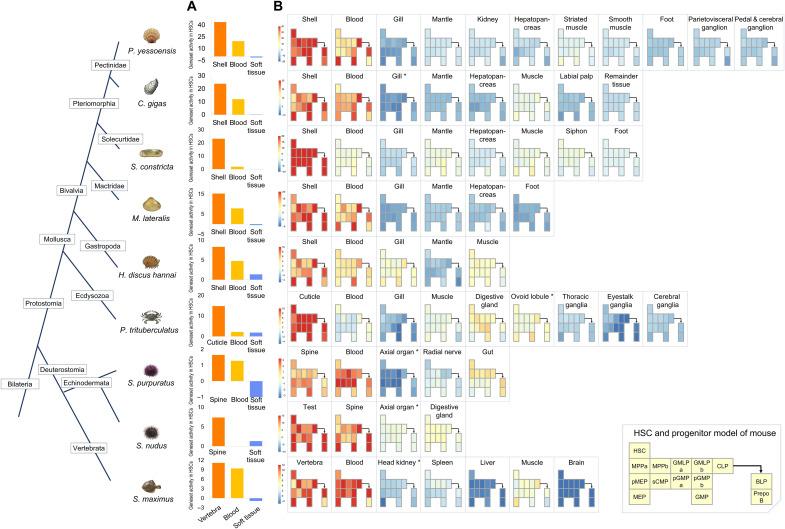
Skeletal harboring of hematopoietic stem cells (HSCs) is generally considered as vertebrate-specific innovation during water-to-land transition. However, this long-standing view has not been rigorously evaluated as hematopoietic sites remain poorly understood in most invertebrate groups. We report, to our knowledge, the first discovery of abundant HSCs in adult mollusk shells, an invertebrate hematopoietic niche resembling vertebrate bone marrow (BM). Cell-lineage analysis and functional assays reveal the developmental origin of HSCs during larval shell formation and their participation in hemocyte-mediated shell regeneration and soft-body blood supply. Widespread skeleton-related HSC-like cells are found in diverse invertebrate groups and bony fish group, suggesting skeletons as a universal niche for animal HSCs and HSC-skeleton association preceding vertebrate water-to-land transition. Comparison of invertebrate and vertebrate skeletal HSCs enables the macroevolutionary profiling of a core-set of animal HSC regulators. Our findings would boost fundamental paradigm shifts for hematopoiesis and stem cell research in invertebrates and provide the redefined understanding of vertebrate BM evolution and water-to-land transition.
造血干细胞(HSCs)在骨骼中的存在通常被认为是脊椎动物在从水生到陆生转变过程中的特有创新。然而,由于大多数无脊椎动物群体的造血部位仍知之甚少,这一长期以来的观点尚未得到严格评估。据我们所知,我们首次在成年软体动物外壳中发现了大量造血干细胞,这是一种类似于脊椎动物骨髓(BM)的无脊椎动物造血微环境。细胞谱系分析和功能测定揭示了造血干细胞在幼虫外壳形成过程中的发育起源,以及它们参与血细胞介导的外壳再生和软体动物身体血液供应的过程。在不同的无脊椎动物群体和硬骨鱼群体中都发现了广泛存在的与骨骼相关的类造血干细胞,这表明骨骼是动物造血干细胞的普遍微环境,并且造血干细胞与骨骼的关联早于脊椎动物从水生到陆生的转变。对无脊椎动物和脊椎动物骨骼造血干细胞的比较能够对一组核心的动物造血干细胞调节因子进行宏观进化分析。我们的发现将推动无脊椎动物造血和干细胞研究的基本范式转变,并为脊椎动物骨髓进化和从水生到陆生的转变提供重新定义的理解。







 Zotero 插件