
高盐肿瘤微环境:不像听起来那么糟糕,也不像看起来那么美好。
High-Salt Tumor Microenvironment: Not as Bad as It Sounds, Not as Good as It Seems.
作者信息
Ali Umer, Tiriveedhi Venkataswarup
机构信息
Department of Biological Sciences, Tennessee State University, Nashville, TN 37209, USA.
Division of Pharmacology, Vanderbilt University, Nashville, TN 37232, USA.
出版信息
Cancers (Basel). 2025 Jun 10;17(12):1924. doi: 10.3390/cancers17121924.
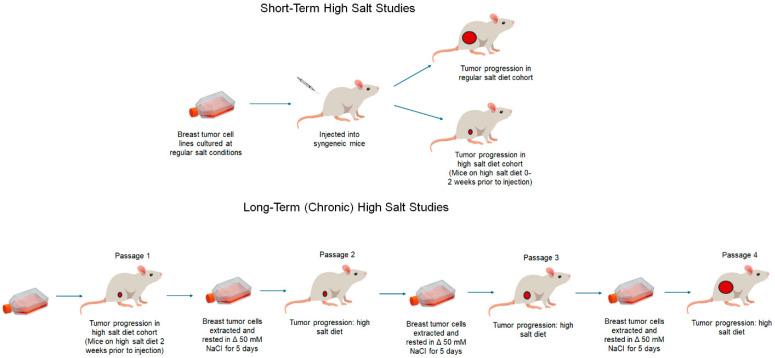
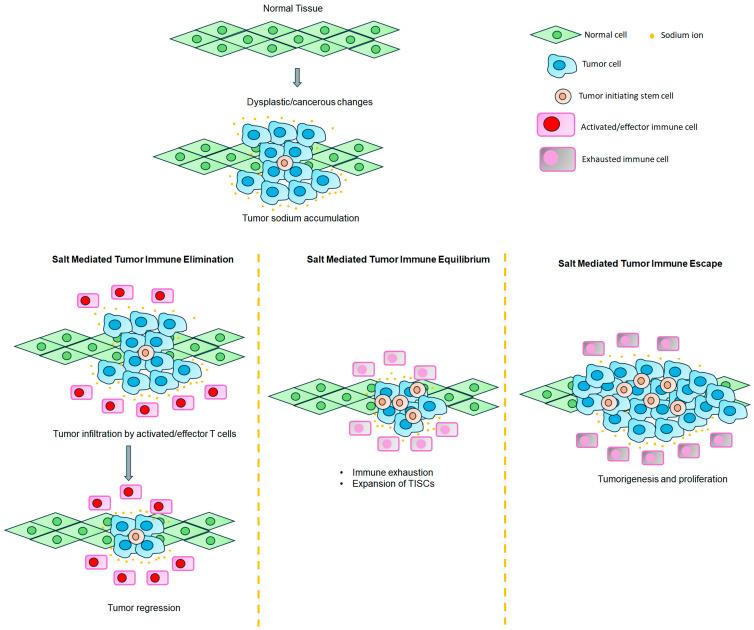
Recent evidence suggests a high-sodium microenvironment in breast tumors. However, the exact role of this high-sodium microenvironment on tumorigenesis is unknown. Salt (sodium chloride, NaCl) is a well-known inflammatory molecule playing a significant role in various chronic ailments like cardiovascular and autoimmune diseases. Importantly, chronic inflammation is recognized as one of the major hallmarks of carcinogenesis. Breast cancer cell culture-based studies demonstrated that high-salt (HS) treatment (Δ35-50 mM NaCl) induced cancer cell proliferation. However, preclinical murine research showed reduced tumor progression kinetics in mice fed a short-term HS diet (4% NaCl diet, 0-2 weeks prior to the injection of tumor cells). Molecular studies demonstrated that the short-term HS diet induced the inflammatory activation of naïve CD4+ T cells to the Th17/Th1 anti-tumor phenotype. As human health-related adverse outcomes from HS diets usually occur as a consequence of prolonged HS intake over a period of several years, we have developed a novel chronic HS dietary murine tumor model. In this model, tumor cells are sequentially passaged (four cycles) in vivo under high-salt conditions, and tumor kinetics were analyzed in the passage-4 mice. These studies demonstrated enhanced tumor progression (pro-tumor) under chronic HS dietary conditions through the activation of tumor-initiating stem cells, along with the exhaustion of immune cells. Based on the, apparently paradoxical, evidence, we propose a comprehensive unifying hypothesis to elucidate the complex role of a high-sodium microenvironment towards tumor immune sculpting. This understanding will enable novel drug repositioning strategies, the development of unique ion channel-based anti-cancer therapeutics and promote low-salt diet intake in breast cancer patients on immunotherapy.
最近的证据表明乳腺肿瘤中存在高钠微环境。然而,这种高钠微环境在肿瘤发生的确切作用尚不清楚。盐(氯化钠,NaCl)是一种众所周知的炎症分子,在心血管疾病和自身免疫性疾病等各种慢性疾病中起重要作用。重要的是,慢性炎症被认为是致癌作用的主要标志之一。基于乳腺癌细胞培养的研究表明,高盐(HS)处理(Δ35 - 50 mM NaCl)可诱导癌细胞增殖。然而,临床前小鼠研究表明,喂食短期HS饮食(4% NaCl饮食,在注射肿瘤细胞前0 - 2周)的小鼠肿瘤进展动力学降低。分子研究表明,短期HS饮食可诱导幼稚CD4 + T细胞向Th17/Th1抗肿瘤表型的炎症激活。由于HS饮食对人类健康相关的不良后果通常是多年长期摄入HS的结果,我们开发了一种新型慢性HS饮食小鼠肿瘤模型。在这个模型中,肿瘤细胞在高盐条件下在体内依次传代(四个周期),并在传代4的小鼠中分析肿瘤动力学。这些研究表明,在慢性HS饮食条件下,通过激活肿瘤起始干细胞以及免疫细胞耗竭,肿瘤进展增强(促肿瘤)。基于这些明显矛盾的证据,我们提出了一个全面统一的假设,以阐明高钠微环境对肿瘤免疫塑造的复杂作用。这种理解将有助于制定新的药物重新定位策略,开发独特的基于离子通道的抗癌疗法,并促进接受免疫治疗的乳腺癌患者摄入低盐饮食。

 Zotero 插件