
动脉粥样硬化与胰岛素抵抗:它们之间存在联系吗?
Atherosclerosis and Insulin Resistance: Is There a Link Between Them?
作者信息
Brie Alina Diduța, Christodorescu Ruxandra Maria, Popescu Roxana, Adam Ovidiu, Tîrziu Alexandru, Brie Daniel Miron
机构信息
Department of Cell and Molecular Biology, "Victor Babes" University of Medicine and Pharmacy, Tudor Vladimirescu Street, No. 14, 300174 Timisoara, Romania.
ANAPATMOL Research Center, "Victor Babes" University of Medicine and Pharmacy, Tudor Vladimirescu Street, No. 14, 300174 Timisoara, Romania.
出版信息
Biomedicines. 2025 May 23;13(6):1291. doi: 10.3390/biomedicines13061291.
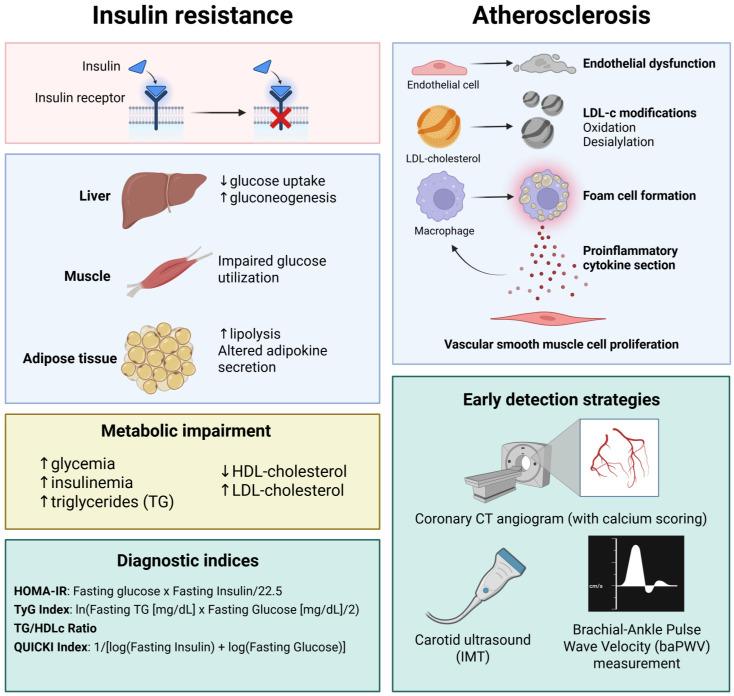
Cardiovascular disease remains the leading cause of morbidity and mortality worldwide, especially in regions like Eastern Europe, South Asia, and Latin America. A significant portion of these cases (80%) is linked to atherosclerosis, which can lead to severe conditions like ischemic heart disease and stroke, with atherosclerosis (ATS) responsible for the majority of cases. This review explores the multifaceted relationship between insulin resistance (IR) and ATS, highlighting their roles as both independent and interrelated contributors to cardiovascular risk. ATS is characterized by lipid accumulation and chronic inflammation within arterial walls, driven by factors such as hypertension, dyslipidemia, and genetic predisposition, with endothelial dysfunction as a key early event. The early detection of subclinical ATS is critical and can be achieved through a combination of non-invasive imaging techniques-such as coronary artery calcium scoring and carotid ultrasound-and comprehensive risk profiling. IR, marked by impaired glucose uptake in liver, muscle, and adipose tissue, often precedes early diabetes and is associated with metabolic disturbances, including dyslipidemia and chronic inflammation. The diagnosis of IR relies on surrogate indices such as HOMA-IR, the QUICKI, and the TyG index, which facilitate screening in clinical practice. Compelling evidence indicates that IR independently predicts the progression of atherosclerotic plaques, even in non-diabetic individuals, and operates through both traditional risk factors and direct vascular effects. Understanding and targeting the IR-ATS axis is essential for the effective prevention and management of cardiovascular disease.
心血管疾病仍然是全球发病和死亡的主要原因,尤其是在东欧、南亚和拉丁美洲等地区。这些病例中有很大一部分(80%)与动脉粥样硬化有关,动脉粥样硬化可导致诸如缺血性心脏病和中风等严重疾病,其中大多数病例由动脉粥样硬化(ATS)引起。本综述探讨了胰岛素抵抗(IR)与ATS之间的多方面关系,强调了它们作为心血管风险的独立和相互关联因素的作用。ATS的特征是动脉壁内脂质堆积和慢性炎症,由高血压、血脂异常和遗传易感性等因素驱动,内皮功能障碍是关键的早期事件。亚临床ATS的早期检测至关重要,可通过冠状动脉钙化评分和颈动脉超声等非侵入性成像技术与综合风险评估相结合来实现。IR的特征是肝脏、肌肉和脂肪组织中葡萄糖摄取受损,通常先于早期糖尿病出现,并与包括血脂异常和慢性炎症在内的代谢紊乱有关。IR的诊断依赖于HOMA-IR、QUICKI和TyG指数等替代指标,这些指标有助于临床实践中的筛查。有力证据表明,即使在非糖尿病个体中,IR也能独立预测动脉粥样硬化斑块的进展,并通过传统危险因素和直接血管效应发挥作用。了解并针对IR-ATS轴对于心血管疾病的有效预防和管理至关重要。

 Zotero 插件