
海洋环境中的微塑料污染:来源、影响及降解
Microplastic pollution in the marine environment: Sources, impacts, and degradation.
作者信息
Ahmad Osamah A, Jamal Mamdoh T, Almalki Hamdah S, Alzahrani Abeer H, Alatawi Amirah S, Haque Md Fazlul
机构信息
Department of Marine Biology, Faculty of Marine Sciences, King Abdulaziz University, Jeddah, Saudi Arabia.
Department of Animal Biology, Faculty of Sciences, King Abdulaziz University, Jeddah, Saudi Arabia.
出版信息
J Adv Vet Anim Res. 2025 Mar 25;12(1):260-279. doi: 10.5455/javar.2025.l893. eCollection 2025 Mar.
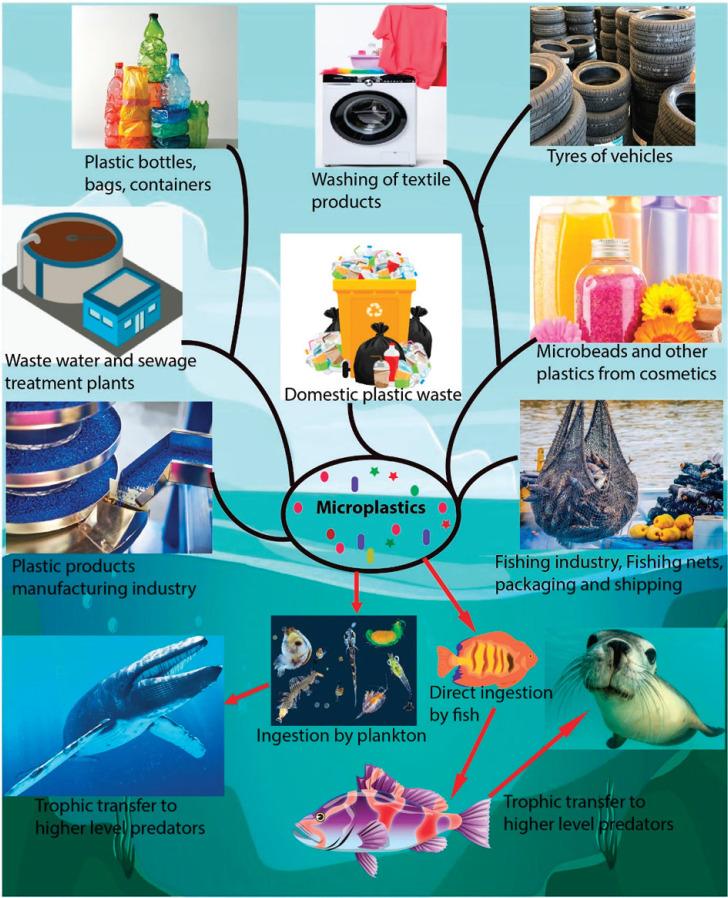
Microplastics (MPs) are tiny particles derived from plastic, and their high fragmentation poses a significant threat to the marine environment. MPs can originate from various sources, such as primary or secondary sources as well as internal or external sources. However, in marine environments, MPs mainly enter from external sources, such as plastic waste, debris from land-based activities, tourism, shipping, and atmospheric deposition. MP accumulation in marine ecosystems is also influenced by the use of plastic equipment, aquaculture feed, health products, and particular environmental conditions. Understanding the ecotoxicological effects of environmentally relevant concentrations of MPs on the health of marine organisms is crucial. The effects of MPs on the health of marine organisms are well reported by different studies, highlighting their interactions with a wide range of marine life, including plankton, invertebrates, crustaceans, corals, seagrass, fish, and even humans. Thus, MPs have been reported as a notorious pollutant because of their deleterious impacts on the morphology, physiology, immunology, behavior, reproduction, and heredity of marine organisms. Moreover, most MPs are slowly degradable, and degradation is dependent on various biotic and abiotic factors, resulting in continuous accumulation in the marine environment. This review provides an in-depth explanation of the sources of MPs, along with their impacts on marine organisms, ecosystems, aquaculture, and human health. In addition, it will discuss the degradation of MPs in the marine environment to explore the potential strategies for reducing the harmful impacts of MPs.
微塑料(MPs)是源自塑料的微小颗粒,其高度碎片化对海洋环境构成重大威胁。微塑料可源自各种来源,如原生或次生来源以及内部或外部来源。然而,在海洋环境中,微塑料主要从外部来源进入,如塑料垃圾、陆地活动产生的碎片、旅游业、航运业以及大气沉降。海洋生态系统中微塑料的积累还受到塑料设备、水产养殖饲料、保健品以及特定环境条件的影响。了解与环境相关浓度的微塑料对海洋生物健康的生态毒理学影响至关重要。不同研究充分报道了微塑料对海洋生物健康的影响,突出了它们与包括浮游生物、无脊椎动物、甲壳类动物、珊瑚、海草、鱼类甚至人类在内的广泛海洋生物的相互作用。因此,微塑料因其对海洋生物的形态、生理、免疫、行为、繁殖和遗传的有害影响而被报道为一种臭名昭著的污染物。此外,大多数微塑料降解缓慢,降解取决于各种生物和非生物因素,导致其在海洋环境中持续积累。本综述深入解释了微塑料的来源,以及它们对海洋生物、生态系统、水产养殖和人类健康的影响。此外,还将讨论微塑料在海洋环境中的降解,以探索减少微塑料有害影响的潜在策略。
 Zotero 插件