
骨骼肌、神经肌肉类器官和组装体:一项范围综述。
Skeletal muscle, neuromuscular organoids and assembloids: a scoping review.
作者信息
Yang Jiang-Li, Qian Shi-Yan, Cheng Min-Li, Wang Li-Xiang, Wang Yu, Liu Jing-Jing, Xi Chen-Shi, Yang Yu-Xin, Li Yue, Gao Chong, Zheng Guo-Qing
机构信息
Department of Neurology, The First Affiliated Hospital of Zhejiang Chinese Medical University (Zhejiang Provincial Hospital of Chinese Medicine), Hangzhou, China.
Science and Technology Innovation Center, Guangzhou University of Chinese Medicine, No.12, Jichang Road, Baiyun District, Guangzhou, 510405, China.
出版信息
EBioMedicine. 2025 Jun 26;118:105825. doi: 10.1016/j.ebiom.2025.105825.
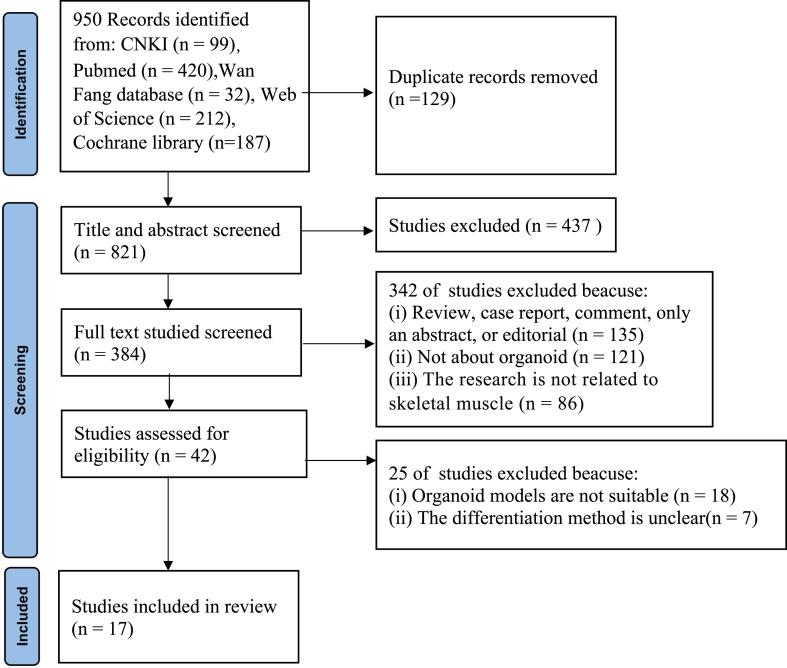
Skeletal muscle organoids (SKMOs), neuromuscular organoids (NMOs), and assembloids have emerged as powerful in vitro models that simulate the intricate cellular interactions between muscle and nerve, offering a promising approach to study function, development, and disease at the neuromuscular junction (NMJ). Given the relevance of NMJ dysfunction in diseases such as amyotrophic lateral sclerosis (ALS), these models provide insights into disease modelling. Scoping reviews are particularly valuable when exploring broad or emerging areas, as they help identify key concepts and evolving methodologies. Here, we conducted a scoping review by searching five databases, ultimately including 17 studies focussing on the development and application of SKMOs, NMOs, and assembloids in muscle function modelling. We highlight recent advancements and summarise various differentiation protocols, primarily utilising the Wnt signalling pathway agonist CHIR99021 and basic fibroblast growth factor (bFGF) to induce pluripotent stem cells into 2D neuromesodermal progenitors, further differentiated into SKMOs, NMOs, and assembloids. We also reviewed their cellular compositions, including motor neurons, neural stem cells, terminal Schwann cells, and astrocytes, alongside related research outcomes. Additionally, we discuss key challenges such as iPSC donor selection, standardisation, vascularisation, and 3D organoid imaging. This scoping review provides a foundation for future research on muscle function modelling.
骨骼肌类器官(SKMOs)、神经肌肉类器官(NMOs)和组装体已成为强大的体外模型,可模拟肌肉与神经之间复杂的细胞相互作用,为研究神经肌肉接头(NMJ)的功能、发育和疾病提供了一种有前景的方法。鉴于NMJ功能障碍在肌萎缩侧索硬化症(ALS)等疾病中的相关性,这些模型为疾病建模提供了见解。在探索广泛或新兴领域时,范围综述特别有价值,因为它们有助于识别关键概念和不断发展的方法。在这里,我们通过搜索五个数据库进行了一项范围综述,最终纳入了17项专注于SKMOs、NMOs和组装体在肌肉功能建模中的开发和应用的研究。我们重点介绍了最近的进展,并总结了各种分化方案,主要利用Wnt信号通路激动剂CHIR99021和碱性成纤维细胞生长因子(bFGF)将多能干细胞诱导为二维神经中胚层祖细胞,进一步分化为SKMOs、NMOs和组装体。我们还回顾了它们的细胞组成,包括运动神经元、神经干细胞、终末雪旺细胞和星形胶质细胞,以及相关的研究成果。此外,我们讨论了关键挑战,如诱导多能干细胞供体的选择、标准化、血管化和三维类器官成像。这项范围综述为未来肌肉功能建模的研究奠定了基础。


 Zotero 插件