
口服阿兹夫定与帕罗韦德治疗新型冠状病毒肺炎合并高血压患者的真实世界有效性和安全性:中国河南省一项多中心、回顾性队列研究
Real-world effectiveness and safety of oral azvudine versus Paxlovid in patients with COVID-19 and pre-existing hypertension: a multicentre, retrospective, cohort study in Henan Province, China.
作者信息
Wang Fuwei, Jia Bohan, Li Guotao, Jin Xiaoli, Yang Mengzhao, Li Guangming, Zhang Shixi, Qian Guowu, Luo Hong, Cheng Ming, Wang Ling, Zhang Donghua, Li Silin, Liang Hongxia, Ren Zhigang
机构信息
Department of Infectious Diseases, State Key Laboratory of Antiviral Drugs, Pingyuan Laboratory, The First Affiliated Hospital of Zhengzhou University, Zhengzhou, China.
Department of Infectious Diseases, Luoyang Central Hospital Affiliated of Zhengzhou University, Luoyang, China.
出版信息
BMJ Open. 2025 Jun 27;15(6):e090230. doi: 10.1136/bmjopen-2024-090230.
OBJECTIVES
Azvudine and Paxlovid are the primary antiviral agents for the management of COVID-19. However, there is currently insufficient evidence regarding the effectiveness and safety of these drugs in treating COVID-19 patients with pre-existing hypertension. The objective of this study was to assess their effectiveness and safety among those patients in a real-world context.
DESIGN
Retrospective cohort study.
SETTING
Electronic medical record data of COVID-19 patients with pre-existing hypertension were extracted from nine hospitals in Henan Province from 5 December 2022 to 31 January 2023.
PARTICIPANTS
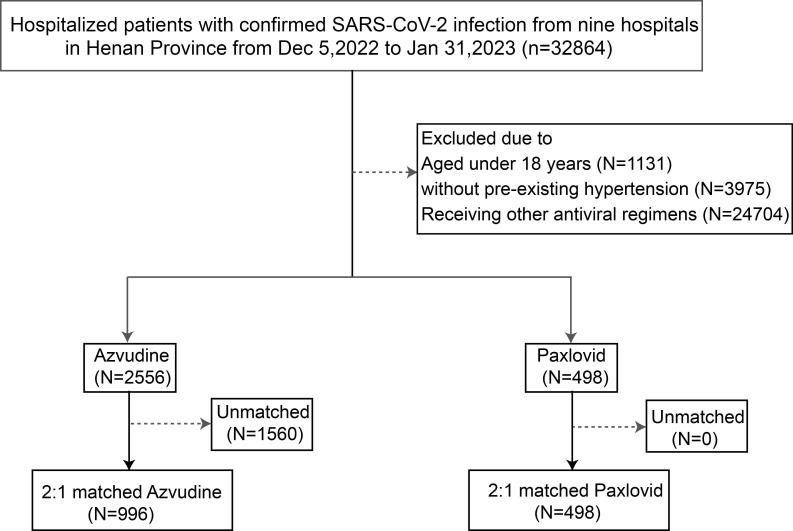
Following 2:1 propensity score matching (PSM), 996 individuals who received treatment with azvudine and 498 individuals who received treatment with Paxlovid were included in the analysis.
PRIMARY AND SECONDARY OUTCOME MEASURES
The primary outcome was all-cause death and the secondary outcome was the composite disease progression.
RESULTS
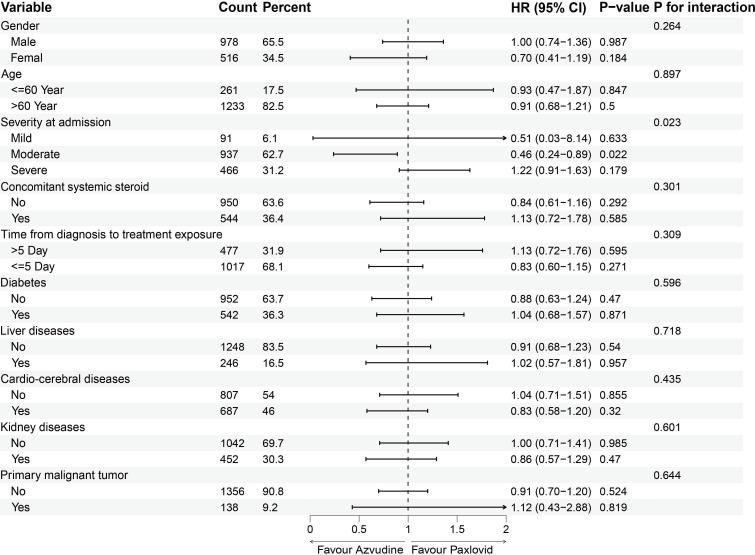
Following adherence to the inclusion and exclusion criteria and 2:1 PSM, 996 individuals were included in the azvudine group and 498 in the Paxlovid group. The Cox regression analysis revealed that the azvudine group had a significantly lower risk of all-cause death compared with the Paxlovid group (HR 0.64, 95% CI 0.455 to 0.911, p=0.013). However, there was no statistically significant difference in composite disease progression between the two groups (HR 0.93, 95% CI 0.711 to 1.229, p=0.629). Subgroup analysis indicated that, compared with Paxlovid, patients with moderate disease receiving azvudine treatment exhibited a significantly reduced risk of composite disease progression (HR 0.46, 95% CI 0.24 to 0.89). The safety analysis showed that the azvudine group had fewer adverse events.
CONCLUSIONS
Among COVID-19 patients with pre-existing hypertension, the effectiveness of azvudine is not inferior to Paxlovid in reducing all-cause death and composite disease progression, with fewer adverse events.
TRIAL REGISTRATION NUMBER
NCT06349655.
目的
阿兹夫定和帕罗韦德是治疗新型冠状病毒肺炎(COVID-19)的主要抗病毒药物。然而,目前关于这些药物治疗合并高血压的COVID-19患者的有效性和安全性的证据不足。本研究的目的是在真实世界背景下评估它们在这些患者中的有效性和安全性。
设计
回顾性队列研究。
背景
从2022年12月5日至2023年1月31日,从河南省9家医院提取合并高血压的COVID-19患者的电子病历数据。
参与者
经过2:1倾向评分匹配(PSM)后,分析纳入了996例接受阿兹夫定治疗的患者和498例接受帕罗韦德治疗的患者。
主要和次要结局指标
主要结局为全因死亡,次要结局为综合疾病进展。
结果
在遵守纳入和排除标准并进行2:1 PSM后,阿兹夫定组纳入996例患者,帕罗韦德组纳入498例患者。Cox回归分析显示,与帕罗韦德组相比,阿兹夫定组全因死亡风险显著更低(风险比[HR] 0.64,95%置信区间[CI] 0.455至0.911,p = 0.013)。然而,两组之间的综合疾病进展无统计学显著差异(HR 0.93,95% CI 0.711至1.229,p = 0.629)。亚组分析表明,与帕罗韦德相比,接受阿兹夫定治疗的中度疾病患者综合疾病进展风险显著降低(HR 0.46,95% CI 0.24至0.89)。安全性分析显示,阿兹夫定组不良事件更少。
结论
在合并高血压的COVID-19患者中,阿兹夫定在降低全因死亡和综合疾病进展方面的有效性不劣于帕罗韦德,且不良事件更少。
试验注册号
NCT06349655。


 Zotero 插件